Thursday, October 1, 2015

What Marketers Need to Know About Cohorts

The word “cohort” can be scary to those unfamiliar with the term. It may sound like something out of a medical journal or statistics class. But, I promise you, there’s nothing to be afraid of. And, if you’re a marketer, it’s pretty important to understand cohorts if you want to get into and benefit from marketing analytics.

So, what is a cohort? Wikipedia defines it as:

“A cohort is a group of subjects who have shared a particular event together during a particular time span (e.g., people born in Europe between 1918 and 1939; survivors of an air crash; truck drivers who smoked between age 30 and 40).”

Pretty simple, right?

And, if you’re one those left-brained people who love to analyze data, then cohorts are perfect for you.

Cohorts are frequently used in studies to compare groups of people. They’re useful because, in a cohort study, you track the cohorts over a period of time to see what kind of data each one brings.

To use one of the examples from above, you could study truck drivers who smoked between age 30 and 40 compared with those who didn’t smoke at all and/or those who smoked earlier or later in life. You would then look at various test results for each cohort and compare the data.

Now, we’re not going to be talking about truck drivers who smoked. Since we’re marketers, we’re going to run through how we can apply cohorts to optimize our marketing. We’ll also examine a couple of tools that offer cohort analysis.

How Can Marketers Use Cohorts?

There are literally hundreds of cohorts marketers can create. But, the question here is not how many they can create. It’s which cohorts will produce the most insightful data.

When thinking about which cohorts to track, ask yourself these questions:

  • Will the data I get from these cohorts produce insights that can change my marketing strategy?
  • Will I be able to clearly know what’s working and what’s not when it comes to marketing?
  • What targets do I need to hit this year? Will this cohort help me improve that metric?

Here are three cohorts marketers may find useful:

1. Signed Up / Purchased, Organized by Time

You’re a marketer, so it’s critical for you to deliver leads and signups to your sales team. Create a cohort that tracks people who visited your site and signed up. You’ll see when they first visited your site and how long it took them to sign up after their first visit. This can essentially tell you if your marketing campaigns lead people to take immediate action. Let’s break it down.

The new year begins, along with your new marketing campaign. You’ve spent the past 2 months planning it, designing it, and setting targets. Now it’s prime time, and you’re ready to see how it performs.

Your campaign runs from January – March. You get 100k visitors to your site, and your signup rate during this time remains at .5%. You start a new campaign in April.

Fast forward a few months, and you’re looking at a Cohort Report. You’re viewing the people who visited your site and signed up. For the people who visited your site sometime in the period January – March, you notice a slight increase in signups in the months following. You see that 1.0% of the people who visited your site in February came back in June and signed up. This means that the January – March campaign was more effective than initially thought.

As marketers, we often expect people to sign up right away. In our minds, we think they come to our site and either sign up or don’t. But the truth is, it’s not that binary. It’s not a yes or no at that very moment. Sometimes it’s a “wait and see.” People might visit our site, browse around, but then not sign up until later.

This is why it’s a useful cohort. Signups don’t always occur right away, and a cohort reporting tool can track signups over a long period of time.

2. Your Most Loyal Customers

Every marketer wants to acquire customers. But, as we know, not all customers are created equal. Some spend more than others, and some may require more “help” than others. There are also customers who sign up for your service and cancel a few months later (which doesn’t help your Cost to Acquire a Customer (CAC)). Most important, there are customers who sign up, stay engaged with your product, and tell their friends about it. You need to know who these customers are, where they came from, and how you can get more of them.

With a sophisticated Cohort Report, marketers can create a cohort of users who frequently login, and then they can segment (aka group) those users by the marketing channel they came from.

Here’s a way to think about it:

Your marketing challenge is finding loyal customers. You have no problem delivering signups, but 80% of them cancel their accounts after a few months. What about the other 20%? Where do they come from and how do you get more of them? This is where a Cohort Report can help you.

kissmetrics-cohort-report-login-retention

This is the Kissmetrics Cohort Report. It’s one of the best places to get this kind of data.

On the left, we see the marketing channel users came from. Move to the right, and you’ll see how well each channel performed. The darker the shade of blue, the higher the login retention.

With this information, we can see which channels are sending us the most valuable customers and then spend more money and energy on them and less on the ones that aren’t delivering.

3. Repurchase Rates

Every business needs loyal customers. That includes retail stores, SaaS companies, subscription-based companies, you name it. They need customers who come back and make purchases on a recurring basis. There’s no getting around it.

So how do you, as a marketer, find and acquire these loyal customers? Use a cohort. Here’s what you’ll want to do:

Find the people who have repurchased. This can be for any business, but let’s use e-commerce as an example. Then segment the purchases by product categories, marketing channels, or marketing campaigns. Here’s what you’ll learn:

  • Do certain product categories keep people coming back? Maybe people who purchased ties come back frequently and purchase other items. If so, it’s time to start promoting your tie collection more often.
  • Do any marketing channels have a tendency to bring loyal customers? For example, perhaps your AdWords campaigns are outperforming your Facebook ad campaign in bringing repeat purchases. If this is the case, you’ll want to spend more time and money on the AdWords campaigns.
  • You have dozens of marketing campaigns running. You have seasonal campaigns running four times a year and dozens of other campaigns running in between. With a Cohort Report, you’ll find out which ones drive purchases and repurchases.

The Value of Cohorts for Marketers

As you can see, there are many insights you can gather by grouping people together and tracking their behavior over time.

Each business and marketing challenge is unique. I’ve listed a few ways marketers can use cohorts to help optimize their marketing. But your challenges are unique, and only you will be able to create cohorts that garner valuable insight.

Where to Get This Data

There are two tools we’ll focus on that provide cohort reporting. The first is Google Analytics and the other is Kissmetrics. Let’s start by examining Google Analytics.

Google Analytics Cohort Analysis

Google Analytics has a feature called Cohort Analysis. Here it is:

Cohort-Analysis-chart-Google-Analytics

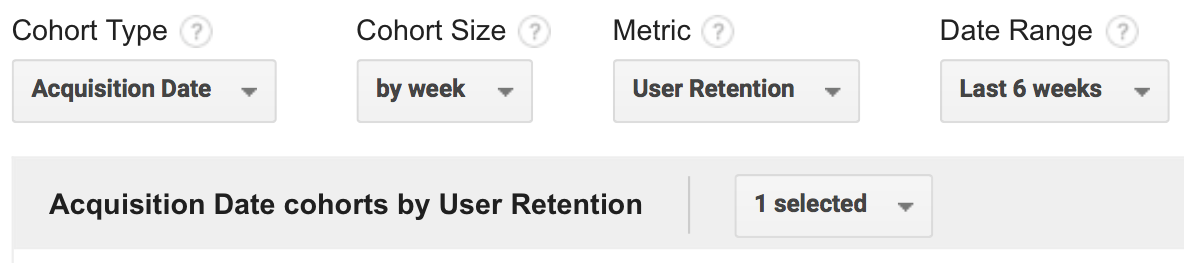
You have four choices in setting up your cohort analysis:
google-analytics-cohort-analysis-four-choices

Cohort Type
This is where you choose a cohort. Acquisition Date, for example, groups people based on when they first came to your site.

Cohort Size
Here you choose the time frame for each cohort. You can measure people on a daily, weekly, or monthly basis.

Metric
Here you choose what you’ll be measuring for each cohort. There are a variety of choices.

Date Range
You have a variety of date ranges you can choose from. This is determined by the size of your cohort. For example, if you choose a cohort size “by day” you’ll have the date range options of 7, 14, 21, and 30 days.

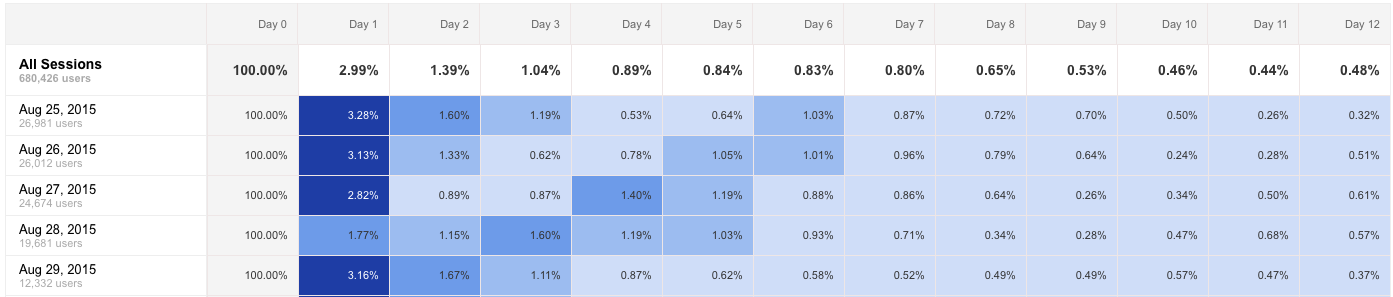
Underneath these options, the Cohort Analysis presents the data visualization. Users can see how well the cohort is performing over time.

The bottom part contains the raw numbers and the retention afterward. The darker the shade of blue, the higher the percentage (i.e., better retention).
cohort-analysis-google-analytics

The Cohort Analysis is still in its early stages. Some of the more advanced things you’ll want to do may be a little more difficult to set up in Google Analytics. It is, of course, free and does not inherently come with support. You can get support through a partner.

Kissmetrics Cohort Report

This report is one of the most customizable out there. You can track any event and property across a custom date range. Using this report, you’ll be able to measure how your marketing campaigns are performing and refine them based on the data. The report’s usefulness can also extend beyond the marketing department. Here are a couple of other departments that could use it:

Product Team

  • Track the features users keep coming back to. Which ones aren’t used as often? Why? Getting answers to these questions will help improve future product iterations and can help you find your product/market fit.
  • Know which features are used first by new users. Are new users gravitating toward one feature over another? What was their experience with this feature?
  • Understand the feature utilization that leads to payment. Is one cohort of users, who use a feature or area of your site more often during their free trial, more likely to pay for your product or cancel? Perhaps some features turn people off and they never return. Knowing this can make a huge difference.

Sales Team

  • Know the product plan that has the best retention. Your sales team should not knowingly be pushing product plans that have been shown to have higher churn.
  • Does viewing a certain element on a page lead to a signup? Maybe visitors who downloaded a white paper are more likely to sign up. If so, you can push people to download that white paper and even ask the marketing department to create more white papers.
  • Find which product features are used by each customer segment. For example, let’s say your sales team is trying to land a big account from a well-known SaaS company. To sell the account, your sales team needs to show them the features your other SaaS customers use. Think about it. You don’t want to show them features that none of your SaaS customers are using. You want to show them the features that their peers are getting value from.

Here’s a video demo of the Cohort Report:


If the video embed is not showing up, you can click here to view the video on the Wistia page.

Recap

We’ve gone through a lot. Here are the takeaways:

  • A cohort is a group of subjects who have shared a particular event together during a particular time span (e.g., people born in Europe between 1918 and 1939; survivors of an air crash; truck drivers who smoked between age 30 and 40). To put it another way, a cohort is a group of people who have a similar characteristic. Their behavior is then tracked over a period of time.
  • These cohorts can help marketers understand how groups of people compare against each other. If you have two groups with different behaviors, notice which one delivers the best results. Then refine your marketing with what you learn.
  • Sometimes signups don’t occur right away. A visitor may visit your site in January, bookmark it, and then return in June to sign up. The June marketing campaign may incorrectly be attributed with the signup even though it was actually the marketing campaign in January that brought the visitor. This is where the Cohort Report comes in handy.
  • One cohort that marketers commonly use is people who have signed up. Marketers can see how each marketing channel or campaign performs at delivering signups.
  • Many tools provide cohort data, but we focused on two of them – Google Analytics’s Cohort Analysis and Kissmetrics’s Cohort Report. Both have their upsides. If you’re looking to get more advanced analysis, definitely go with the Kissmetrics Cohort Report. The Cohort Analysis tool is still in its early stages.
  • The Cohort Report can be used by more than marketers. Nearly all departments in your company will be able to get useful data out of this report.

See How Cohorts Can Impact Your Marketing

Want to learn how the Cohort Report can help you optimize your marketing? Request a personal demo today!

About the Author: Zach Bulygo (Twitter) is a Content Writer for Kissmetrics.

Marketing Day: Google On Ad Blocking, Microsoft & Google Patents & Promoted Pins

Here’s our recap of what happened in online marketing today, as reported on Marketing Land and other places across the web.

Please visit Marketing Land for the full article.

Is Data the New Marketing?

I don’t know if it’s just me, but all these global startups seem to go crazy about collecting and leveraging data for their go-to-market. More and more enterprises start to wonder why and if they miss a boat? Well, there’s one reason behind it which I call the "90% revolution“ and - spoiler alert - it will probably change the way we go-to-market forever.

Why?

Let’s say your company has a 10% market share. In the offline past, your IT systems could only operate with your own first party data mainly collected from customer transactions (so, 10%). In the digital era though, customers use dozens of 3rd party systems, mobile and social, to discover, research, buy and use products in real-time.

Now, the anonymous data sets behind these buying signals become accessible as advertising and marketing technology converges. And here comes the "90% revolution“: if third party data for nearly all of the market buying signals becomes available as a service, doesn’t operating sales and marketing with the old 10% in-house data only feel like "flying blind“?

In other words, is Data the New Marketing?

Let’s cut through the hype with three real-life use cases:

First, why not start with significantly decreasing your Ad Spend without negative impact. How? By real-time filtering your existing customer data from paid search or display advertising, you avoid double-spending to reach contacts you already know. Think of it, it’s amazing how often returning customers click on Google paid-search just for ease of use. And besides saving money you also look less creepy not addressing loyal customers as prospects on all channels. Btw, this "classic“ use case alone creates an immediate ROI for most customers of the Oracle Data Management Platform (DMP).

Another use-case is called Look-Alike modeling. It means to match your own best customer data with 3rd party data sets in the audience who digitally "look alike“. If these anonymous prospects then visit your websites or see your advertising, you can customize any communication in real-time to drive conversion. This use case demonstrates modern marketing is all about context in every customer interaction - data is just the tool.

Intent data is my favorite use case, as it helps transforming advertising from "shouting“ to "listening“. How? Think of all the interactions on eCommerce, financial, retail or travel sites indicating our intent to buy something. Like searching, reading blogs, product comparison, loan calculators, etc. By adding up single cookie ID signals to meaningful intent data sets, companies can now address prospects in a highly relevant context - while the individual always stays anonymous.

For best practices when it comes to data, download the Modern Marketing Essentials Guide to Data Management. This guide uncovers tips like the customer ID Graph concept to help marketers define marketing and communication goals with a data audit, be more strategic with the information you’re collecting and accessing and a lot more.

Testing and Optimization: Welcome send test results in 46% open rate for CNET

One of the most discussed sends in email marketing is the welcome email — and for good reason. This first email often acts as the first point of direct contact a customer has with your brand, so the pressure to make it as perfect as possible is there. That’s where testing comes into play.

In her session at MarketingSherpa Email Summit 2015, Diana Primeau, Director of Member Services, CNET, spoke on the importance of testing her brand’s welcome and nurturing series as well as how the brand utilized segmentation to create a more personalized content series. Described by Erin Hogg, Reporter, MarketingSherpa, as a “mentor and teacher here at MarketingSherpa,” Diana has spoken at several brand events and has an impressive amount of experience when it comes to testing.

[Note: MarketingSherpa is the sister company of MarketingExperiments]

The typical CNET user is someone who is interested in technology and wants to research certain technology to reach a buying decision. According to Diana, CNET is the largest tech site in the world, and the site sees over 100 million unique visitors every month. CNET also has a large newsletter portfolio, which includes 23 editorial newsletters that are hand-curated by the brand’s editors, two large marketing newsletters and three deal space newsletters.

“I feel pretty fortunate. I get to play in a pretty large sandbox,” she joked.

One of the most dynamic tests Diana presented during her Summit 2015 presentation tested CNET’s welcome series against five different treatments. This test was conducted with an A/B split design, and the changes to the treatments were made according to three factors:

  • Content
  • Subject lines
  • Advertisements

Watch the video excerpt below to learn how these drastic changes compared to Diana’s original hypothesis of including as much information for the user as possible.

Control

“We had this crazy hypothesis, and it was ‘Tell the user everything,’” Diana said. “We wanted them to know everything about our brand, and this email actually performed very well.”

This initial email included the subject line that CNET always used in its welcome emails, an advertisement and four sections:

  • Product reviews
  • Tech news
  • More newsletters
  • Forums

However, though the Control performed well, there was nothing to benchmark against this first send. Together with a summer intern, Diana determined the three areas of this send she wanted to test and developed the corresponding treatments.

Version 2 and Version 3

Version 2 of the welcome email condensed the Control’s long copy into a simple introductory message and a simple call-to-action, which directed users to the homepage. This version also added an image of a CNET editor.

Version 3 featured the same content from Version 2, but arranged it in a slightly different way. Also, the picture of the editor was replaced with an ad unit.

“Advertising and ad units in our newsletters are very much an important part of our strategy,” Diana explained. “They’re a very nice revenue stream for us, and they help us find some of the initiatives.”

Version 4 and Version 5

Version 4 was essentially the same as Version 3 with one small change — the subject line.

Prior to this test, the brand had been using the subject line, “Welcome to CNET! Let’s get started.” This subject line had been tested many different times and had proven to be victorious. For this treatment, the subject line was subtly changed to “Thanks for joining! Let’s get started.”

Version 5 used the same subject line as Version 4 and also included an image, which was positioned differently. Instead of featuring an editor, this image was a collage of the different types of things users would expect to see on the site.


Version 6

This last treatment, Version 6, utilized all the winning changes from the previous four treatments but added in an ad unit and a block of content. For this content block, only high-traffic pieces were selected.


Results

Through all of this testing, Diana and her team learned that simple worked best. Each test produced an increase in both opens and clickthrough. This welcome email started with a 32% open rate and ended on a 46% open rate. Likewise, the clickthrough rate for these tests increases from 12% to 21%.

“Our hypothesis was wrong. For our brand, less is better,” Diana said. “I really want to stress that — it’s for our brand.”

“Every brand is different, so I really encourage you, if you’re going to do this, that you do test and make sure that what works is good for your brand,” she concluded.

You can follow Kayla Cobb, Reporter, MECLABS Institute, on Twitter at @itskaylacobb.

You might also like

Want to gain access to more markeing insights? Reserve your seat for MarketingSherpa Summit 2016 today — February 24-26, at the Bellagio in Las Vegas

Gain access to 14 full sessions from MarketingSherpa Email Summit 2015

Content Optimization: Reduce redundancy, improve relevance and increase engagement [MarketingSherpa video]

Win-back Campaigns and List Cleansing: How CNET re-engaged 8% of its email list [MarketingSherpa video]

Email Marketing: CNET increases engagement by cutting nearly half of newsletter portfolio [MarketingSherpa case study]

5 Ways Content Underpins Outbrain’s Customer Retention Strategy

customer-retention-content-marketing-650
Content marketing isn’t just for generating leads – it can also help you support and retain customers. Image source.

It takes more than coupon clippings and reward points to win over today’s consumers — they’re looking for value that goes beyond monetary incentive. Businesses that know how to engage their customers and provide unconditional value will be the ones that foster a long-term relationship with their community.

This makes the pairing of content marketing and customer retention a powerful match that can’t be ignored.

The growth team I lead at Outbrain, the world’s largest content discovery platform, provides a real-life case study for content and retention coming together to produce results.

I’d like to share five specific content-based customer retention tactics we’re employing to grow our customer base and revenue at Outbrain – tactics you can steal for your own customer retention strategy.

1. Get new customers trained up fast with educational emails

The sooner you educate customers about using your product, the faster they can derive value from you and become sticky.

According to a survey conducted by SaaS metrics company Preact, 23% of customers churn due to poor onboarding. Especially when you have a fairly complex service, frontloading the delivery of educational content and learning from how new signups interact with this content is critical.

We’ve certainly seen a direct correlation between reducing our churn and improving our onboarding process. To help our customers get acquainted with our platform and understand how our system works, we created a bootcamp training series.

As soon as a customer’s first campaign is launched, an automated email campaign (which we call our Brainiac Bootcamp) is triggered for them. It sends four daily emails that walk the customer through campaign optimization tips, our dashboard and other resources. Here’s a screenshot of the first of four emails:

brainiac-bootcamp-email
The first of four emails in our automated email training series.

When we first launched our Bootcamp series, we did a test and control experiment by sending 90% of first-time customers the email program and keeping a 10% control group. For customers who received the bootcamp emails, we saw a direct correlation between content and retention.

Pro tip: If you’re launching a new email campaign, exclude 10% of recipients as a control group so you can say with confidence that the customer’s actions were a result of the campaign, and they wouldn’t have taken the same actions even if they hadn’t received the emails.

We dug even deeper by being strategic about which features required more education than others.

For example, we knew from analyzing the overall behavior of our customers that the more headlines they are testing per individual piece of content, the better chance they have of receiving a higher click-through rate (CTR) when their content is recommended in our publisher network.

outbrain_headline_graph
This graph shows the drastic increase in CTR when a campaign has greater than 5, 10 and 15 headlines on rotation.

Knowing this, we made sure our bootcamp content helped customers understand the importance of testing more headlines. As a result, those customers received higher click-through rates – and stayed active 1.5x longer than people who did not receive the bootcamp emails.

Takeaway for your campaigns:

Make sure your onboarding process is laser-focused on educating users on the importance of certain product behaviors you know will result in their success.

Through testing, determine which features lead to a higher retention rate – and then be sure to frontload that education. If customers do well, they’re more likely to stick around longer. It’s mutually beneficial.

2. Use live webinars to step up customer training

Webinars are often discussed as an acquisition tactic, but they’re also a great way of engaging more personally with customers at scale. Nothing beats real face-time when explaining a complex product.

We run bi-monthly webinars conducted by our Account Strategists. The content has evolved over time, and it’s always driven by feedback from our customers, as well as questions fielded by our Customer Support team.

outbrain_webinar
A landing page for one of our bi-weekly live webinars.

We put a lot of time into adapting the content we present in these webinars, but also closely measure the webinars’ impact on our bottom line.

Our Business Intelligence team built a report to compare customers’ campaign performance a week before and a week after they attend the webinar. We also look at their metrics two weeks and a month later to see if they’re continuing to optimize their performance based on webinar learnings.

On average, we’ve seen a 50% increase in average spend and 38% increase in cost-per-click (CPC) as a result of these webinars.

You may be thinking that increase in spend and CPC does not necessarily equal success for our customers, who are optimizing for leads and pages per visit. But due to the competitive nature of our content marketplace, a campaign that starts with a higher CPC has a much better chance of receiving any traffic at all.

It’s another win-win scenario – if we can effectively explain this to customers on a webinar, they’re more likely to see results from their campaigns and they’re more likely to stick around.


Use webinars to demystify your product. If you help customers succeed, they’ll help you succeed too.
Click To Tweet


3. Always be adding content to your help center

Not nearly enough content marketers are focused on making their help center and FAQs as useful as possible – but help centers should be a vital part of the customer journey.

At Outbrain, we’ve structured our Help Center to reflect our customers’ needs from the pre-signup stage to first-time campaign creation to more advanced optimizations and reporting.

Just like webinars and bootcamp emails, help centers should be works in progress that you’re constantly striving to improve. You can use a combination of sources to help determine what content needs to be developed, refined or updated. These could include:

  • New product developments that require more training and FAQs: Product releases are exciting, but the platform and its features are only as good as your ability to communicate them to your customers. It’s important to educate customers on how to get the most out of new features — create new training content and FAQs to guide them!
  • Commonly asked questions sent to your Customer Support team: If your customer support team notices a trend in a particular topic of enquiry, that’s great fodder for new Help Center content.
  • Google Analytics reports for the top Help Center search terms, search refinements made by customers and most commonly visited FAQs: For example, have a look at the chart below which shows our most commonly searched terms from 2014 and the percentage of search refinements users were making when trying to find relevant content.
    outbrain_help_center_graph

    Customers searching for FAQs on cancelling accounts or languages were having to further refine their terms to find the content they were after, whereas customers looking for FAQs on UTMs, mobile, tracking or adding content were finding what they needed right away.

    We used this report to create more relevant and obvious FAQs to address these trickier searches and saw an improvement in search refinements and a reduction in questions on these topics sent to Customer Support.

All of these measures help customers feel supported the entire way through their journey, and allow them to better understand your product and derive more value. And that keeps customers coming back for more.


Use your search box data to understand what content your customers want but can’t find.
Click To Tweet


4. Communicate product improvements and new features with great content

Collaboration between content and product marketing is essential to bringing new features to customers in the most efficient way. The more educational content created around each release, the more customers will continue to engage with and provide feedback on the new feature.

For us, email and our blog are our two most effective channels for sharing product updates with our customers. Our email updates are designed to alert customers to the latest developments, and then we drive them to the blog to learn more.

When we created the ability for customers to upload content in bulk and test multiple headlines and images per URL, we sent out an email announcing the feature:

outbrain_product_email

The goal of adding this feature was to make it easier to add more headlines; a process that had been manual and very time consuming.

By tracking the feature as an event in Kissmetrics, we were able to see that the average number of headlines and images per content increased significantly after our blog post and email explaining the new feature.

outbrain_kissmetrics_graph
The peak in this Kissmetrics graph shows how usage increased after we informed our audience of the new feature.

The concept here is pretty straightforward: the more customers are aware of new tools and features, the more likely they are to use them.

5. Use lifecycle email marketing to segment customers

Email campaigns are still the bread and butter of many a retention marketer’s efforts. With today’s overloaded inbox, personalization of the content based on individual product usage data is now more important than ever.

This is where lifecycle email marketing comes in: reaching your customers at each stage of their journey with you and tailoring relevant content to their needs and experience at each stage.

For lifecycle email marketing to our customers, we use a customer retention automation platform called Optimove to measure the impact of every campaign on revenue and customer lifetime value across five major customer segments:

  • New customers
  • Non-spending customers
  • Engaged customers
  • Churned customers
  • Reactivated customers

Our seasonal performance email campaign is a great example of this. Historically, we’ve seen that the end of each quarter is a competitive time on the Outbrain network; more buyers and higher cost-per-click. It’s especially important to communicate that to customers so they understand how to optimize their campaigns accordingly.

When we ran an educational email campaign for our most active customer segment about the importance of adding more headlines to increase your click-through rate (CTR), we saw a 10% increase in the average number of headlines per content campaign among those who received the email – along with an increased CTR in the most active customer segment.

Put your content to work

If you plan to prioritize customer retention as a major driver of growth and revenue for your business, investing in content will be critical to your success.

Here’s a quick recap of the five ways content underpins our entire customer retention strategy:

  1. Get new customers trained up fast with educational emails
  2. Use live webinars to step up customer training
  3. Always be adding content to your help center based on customer feedback and user behavior
  4. Communicate product improvements and new features with great content
  5. Use lifecycle email marketing to segment customers

Over to you — how are you using content marketing to drive your customer retention strategy?

How Recommendation And Remarketing Tools Can Boost Your Sales

How Recommendation And Remarketing Tools Can Boost Your Sales written by Guest Post read more at Duct Tape Marketing

Up until fairly recently eCommerce recommendations and remarketing were only possible for large eCommerce sites. However, the emergence of recommendation and remarketing tools and service providers over the last two years have made these sales boosting benefits accessible to even small businesses and marketers.

In this article we will look at what recommendations and remarketing are within the field of eCommerce, before looking at how they can benefit your business and boost your sales.

What Recommendations & Remarketing Mean

Recommendations have long been a core component of Amazon’s website, with up to 70% of Amazon’s home page dedicated to recommendations.  There are three primary types of recommendations:

  • Generic: These recommendations are seldom influenced by your past browsing and shopping history, and often show what other customers are currently looking at, or what the top-sellers are in general, or by category.
  • Complementary: These recommendations are directly influenced by your current and past behavior on an eCommerce site, and will be made up of items that complement or enhance the items you are currently looking at.
  • Alternatives: These recommendations are alternatives to what you are currently looking at, or what is already in your cart. Alternative recommendations can be used to either upsell or to retain a customer where the product they were originally interested in is out-of-stock.

Remarketing is primarily about having your online ads displayed to users who have previously visited your site, as they browse other websites. However, remarketing can also be used in tandem to recommendations by showing visitors to your site products they have viewed on other sites, and even items that are relevant to their current geographical location.

Both recommendations and remarketing rely on you having a substantial amount of data regarding your customer’s behavior and history, and the arrival of recommendation and remarketing tools and service providers gives small businesses access to this, along with access to 3rd-party data that enhances what they have already collected.

http://asset1.basecamp.com/2764596/projects/7264400/attachments/183337863/how-digital-connects-shoppers-to-stores_02.jpg

Photo Credit Think with Google

Using Recommendations to Increase Average Basket Size

Careful implementation of complementary, and even generic recommendations, can lead to an increase in your average basket size, with a McKinsey case study showing that cross-selling techniques can increase sales by 20%. The focus should be on items that enhance what the customer is looking at; for example, if the customer is looking at a shirt, complementary recommendations would be pants, shoes and even socks that create a complete outfit.  However, there shouldn’t be too many recommendations or you risk losing the customer. Generic recommendations in this context can encourage customers to explore your site more, possibly finding items they want, but weren’t actively looking for.

http://asset1.basecamp.com/2764596/projects/7264400/attachments/183337862/how-digital-connects-shoppers-to-stores_01.jpg

Photo Credit Think with Google

Using Recommendations to Increase Conversions

Countless sales are lost each day when the item the customer is looking for is out-of-stock; but alternative recommendations can help you. Whenever an item is out-of-stock, ensure that you display at least three alternatives, using a good, better, best approach. Caution must be taken when setting up your alternatives since they should closely match the original; if the customer was looking for a light switch, don’t offer them a new lampshade as an alternative.

http://asset1.basecamp.com/2764596/projects/7264400/attachments/183337864/Infosys-Consumer-Attitudes-to-Personalized-Shopping-Experiences-Jan2014.jpg

Photo Credit InfoSys

Using Recommendations to Improve Customer Loyalty

Personalization plays a critical role in fostering customer loyalty for online stores, and personalizing some of your generic recommendations is one way to start. Generic recommendations are shown when you don’t know what the customer is actually looking for, but once you have some history on a customer’s past behavior you can, in addition to the standard generic recommendations, show a list of items they bought recently, or buy frequently. This is particularly appropriate for FMCG and other items customers need to buy regularly.

Amazon’s recommendations are said to generate up to 30% in additional revenue for the company, and while they have been doing this for quite a few years, any online business, big or small, can realize a boost in sales through the proper implementation of their own recommendation and remarketing strategy. The only requirement is that you start now.

pm3Przemyslaw Mankowski as a CEO of QuarticON concentrates on company’s further expansion on the market, lead International business strategy and develops business partnerships in CEE and worldwide. He has been working in New Tech industry for several years. Prior to joining QuarticON.com, he was Sales Director in Agora and Member of the Board in Trader.com (Poland). He was also CEO at Passus and NextWeb Media.

Wednesday, September 30, 2015

Over 140 B2B Content Marketing Statistics for 2016 Strategy Planning

B2B Content Marketing Report 2016

The best content marketing strategies are informed by data and one of the most consistent B2B marketing research reports chock full of data comes from Content Marketing Institute and MarketingProfs.

Today the 6th edition of the B2B Content Marketing – 2016 Benchmarks, Budgets and Trends – North America report was published revealing a canyon of difference between successful content marketers and those that seem to be lost in the wilderness. This report is also a reality check for content marketers that drink too much of their own kool-aid, offering a mix of slightly downward trend data right along with numerous reasons for future content marketing optimism.

What do I mean by reality check? Fewer marketers have a documented content marketing strategy than last year 32% vs 35% and less marketers see their content marketing as effective 30% vs 38%.

What are the content marketing disconnects? Here’s one example: 57% of B2B marketers are still using Print or Other Offline Promotions, even though only 31% consider that paid tactic as effective. Also, 55% are still using traditional banner ads, even though only 29% consider banners effective.

B2B Marketers are still missing on tactics. The most popular content marketing tactics are things like shiny object social media (93%) and blogs (81%) while the most effective B2B content marketing tactics are In-Person Events (75%) and Webinars / Webcasts (66%). Only case studies get near-top treatment when it comes to both popularity (82%) and effectiveness (65%).

Marketers are still challenged to produce engaging content (60%) on a consistent basis (57%). That said, their priorities are in the right place, putting the task of creating engaging content (72%) at the top of the list for future focus.

Here’s the good news: 88% of B2B marketers are using content marketing, up from 86% in 2015 and 76% of marketers will produce more content in 2016 – they just want to know what content is effective and what isn’t (65%). They also want to know more about repurposing (57%) creating more visual content (51%) and telling better stories (41%).

The most successful B2B content marketers do these four things including documenting both their strategy (48%) and editorial mission statements (49%) as well as meeting with their content teams frequently (41%) and having organizational clarity on what content marketing success actually looks like (55%). There’s a consistent message in this: marketers who are goals focused, strategic in planning and action are more effective.

B2B marketers who are goals focused, strategic in planning and action are more effective. 

Ways to use this data: Marketing research data, statistics and charts are useful in different ways when it comes to informing a B2B content marketing program. Whether it’s citing a key stat when building a business case, advocating a particular course of action in a report or reinforcing recommendations in a presentation, the kind of information in this report can be effectively persuasive.

That’s why I’ve had the individual statistics broken out by category so you can easily copy and paste into whatever content, presentation or social share you’re creating. Just be sure to cite @CMIContent / @MarketingProfs as the source.

Hopefully this compendium will help those with clarity about content marketing confirm being on the right track and at the same time help those that are a little lost get pointed in the right direction.

B2B Content Marketing Use and Effectiveness

88% of B2B marketers use content marketing (86% in 2015)
12% of B2B marketers do not use content marketing

8% of of B2B marketers rate their content marketing maturity as sophisticated
24% of of B2B marketers rate their content marketing maturity as mature
29% of of B2B marketers rate their content marketing maturity as adolescent
27% of of B2B marketers rate their content marketing maturity as young
11% of of B2B marketers rate their content marketing maturity as first steps

CMI’s Content Marketing Maturity Definitions

  • Sophisticated: Providing accurate measurement to the business, scaling across the organization
  • Mature: Finding success, yet challenged with integration across the organization
  • Adolescent: Have developed a business case, seeing early success, becoming more sophisticated with measurement and scaling
  • Young: Growing pains, challenged with creating a cohesive strategy and a measurement plan
  • First Steps: Doing some aspects of content but have not yet begun to make content marketing a process

64% of sophisticated/mature marketers say they are effective at content marketing
6% of young/first steps marketers are effective at content marketing

5% of B2B marketers say their content marketing is very effective
24% of B2B marketers say their content marketing is effective
44% of B2B marketers say their content marketing is neutral
22% of B2B marketers say their content marketing is minimally effective
1% of B2B marketers say their content marketing is not at all effective

What do the most successful content marketers do to be more effective?

48% of B2B marketers with a documented content marketing strategy are effective
49% of B2B marketers with a documented editorial mission statement are effective
55% of B2B marketers with organizational clarity on what content marketing success looks like are effective
41% of B2B marketers that meet daily or weekly are effective

44% of B2B marketers are clear about what a successful content marketing program looks like
34% of B2B marketers are NOT clear about what a successful content marketing program looks like
21% of B2B marketers are unsure what a successful content marketing program looks like

Strategy and Organization

32% of B2B marketers have a documented content marketing strategy
48% of B2B marketers have an undocumented content marketing strategy
16% of B2B marketers do not have a documented content marketing strategy
4% of B2B marketers are unsure if they have a documented content marketing strategy

54% of B2B marketers say team meetings are valuable to content marketing effectiveness

Content Creation and Distribution

76% of B2B marketers will produce more content than 2015
19% of B2B marketers will produce the same amount of content as 2015
2% of B2B marketers will produce less content than 2015

The top content marketing tactics:
(the average number of tactics used: 13)

93% Social Media Content
82% Case Studies
81% Blogs
81% eNewsletters
81% In-Person Events
79% Articles on Your Website
79% Videos
76% Illustrations / Photos
71% White Papers
67% Infographics
66% Webinars / Webcasts
65% Online Presentations
49% Research Reports
47% Microsites / Separate Website Hubs
42% Brand Content Tools
39% eBooks
36% Print Magazines
30% Books
29% Digital Magazines
28% Mobile Apps
25% Virtual Conferences
23% Podcasts
22% Print Newsletters
12% Games / Gamification

The most effective B2B content marketing tactics:

75% In-Person Events
66% Webinars / Webcasts
65% Case Studies
63% White Papers
62% Videos
61% Research Reports
60% eNewsletters
59% Blogs
58% Infographics
58% Online Presentations

Top social media platforms for B2B content marketers:
(Average social platforms used: 6)

94% LinkedIn
87% Twitter
84% Facebook
74% YouTube
62% Google+
37% SlideShare
29% Instagram
25% Pinterest
21% Vimeo
10% iTunes
9% Tumblr
7% Vine
6% Medium
6% Periscope
5% SnapChat

Most effective social media platforms for content marketers:

B2B Social Media

Congratulations yet again, to our client LinkedIn for being the top, most effective social media platform for B2B content marketers!

Paid advertising tactics used most by content marketers:

66% Search Engine Marketing
57% Print or Other Offline Promotions
55% Traditional Online Banner ads
52% Promoted Posts
51% Social Ads
29% Native Ads
14% Content Discovery Tools

Most effective paid advertising tactics used by content marketers:

55% Search Engine Marketing
48% Promoted Posts
45% Content Discovery Tools
45% Social Ads
40% Native Ads
31% Print or Other Offline Promotions
29% Traditional Banner Ads

Goals and Metrics

The most important goals for B2B content marketing:

85% Lead Generation
84% Sales
78% Lead Nurturing
77% Brand Awareness
76% Engagement
74% Customer Retention / Loyalty
61% Customer Advocacy
58% Upsell / Cross-Sell

Most important metrics for B2B content marketing:

87% Sales Lead Quality
84% Sales
82% Higher Conversion Rates
71% Sales Lead Quantity
71% Website Traffic
69% Brand Lift
67% SEO Ranking
66% Customer Renewal Rates
64% Purchase Intent
62% Subscriber Growth

Budgets and Spending

28% on average is the percentage of total marketing budgets spent on content marketing
51% of B2B marketers will increase content marketing spending in 2016

Challenges and Priorities

Top challenges for B2B content marketers:

60% Producing Engaging Content
57% Measuring Content Effectiveness
57% Producing Content Consistently
52% Measuring the ROI of Content Marketing Programs
35% Lack of Budget
35% Producing a Variety of Content
25% Gaps in Knowledge and Skills of Internal Teams
24% Understanding / Choosing Technology
23% Lack of Integration across marketing
21% Finding or Training Skilled Content Marketing / Content Creation Professionals
19% Lack of buy-in / vision from higher-ups
18% Implementing the technology that we already have

Top priorities for B2B content marketers:

72% Create More Engaging Content
65% Better Understanding of What Content is Effective and What Isn’t
57% Finding More and Better Ways to Repurpose Content
51% Creating Visual Content
41% Becoming Better Storytellers
41% Better Understanding of Audience
38% Content Optimization
22% Content Curation
20% Content Personalization
19% Becoming Stronger Writers

To see the full B2B Content Marketing – 2016 Benchmarks, Budgets and Trends – North America report, check it out below:

What do you think? Were there any statistics in this year’s report that surprised you?

If you’re looking at investing in your B2B content marketing skills, I would highly recommend MarketingProfs B2B Marketing Forum conference coming up in just 3 weeks. Boston is a great place to visit in the fall and who knows what smarts and new network connections you’ll pick up when you’re there. TopRank Marketing staff will be attending and speaking at the event so we hope to see you there.


Email Newsletter Gain a competitive advantage by subscribing to the
TopRank® Online Marketing Newsletter.

© Online Marketing Blog - TopRank®, 2015. | Over 140 B2B Content Marketing Statistics for 2016 Strategy Planning | http://www.toprankblog.com

The post Over 140 B2B Content Marketing Statistics for 2016 Strategy Planning appeared first on Online Marketing Blog - TopRank®.