The Top 4 Rated Social Media Management Tools of 2015 – The results come from detailed customer reviews from G2Crowd, and cover a variety of information including user satisfaction, product direction, how easy it is to learn to use the platform, level of support, usability and more. iag.me
The Twitter Tweet and Follow Buttons Get A Redesign – Next month the Tweet and follow buttons will switch to a modern, high-contrast design of white text on a dark blue background. This visual refresh updates our button design from 2011. Twitter
Instagram Ads: Now Available Around the World – Marketers use Instagram to tell visual and creative stories related to their business, and now all marketers have access to Instagram ads. Instagram ads are now available for purchase through Power Editor, the Instagram Ads API and select Facebook Marketing Partners. Facebook
Google: The Real Time Penguin Algorithm May Launch Before Years End – Back in June, Google told us the Penguin update is months away at best. We also know Google is working on a real time update to the algorithm, so it runs immediately and would not require manual pushes. This morning in a Google+ Hangout, John Mueller said at the 28:25 mark or so that he doesn’t know for sure when the Penguin algorithm would launch but if he had to guess, it would be before the end of the year and it would be the real time version. Search Engine Roundtable
Twitter Introduces Autoplay Video Ad Option for Apps – Twitter is now moving to incorporate more video options into their ad offerings, bringing ‘the power of video’ to mobile app advertising on the platform. Social Media Today
Political Donations, Now Through A Tweet – When people have conversations about politics, they have them on Twitter. It’s what voters learn and share in these conversations that routinely motivates political action. That’s why we’re making it easier for Twitter users to actively support candidates and causes. Twitter
Updates for Facebook Notes – We’re rolling out an update to make notes on Facebook more beautiful and customizable. Notes are now an even better way to write a longer post and share with anyone — whether it’s a small group of friends or everyone on Facebook. Facebook
Google Announces Customer Match: Upload Email Lists For Search, Gmail, YouTube Ad Targeting – Customer Match marks the first time advertisers will be able to set bids and create specific ads tailored to customer audience segments built with first-party data. Google
Twitter Plans to Go Beyond Its 140-Character Limit – Twitter is building a new product that will allow users to share tweets that are longer than the company’s 140-character limit, according to multiple people familiar with the company’s plans. Re/code
Facebook Improving Mobile Profiles – This week, we’re unveiling some new, mobile-friendly features for Facebook profiles. There are three main improvements that will give you more opportunities to express who you are and control the content showcased on your profile. Facebook
Twitter Buy Button Announced – Twitter announced that the button is now available “to any merchant in the United States that uses one of three major e-commerce platforms to run its online shopping operations,” according to an article in the New York Times by Vindu Goel. Twitter
What were the top online and digital marketing news stories for you this week?
"Sponsored lenses" reportedly will cost $750,000 on peak days, giving brands another way to reach Snapchat's young, digitally native audience of 100 million.
Events drive leads for sales and are a powerful networking tool that enables companies and brands to connect with their audiences and clients face to face. At least, that’s what we know. But as any marketer, sales rep and event organizer will tell you, qualifying those collected leads is anything but certain.
Why?
Because not all leads are created equal, and every individual at your event has their own unique journey to the final sale.
According to Statista, only 14% of B2B marketers’ budgets are being allocated for in-person trade shows in 2015. Because of this, event marketers are pressured to find the metrics that matter when it comes to proving value.
Traditionally most event organizers and sales reps have focused on the data that is generated before and after an event, which gives a good picture of who showed up, but not much else.
Here are 5 ways that event marketers can use the data that is being generated before, during, and after their events to create a richer experience for their attendees, while providing insights into the value of their show.
1. Social Listening
Using social media to track activity pre and post-event is nothing new, but keeping up with what your audiences are saying during your event could lead to valuable clues and insights to help optimize your event for the future. EventTrack revealed that nearly 77% of event marketers use social media as a key engagement strategy before an event. But that number drops to 61% after the event. It seems silly that most organizers would disappear on social after their event is over, and even sillier that we wouldn’t be prioritizing social media during events!
Try setting up a social listening dashboard to track your event’s unique hashtag. (And if you don’t have one of those, you’d better jump on that bandwagon!) Look for valuable clues such as sentiment, number of posts, images, etc. from your audience. Are they posting quotes from speakers who inspired them? Or are they complaining that the speaker went on too long? Are they posting a ton of photos about a specific exhibitor’s booth or product that they’re excited about? Those comments can go a long way to tailoring future events and finding the content that’s really connecting with your audience.
Using that social data will help you identify engaged attendees who really are invested in your event. Or use that social data to generate post-event content that you know your attendees loved by sending out notes from your most popular speakers, creating graphics based on trending quotes from your sessions, point audiences towards presentations that were used during keynotes, post photos of people having fun and enjoying themselves, or send out a newsletter highlighting all the great social activity that your event attracted to make attendees feel special.
Some tools you can use to set up an easy to use social listening dashboard:
Hootsuite – Set up an alert for your event’s unique hashtag or name and collect all social mentions on your registered social accounts. The mobile app will allow for real-time responses and monitoring no matter where you are on the floor.
Google Alerts – An “oldie but goodie” in terms of being able to have all mentions from around the web about your conference’s hashtag or name sent directly to your email account.
Mention – A personal favorite of mine for setting up a dedicated dashboard to listen for any mention of your show. Mention pulls in everything from blogs, to forums, to social posts all in one dedicated location.
2. In-Event Surveys
Want to know what your audience thought about the speakers or exhibitors you’ve booked? Ask them while the content is still fresh in their mind! Sending out surveys during or the night of an event is a great way to gauge interest from your attendees and an excellent way to collect additional data that you can use when planning for your next one. How long did they spend at the session? Did they enjoy the topic? Is there anything else they wish the speaker would have covered? What topics are they most interested in?
Don’t forget to look at the metrics that come with your survey as well, such as open rate, bounce rate, time on page, etc. Those people who took the time to give you feedback might be qualified leads waiting to be added to your sales pipeline! And what a great excuse to follow up with them to thank them for their time, whether the response was good or bad!
Don’t forget to pool your exhibitors for their thoughts and feedback on the event. They are in the trenches talking to your attendees, and they can probably offer some unique insights as to how they thought the event’s marketing worked, what could be done better, attendee attitude, etc.
Some survey tools you can use during your event to maximize attendee response:
Your Mobile App – If your conference has a dedicated mobile app that allows for surveying, this is an effective way to reach those who are already engaged and using your content to find their way around. Create surveys on the fly or work with your speakers to craft a questionnaire that will give valuable insights.
Email – If you’re collecting attendee email addresses at your event (and you really should), then you already have a direct way to connect with them to gain insights. Not everyone will respond during the event, because hopefully they’re still engaged with the event itself, but you might be surprised who answers after the day is over.
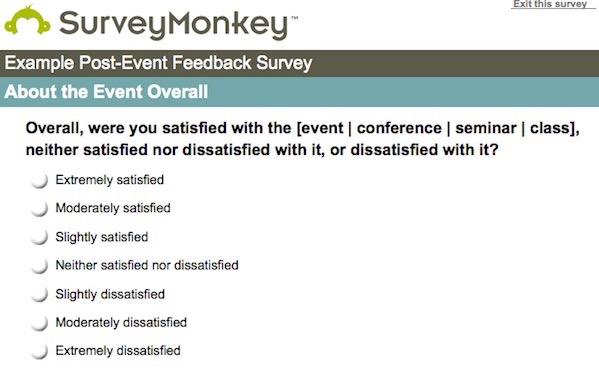
SurveyMonkey – A powerful and free survey tool to help you manage the email addresses, which allows organizers to “jazz up” their content a bit. Pro tip: Add your company’s branding to legitimize the messaging and increase response rate.
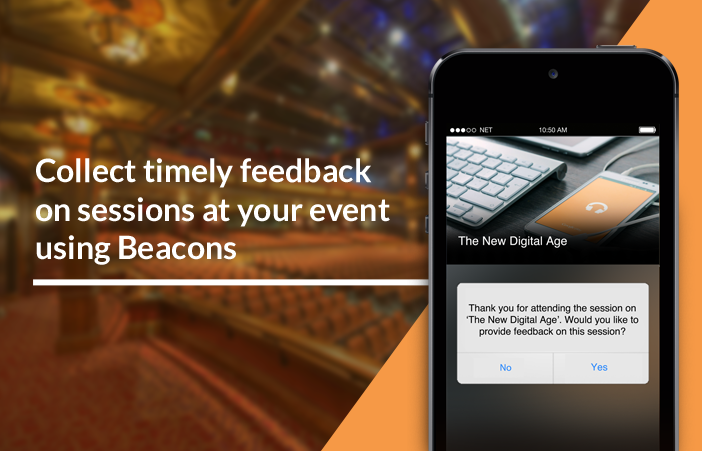
If you’re tracking movement during your event using beacon or RFID technology, then you have a good idea of where people are gravitating on the floor. Most event organizers send out messaging via their conference app, or using emails to “remind” attendees of upcoming speakers, special offers, etc.
Use that digital data to help understand which messaging and attractions at your event really resonated with attendees or inspired them to attend. For example, you can correlate how many individuals were scanned going to the events that you messaged them about via your conference app or use the email analytics to understand who was reading your content and who wasn’t. Not only will you have a better understanding of what messaging really caught people’s attention, you can prove to speakers, exhibitors, and your boss, which partners you should be securing for future events who will really drive attendance and traffic.
4. Gamification
Gamification is a trend that’s worth looking into when it comes to live events. What better way to engage attendees and get them excited about exhibitors, speakers, and parties than by creating a fun game with swag to encourage them to discover?
Some examples of successful gamification methods would be:
Scavenger hunts – just as much fun as when you were a kid, but now you’re competing for grown-up prizes, and there’s networking along the way.
Photo quests – encourage attendees to find locations or people to snap photos of that they can post to their social channels; it gets them to use your event’s hashtag, while promoting how much fun they’re having (and again, there’s prizes).
Social check-ins – getting people to check in at certain event locations can be difficult, but not when you incentivize them or make it part of a bigger game!
Networking challenges – Who’s going to be the first to collect 100 business cards or gain 20 new followers on Twitter?
The data that these types of games collect will be invaluable to knowing whether or not your content was compelling, and will help you understand which of your attendees were really interacting with your event.
Getting exhibitors in on the game is another great way to collect data too. They will appreciate the increased networking opportunities, and you will be able to see how actively people participated and where they went. Those attendees who enthusiastically played along may qualify as sales leads for your organization or possible thought-leaders to partner with in the future to help promote upcoming events or content that you plan on releasing.
5. Mobile App Insights
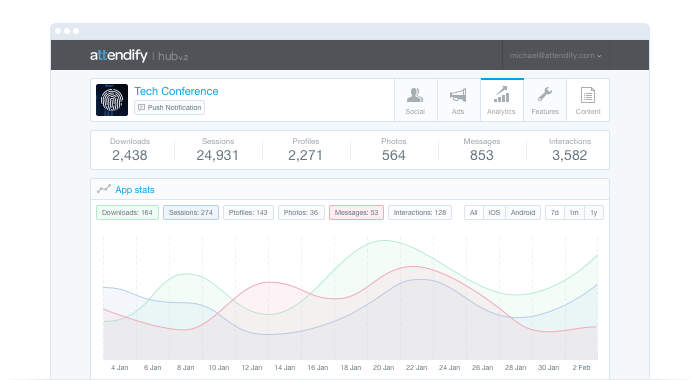
Your event’s mobile app is a treasure trove of attendee activity that you can export and use to produce data-driven insights. Beyond the total number of downloads, ask your app provider for a full breakdown of who used the app and how to discover whether or not it was effective. Did your attendees use the messaging function? Or were they more focused on the app’s networking capabilities? You could even send out a survey to ask attendees what improvements you could make to your event’s app. Those metrics will drive a better understanding of your audience’s needs as well as improve functionality.
Using this kind of digital data to help inform the layout, agenda, and messaging for your event will take a lot of the guesswork out of planning, not to mention deliver a more qualified list of leads to your sales teams! And because events are an expensive and immersive experience for everyone involved, marketers need these kinds of insights to help them prove value to their attendees, sponsors, speakers, and exhibitors.
Conclusion
Connecting with your prospects and clients in person is key to driving your sales and marketing. As described in this post, I am proposing several ways that you can learn about the actual experience of your attendees. Because each attendee has their own agenda, priorities and social behavior, it is complicated to understand every journey throughout your event.
At the very least, you should identify and understand those attendees who are the most engaged at the event. By focusing on these attendees, you will be able to optimize your messaging before, during, and after future events? With the right combination of tools, you can reveal much about your attendees and translate this on broader scale into successful sales and marketing campaigns.
Have you ever wondered how I’ve been able to build multiple successful businesses? KISSmetrics receives over a million visitors a month, and the business raised over 15 million dollars in funding.
Crazy Egg, although it isn’t talked about much these days, does well too. It’s actually larger than KISSmetrics from a financial standpoint… it generates more profit each year than KISSmetrics does in revenue. And Hellobar, which is owned by Crazy Egg, is growing at a rapid pace. The bar is seen millions of times each and every day.
And those are just the businesses people know me for. I have a handful of other businesses that do well too that no one hears about. For example, I’ve made millions of dollars in profit from real estate over the last few years…simply by buying distressed properties, fixing them, and then flipping them.
I’m not here to brag because the reality is I’m not that smart or even lucky. I’m where I am today because I’ve surrounded myself with people who are smarter than me. And I make sure I always take care of those people who do well for me…
In essence, my team members are like my family members. Without them, I wouldn’t be where I am.
So what’s the purpose of today’s blog post? I am actually looking for more team members—family members—ones that I can work with for life.
Now, before you apply to any of these positions, make sure you read them all, and pick the one that’s the best fit for you.
Basic skills
No matter what position you are applying for, I’m looking for people who have the following qualities:
You are a natural hustler.
You communicate professionally.
English must be your native language or you have native fluency.
You have a constant and reliable computer and Internet access.
You are intelligent, self-motivated, and hardworking.
You are looking for a long-term partnership because once I find someone I enjoy working with, I want to work with them for life (seriously).
You have to be willing to work 40 hours a week.
You need to have good time-management skills (you can work remotely).
If you have these qualities and skills, you may be a good fit for ONE of the openings below.
There are multiple job openings/partnership opportunities, apply to each of the ones that you feel you are a good fit for.
Opportunity #1: My new book
Over the years, many of you have told me that I should write a book. And I am actually now. It’s been in the works for more than six months, and it will come out next year. I’ll be announcing more details of the book in January.
The book is going to be co-authored with two of my long-time friends: Patrick Vlaskovits, who is a New York Times best-selling author, and Jonas Koffler, who is responsible for a lot of The New York Times best-selling books you’ve read.
If you are interested in joining our book team, here are the three positions we are looking for:
Digital Marketer/Growth Hacker – you will be responsible for top-of-the-funnel marketing. You should have experience with SEO, social media marketing, conversion optimization, and anything else that could be used to drive sales.
Content Marketer – you will be responsible for the editorial content and calendar, supporting this project, and will help identify and target sites with large audiences receptive to our messages as well as craft and create blog posts for A-list blogs and media outlets. You will also help schedule podcasts and AMAs. Being detail- and deadline-oriented is a must, and we’ll need our person to be extremely well-organized and have a passion for putting together insanely great content with a deep knowledge of outlets. Oh, and design skills are a plus.
Research Assistant - you will work with us to track down great stories and data. You love getting to the heart of the matter, and you know how to find gems in unexpected places. You’re fearless and committed to new and big ideas while able to gather materials quickly. You will be an integral part of the content team, helping us dig up inspirational and exciting content for the project.
If you are interested in working on the book project with me, here’s how you can apply:
The subject line must be: “Book Project for NAME OF POSITION” (This is not a trick question. Include the actual name of the position you are applying for.)
In the email, note the following three things:
Your full name
Where you live
The name of the city and name of the venue that the Beatles performed in for an entire year before they became globally famous.
Attach a picture of a slice of pepperoni pizza. It has to be in the .png format and cannot be greater than 1 MB.
Do only those tasks.
For the book project, you’ll be going through three rounds of interviewing before we choose the three lucky individuals. The tasks above will get you through round 1, after which we will give you the next set of tasks you will need to complete.
The deadline to apply for the openings for the book project is October 6th by 5 p.m. Pacific Standard Time.
Opportunity #2: My new software company
I’m looking for an engineer who can help create an ad management software. I already have the customer base and clientele for this business.
I’m not just looking for an engineer. I’m looking for someone who wants to become business partners and help start a new venture.
Here’s some of the skills I’m looking for:
Proficient coder – someone who writes clean code and can code extremely fast.
API knowledge – you either need to have the knowledge or to be a quick learner as you’ll be tapping into the Facebook ad API and the Google AdWords API.
Knowledge of Amazon Web Services – the product will be hosted on Amazon Web Services.
Ability to create a product that scales – keep in mind that there will be thousands, if not hundreds of thousands, of users going through the product each and every day. There will also be a lot of data passing through the application that needs to be analyzed and computed.
If you are interested in becoming partners in the software company, please go here to apply.
Opportunity #3: Copywriters and funnel experts
I am doing a lot of stuff in the conversion optimization space right now. Here’s what I am looking for:
You need to read Quick Sprout. Make sure you read the guides and posts on Quick Sprout as I am looking for someone who already knows the conversion optimization basics.
You have to be passionate about online marketing. If you don’t love what you are working on, you’ll eventually quit. That’s why you need to have a passion for marketing.
You need to understand copywriting, sales funnels, and email marketing. You don’t have to be the best at any of these tasks, but having a basic understanding of them is a huge plus. My team and I can help you become an expert on these topics.
If you have any questions, feel free to leave a comment. If you applied for a past job and didn’t get selected, it doesn’t mean you can’t apply for any of these openings.
Last time, we had an applicant who was very persistent. His name is Jared Mitchell. He kept emailing and calling and even got a meeting with me. He proved his value and did so well in the first few months that over the next six months he will make $150,000 to $200,000 just from my network.
And Jared isn’t the only case. Jonathan Rozek continually bugged me to show me how he can improve my conversions through copy changes. He showed me the results, and he is on track to make a similar to Jared’s income over the next 12 months.
I look forward to bringing you into my family so that we can become team members and help each other grow and prosper.
P.S. Don’t forget to apply to one of the positions above.
We’ve all found those pennies behind the couch pillow, and that occasional quarter in the crevice can eventually pack a punch—a cup of coffee here, a trip to the movies there. But how much does that analogy reflect on those lost leads that slip through the cracks in our customer buying funnel?
Below are some easy and effective ways to re-engage with visitors who have visited your website but may have forgotten to get back to their project, or worse, may already be engaging with your competitors. In any case, you’ll want to creatively remind them to re-visit your site and finish the purchase.
Use Re-marketing Ads & Target Specific Visitors
Re-marketing ads are ads that display to people who have previously visited your website, or leads from whom you collected an email address. They’re offered by many publishers and serving platforms. While some of the larger advertisers use products like Adroll or Criteo, other large and small advertisers still see a lot of advantages re-marketing directly in the publishers. Some of the most popular publishers are Google Adwords, Facebook, Twitter Ads, and even Instagram as of late. However, many would agree that Google and Facebook are probably the top two options for the most impact of performance.
Whether or not you are using Google for paid search or contextual ads, consider an Adwords remarketing ad campaign. Adwords provides great tools for tracking performance and easily creating image ads, even for those of us with no creative capabilities—making ads is as easy as uploading your logo or image and drafting some text in the tool.
Facebook Ads is another great channel for re-marketing. One and a half billion people hangout on its social platform providing an extensive reach, and many agree that the advertising costs are still quite low compared to other channels.
Upload a List of Emails in Facebook for Targeting
Like the target settings that segment audiences by page visits and actions on the website, Facebook, Twitter Ads, and others allow email list uploading. You can then easily create ads to show to your most valuable emails, which is great if you are scoring leads from a CRM and want to focus efforts based on lead quality or positions of a conversion process.
Reach Only the Visitors Who Show Interest in Your Product or Service
Since re-marketing ads are not free, many advertisers roll up their sleeves and take steps to increase their ROAS (Return On Advertising Spend). Both Google and Facebook allow advertisers to create rules that will allow spend to only show ads to people who have taken specific actions on a website or in a conversion path. Try setting up uniquely targeted campaigns to people who have visited your shopping cart in the last seven days, but who have not made a purchase. Or, run an ad exclusively to people who have filled out a form to learn more about your business.
By targeting only users who have shown certain levels of intent to purchase your product, marketers often save money by eliminated wasted ad spend on traffic that bears no fruit.
Measure Your Results and Refine Your Strategy
Implementing re-marketing ads to help bring users back into the conversion funnel should be common sense. But don’t forget to use good data when making decisions about your investment. These tools all offer robust tracking to enable insights into what’s working and what might be cut out.
Read some good resources about tactics that work for other businesses and apply to refine your efforts. Whatever you do, don’t leave those open leads to your competitors.
Engage with those lost gems and drive results to your top and bottom line.
David Johns is the Digital Marketing Director for RushOrderTees, a national screen printing company that specializes in custom printed apparel for every occasion. He is a senior PPC, SEO, and SMO marketing specialist with skills and experience optimizing ROI through advanced data-driven strategies. He hails from San Francisco, but currently resides in Philadelphia.
Perhaps it's because I am less than a month away from hitting the big five-oh, but the first thing that came into my head after writing this title was the chorus to a certain song that was released way back in the year 1981.
I've taken the liberty of altering a few of the words but I'm guessing - or better still, hoping you know what song I am referring to:
Let's get tactical, tactical
I wanna get tactical
Let's get into tactical
Let me hear your social talk, your social talk
Let me hear your social talk.
Ok, I know. Cheesy as all get out. My apologies. But when a song gets stuck in your head... oh never mind.
About 3 weeks ago I wrote a post for Forbes re: video which included the following statistics:
70% of marketing professionals report that video converts better than any other medium.
The average internet user spends 88% more time on a website with video than without.
64% of consumers are more likely to buy a product after watching a video about it.
Using the word “Video” in an email subject line boosts open rates by 19%, click-through rates by 65%, and reduces unsubscribe rates by 26%.
69% of smartphone users say videos are a perfect solution for smartphone viewing as it offers a quick way for consumers to grasp an overview of a product.
You can probably understand why I chose the following title for my Forbes piece: Using Video In Marketing: Why Wouldn't You?
In that piece I did not specifically do a dive into one form of video over another.
Today, however I will.
Here's 3 ways to use video to get tactical on Facebook.
1. The direct approach. Post videos directly to Facebook rather than via YouTube, Vimeo, etc. The folks at Search Engine Journal recently conducted a study looking at native video vs. YouTube, Vimeo, etc. The results, while not from a large sampling, are pretty telling.
2. Featured video. Adding a featured video is easy and provides the video with a prominent spot as it appears above the about section of your Facebook page and is larger on your videos tab. This is a great way to greet visitors to your Facebook page. It puts your message front and center.
3. Video playlists. If you have multiple videos covering multiple topics re: your brand and business, you can provide your viewers with a list - a sorted list to help them navigate to those they want to watch. Remember,this is all about your customers and prospects so anything you can do to help them along the funnel... well as I wrote earlier: Why Wouldn't You?
Couple of final thoughts on the topic of Facebook and video.
"Facebook is absolutely taking traffic from Youtube right now with video. What happens with autoplay, it’s all psychology. They come in through your newsfeed, start to see a tiny bit of movement, boom, it draws them in. They’ll stop and play your video. Make it short, quick and easy, with a call to action.” - Mari Smith, self-proclaimed Facebook Queen
Earlier this year social media analytics company Socialbakers released findings of a study they conducted re: Facebook posts. They analyzed close to 700,000 posts from nearly 4,500 brand pages and what they discovered was posts that contained video had an organic reach of 8.71% - which is 50% higher than statuses which were text-only and 133% higher than photo posts!
The word “cohort” can be scary to those unfamiliar with the term. It may sound like something out of a medical journal or statistics class. But, I promise you, there’s nothing to be afraid of. And, if you’re a marketer, it’s pretty important to understand cohorts if you want to get into and benefit from marketing analytics.
“A cohort is a group of subjects who have shared a particular event together during a particular time span (e.g., people born in Europe between 1918 and 1939; survivors of an air crash; truck drivers who smoked between age 30 and 40).”
Pretty simple, right?
And, if you’re one those left-brained people who love to analyze data, then cohorts are perfect for you.
Cohorts are frequently used in studies to compare groups of people. They’re useful because, in a cohort study, you track the cohorts over a period of time to see what kind of data each one brings.
To use one of the examples from above, you could study truck drivers who smoked between age 30 and 40 compared with those who didn’t smoke at all and/or those who smoked earlier or later in life. You would then look at various test results for each cohort and compare the data.
Now, we’re not going to be talking about truck drivers who smoked. Since we’re marketers, we’re going to run through how we can apply cohorts to optimize our marketing. We’ll also examine a couple of tools that offer cohort analysis.
How Can Marketers Use Cohorts?
There are literally hundreds of cohorts marketers can create. But, the question here is not how many they can create. It’s which cohorts will produce the most insightful data.
When thinking about which cohorts to track, ask yourself these questions:
Will the data I get from these cohorts produce insights that can change my marketing strategy?
Will I be able to clearly know what’s working and what’s not when it comes to marketing?
What targets do I need to hit this year? Will this cohort help me improve that metric?
Here are three cohorts marketers may find useful:
1. Signed Up / Purchased, Organized by Time
You’re a marketer, so it’s critical for you to deliver leads and signups to your sales team. Create a cohort that tracks people who visited your site and signed up. You’ll see when they first visited your site and how long it took them to sign up after their first visit. This can essentially tell you if your marketing campaigns lead people to take immediate action. Let’s break it down.
The new year begins, along with your new marketing campaign. You’ve spent the past 2 months planning it, designing it, and setting targets. Now it’s prime time, and you’re ready to see how it performs.
Your campaign runs from January – March. You get 100k visitors to your site, and your signup rate during this time remains at .5%. You start a new campaign in April.
Fast forward a few months, and you’re looking at a Cohort Report. You’re viewing the people who visited your site and signed up. For the people who visited your site sometime in the period January – March, you notice a slight increase in signups in the months following. You see that 1.0% of the people who visited your site in February came back in June and signed up. This means that the January – March campaign was more effective than initially thought.
As marketers, we often expect people to sign up right away. In our minds, we think they come to our site and either sign up or don’t. But the truth is, it’s not that binary. It’s not a yes or no at that very moment. Sometimes it’s a “wait and see.” People might visit our site, browse around, but then not sign up until later.
This is why it’s a useful cohort. Signups don’t always occur right away, and a cohort reporting tool can track signups over a long period of time.
2. Your Most Loyal Customers
Every marketer wants to acquire customers. But, as we know, not all customers are created equal. Some spend more than others, and some may require more “help” than others. There are also customers who sign up for your service and cancel a few months later (which doesn’t help your Cost to Acquire a Customer (CAC)). Most important, there are customers who sign up, stay engaged with your product, and tell their friends about it. You need to know who these customers are, where they came from, and how you can get more of them.
With a sophisticated Cohort Report, marketers can create a cohort of users who frequently login, and then they can segment (aka group) those users by the marketing channel they came from.
Here’s a way to think about it:
Your marketing challenge is finding loyal customers. You have no problem delivering signups, but 80% of them cancel their accounts after a few months. What about the other 20%? Where do they come from and how do you get more of them? This is where a Cohort Report can help you.
This is the Kissmetrics Cohort Report. It’s one of the best places to get this kind of data.
On the left, we see the marketing channel users came from. Move to the right, and you’ll see how well each channel performed. The darker the shade of blue, the higher the login retention.
With this information, we can see which channels are sending us the most valuable customers and then spend more money and energy on them and less on the ones that aren’t delivering.
3. Repurchase Rates
Every business needs loyal customers. That includes retail stores, SaaS companies, subscription-based companies, you name it. They need customers who come back and make purchases on a recurring basis. There’s no getting around it.
So how do you, as a marketer, find and acquire these loyal customers? Use a cohort. Here’s what you’ll want to do:
Find the people who have repurchased. This can be for any business, but let’s use e-commerce as an example. Then segment the purchases by product categories, marketing channels, or marketing campaigns. Here’s what you’ll learn:
Do certain product categories keep people coming back? Maybe people who purchased ties come back frequently and purchase other items. If so, it’s time to start promoting your tie collection more often.
Do any marketing channels have a tendency to bring loyal customers? For example, perhaps your AdWords campaigns are outperforming your Facebook ad campaign in bringing repeat purchases. If this is the case, you’ll want to spend more time and money on the AdWords campaigns.
You have dozens of marketing campaigns running. You have seasonal campaigns running four times a year and dozens of other campaigns running in between. With a Cohort Report, you’ll find out which ones drive purchases and repurchases.
The Value of Cohorts for Marketers
As you can see, there are many insights you can gather by grouping people together and tracking their behavior over time.
Each business and marketing challenge is unique. I’ve listed a few ways marketers can use cohorts to help optimize their marketing. But your challenges are unique, and only you will be able to create cohorts that garner valuable insight.
Where to Get This Data
There are two tools we’ll focus on that provide cohort reporting. The first is Google Analytics and the other is Kissmetrics. Let’s start by examining Google Analytics.
Google Analytics Cohort Analysis
Google Analytics has a feature called Cohort Analysis. Here it is:
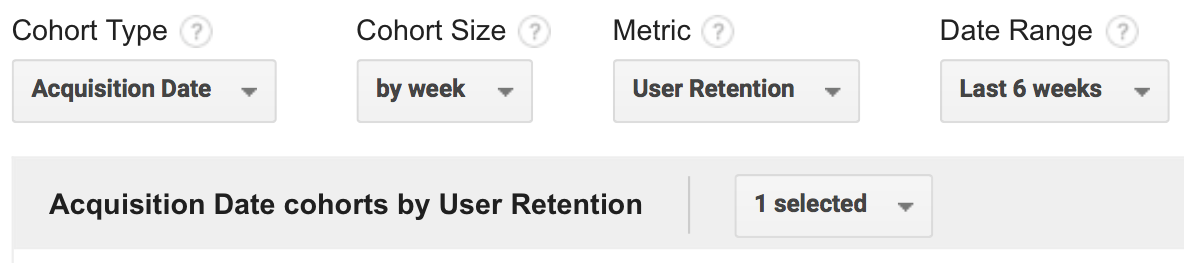
You have four choices in setting up your cohort analysis:
Cohort Type
This is where you choose a cohort. Acquisition Date, for example, groups people based on when they first came to your site.
Cohort Size
Here you choose the time frame for each cohort. You can measure people on a daily, weekly, or monthly basis.
Metric
Here you choose what you’ll be measuring for each cohort. There are a variety of choices.
Date Range
You have a variety of date ranges you can choose from. This is determined by the size of your cohort. For example, if you choose a cohort size “by day” you’ll have the date range options of 7, 14, 21, and 30 days.
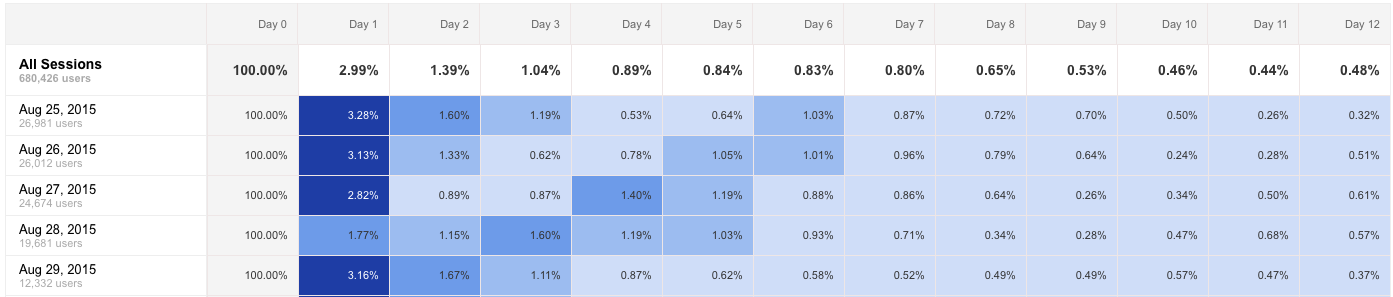
Underneath these options, the Cohort Analysis presents the data visualization. Users can see how well the cohort is performing over time.
The bottom part contains the raw numbers and the retention afterward. The darker the shade of blue, the higher the percentage (i.e., better retention).
The Cohort Analysis is still in its early stages. Some of the more advanced things you’ll want to do may be a little more difficult to set up in Google Analytics. It is, of course, free and does not inherently come with support. You can get support through a partner.
Kissmetrics Cohort Report
This report is one of the most customizable out there. You can track any event and property across a custom date range. Using this report, you’ll be able to measure how your marketing campaigns are performing and refine them based on the data. The report’s usefulness can also extend beyond the marketing department. Here are a couple of other departments that could use it:
Product Team
Track the features users keep coming back to. Which ones aren’t used as often? Why? Getting answers to these questions will help improve future product iterations and can help you find your product/market fit.
Know which features are used first by new users. Are new users gravitating toward one feature over another? What was their experience with this feature?
Understand the feature utilization that leads to payment. Is one cohort of users, who use a feature or area of your site more often during their free trial, more likely to pay for your product or cancel? Perhaps some features turn people off and they never return. Knowing this can make a huge difference.
Sales Team
Know the product plan that has the best retention. Your sales team should not knowingly be pushing product plans that have been shown to have higher churn.
Does viewing a certain element on a page lead to a signup? Maybe visitors who downloaded a white paper are more likely to sign up. If so, you can push people to download that white paper and even ask the marketing department to create more white papers.
Find which product features are used by each customer segment. For example, let’s say your sales team is trying to land a big account from a well-known SaaS company. To sell the account, your sales team needs to show them the features your other SaaS customers use. Think about it. You don’t want to show them features that none of your SaaS customers are using. You want to show them the features that their peers are getting value from.
Here’s a video demo of the Cohort Report:
If the video embed is not showing up, you can click here to view the video on the Wistia page.
Recap
We’ve gone through a lot. Here are the takeaways:
A cohort is a group of subjects who have shared a particular event together during a particular time span (e.g., people born in Europe between 1918 and 1939; survivors of an air crash; truck drivers who smoked between age 30 and 40). To put it another way, a cohort is a group of people who have a similar characteristic. Their behavior is then tracked over a period of time.
These cohorts can help marketers understand how groups of people compare against each other. If you have two groups with different behaviors, notice which one delivers the best results. Then refine your marketing with what you learn.
Sometimes signups don’t occur right away. A visitor may visit your site in January, bookmark it, and then return in June to sign up. The June marketing campaign may incorrectly be attributed with the signup even though it was actually the marketing campaign in January that brought the visitor. This is where the Cohort Report comes in handy.
One cohort that marketers commonly use is people who have signed up. Marketers can see how each marketing channel or campaign performs at delivering signups.
Many tools provide cohort data, but we focused on two of them – Google Analytics’s Cohort Analysis and Kissmetrics’s Cohort Report. Both have their upsides. If you’re looking to get more advanced analysis, definitely go with the Kissmetrics Cohort Report. The Cohort Analysis tool is still in its early stages.
The Cohort Report can be used by more than marketers. Nearly all departments in your company will be able to get useful data out of this report.
See How Cohorts Can Impact Your Marketing
Want to learn how the Cohort Report can help you optimize your marketing? Request a personal demo today!
About the Author: Zach Bulygo (Twitter) is a Content Writer for Kissmetrics.




 David Johns is the Digital Marketing Director for