Monday, February 1, 2016

Book Review & Interview: Meaningful: The Story of Ideas That Fly

meaningful-the-story-of-ideas-that-flyFor every startup that succeeds, many more fail. But what is it that makes the difference between a successful company, and one that just doesn’t quite hit the mark?


Bernadette Jiwa uncovers that and more in her new book, Meaningful: The Story of Ideas That Fly. According to Jiwa, many companies miss an essential opportunity to focus on the customer story and what they want, and instead focus on the story that they want to tell.


The mix of customers and innovation is a key focus for the book and how those two concepts can be used to change the life of the people that use your products or services.


One of the great things about this book is that it isn’t just filled with theories of how these concepts should work in the real world. Instead, the author uses stories and examples of real companies, many of which have become beloved brands, because of their approach to innovation and focus on customers. Additionally, you’ll find a blueprint for understanding the connection between customers and your products or services.


One of my favorite passages in the book is seemingly simple, but something that brands often overlook in an effort to get their company off the ground:  “The best products and services in the world don’t simply invite people to say ‘this is awesome’; they remind people how great they themselves are.”


Building brand awareness is another goal that has long been on the minds of many marketers. However, the approach that we used to take, and the requirements for meeting customer needs today have changed. Below are the old and new rules of brand awareness according to Bernadette.


Old Rules of Brand Awareness:


  • Make something for everyone

  • Tell our story

  • Attract customers

  • Build brand awareness


New Rules of Brand Awareness:


  • Understand the customer’s story

  • Make something they want

  • Give them a story to tell

  • Create brand affinity


Putting What We Learned Into Action


Below are a couple examples of how the information in this book has reinforced TopRank Marketing’s customer centric approach to digital marketing.


Debbie Friez, Social Media Lead, TopRank Marketing


Bernadette Jiwa uses storytelling to inspire marketers to find a new way to provide meaning for their audience. I was able to utilize her insights for a recent client meeting. I wanted the client to understand we are no longer looking to drive awareness and attention of the brand. The new marketing model looks for audience attraction and affinity. We can’t just think about what the brand wants, but  what the customer sees as useful and valuable to their lives.


Josh Nite, Content Marketing Lead, TopRank Marketing


I found the way Bernadette talks about “seeing customers” to be inspiring. When I’m writing content for a client, it reminds me to write with their customers in mind. Does what I’m saying have value? Does it help them be their best selves?


Interview With Author Bernadette Jiwa


I was so pleased when I was able to connect with Bernadette and she agreed to answer some interview from our book club members. And, she did not disappoint. Below are her answers to some of your most burning questions about Meaningful: The Story of Ideas That Fly.


Q: What inspired you to write this book?


A: My readers and my clients. I’ve been doing this work for a number of years and what is interesting is that every time I write a book I realize that I needed to write the book before that book to fill in some gaps for the readers. What I’m helping people to do is unlock the magic and the value in their story, but the key to doing that is understanding the customer story first.


People wanted to know, how do I get more hits, traffic and customers. What I recognized in working with other companies is that people were starting in the wrong place. It all started with my customer which I believe walks the talk of the book.


Q: One of the concepts that stood out to me the most was when you said “there is a life and a way of being before the product or service existed, and a life and way of being after it.”. What do you think brands can do to not only provide a product/service, but change the way that life exists after?


A: Because we have ideas that we want to get out in the marketplace, we tend to focus on the short-term. If you think about any of the brands you love and think about your life before you used that app or product and your life after, you’ll see the difference it made.


A long-term view focuses on where you want to take your customer and what happens in their life because your product exists. A great example of that is Uber. Think back to what was it like waiting for a cab and not knowing if the cab was going to arrive? Uber thought about all of the ways they can solve problems for the customer and build it into their product.


Your product has the potential to be something that creates value and magic in a customer’s life and changes how they feel, and what they do and how they go about their day.


Q: What methods do you recommend for listening to current or potential customers? What channels would you use for gathering that intel?


A: There are so many ways that we can listen and we don’t take advantage of enough of them. If you think about social media, we have access to resources that only massive multi-billion companies had access to previously. Now, you can jump on social media and start listening. Instead of using it to broadcast which is what we mostly use it for, you can start listening to your customers today.


You can find people in your demographic or whose worldview you want to appeal to and start listening to them on social media, public transport, the places they hang out.


Sometimes we get so stuck on developing what we are developing and we look internally and we don’t actually reflect out to the world and the opportunities to do that.


Q: In your book, you describe how entrepreneurs get stuck focusing on the bottom of the ‘Expectation Hierarchy' pyramid (product, service, platform, access). In an increasingly results-oriented marketplace, how can we break the cycle, and focus business efforts on empathy, while still producing results? Is it even possible?


A: If you just measure business success on the amount of traffic you get or customers on your website, then you stop focusing on the difference you’re creating for those customers.


We need to look at the quality of those numbers. How are you measuring connection with your customer and loyalty? That is the most important thing. I would say what is more important than lots of shallow connections is fewer, deeper connections. A lot of times I try to flip my client’s mindset to how they will deepen connections versus how they will get the most customers to their door.


If you can actually deepen those connections that is how you garner more loyalty and repeat business and create products for them instead of trying to find more customers for the products you have.


Q: What are the top ideas that you want readers to walk away from your book understanding?


  • First, focus on the customer. That is the key message in the book.

  • Sit down and use the tool in the book. A lot of times we read a book and don’t do anything with it.

  • Think about intangible benefits that you provide. There are both rational and emotional benefits that you can provide to your customers.

  • Think about the change that you are going to create in your customer with their product.

  • Don’t be afraid if you don’t have all of the answers right away, just start.


What Did You Learn?


To me, this book was both inspirational, and actionable. There is much to be learned from companies that have succeeded and failed in meeting customer needs. I’m very curious to know what passages of the book stood out to you and which ones have you already started applying to your marketing?


If you aren’t already a member of the TopRank Marketing Book Club, join now!


Email Newsletter
Gain a competitive advantage by subscribing to the
TopRank® Online Marketing Newsletter.


© Online Marketing Blog - TopRank®, 2016. |
Book Review & Interview: Meaningful: The Story of Ideas That Fly | http://www.toprankblog.com

The post Book Review & Interview: Meaningful: The Story of Ideas That Fly appeared first on Online Marketing Blog - TopRank®.


Which Types of Content do B2B Tech Buyers Respond To Most?

It’s no secret: B2B decision makers have to slog through a lot of information. They need to be on the cutting edge of their industry yet still be adaptable enough to shift as the market’s demands and interests change.


Just getting to the key decision makers is an uphill climb, to be sure, but what if there were a shortcut?


A path you could carve, away from all the “me too” businesses and services aiming for a piece of that company’s profit pie – and still end up at the top?


Wouldn’t you want to know how?


The answer is all in the content.


But it’s not how much of it you produce that matters – it’s what you produce.


And these are the types of content that gets them to move ahead with a purchase.


How Much Content Do They Need to Make a Decision?


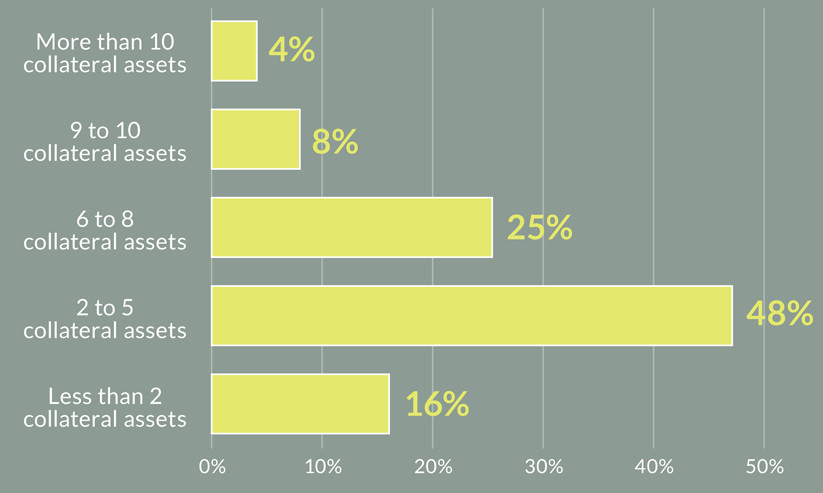
The recently revealed Eccolo Media B2B Technology Content Survey Report published by Eccolo Inc., pulls back the curtain on the buying habits of B2B technology decision makers. For example, they found that, on average, nearly half of those surveyed reported consuming only 2-5 collateral assets before making a decision.


marketing-collateral


Key B2B decision makers only need to consume as few as 2 pieces of collateral before deciding


That means if you’re pumping out lots of content in an attempt to sway them, you may be simply spinning your wheels in the mud. Instead, concentrate on creating less content, but making the content you do create better quality. Don’t just show why your service is a great deal or why your offer is irresistible – show the kinds of results it produces. Show how it performs “in the field.” Go the extra mile and do the research legwork that your competitors are unable, or unwilling to do.


What Kinds of Content Help Propel Their Decision?


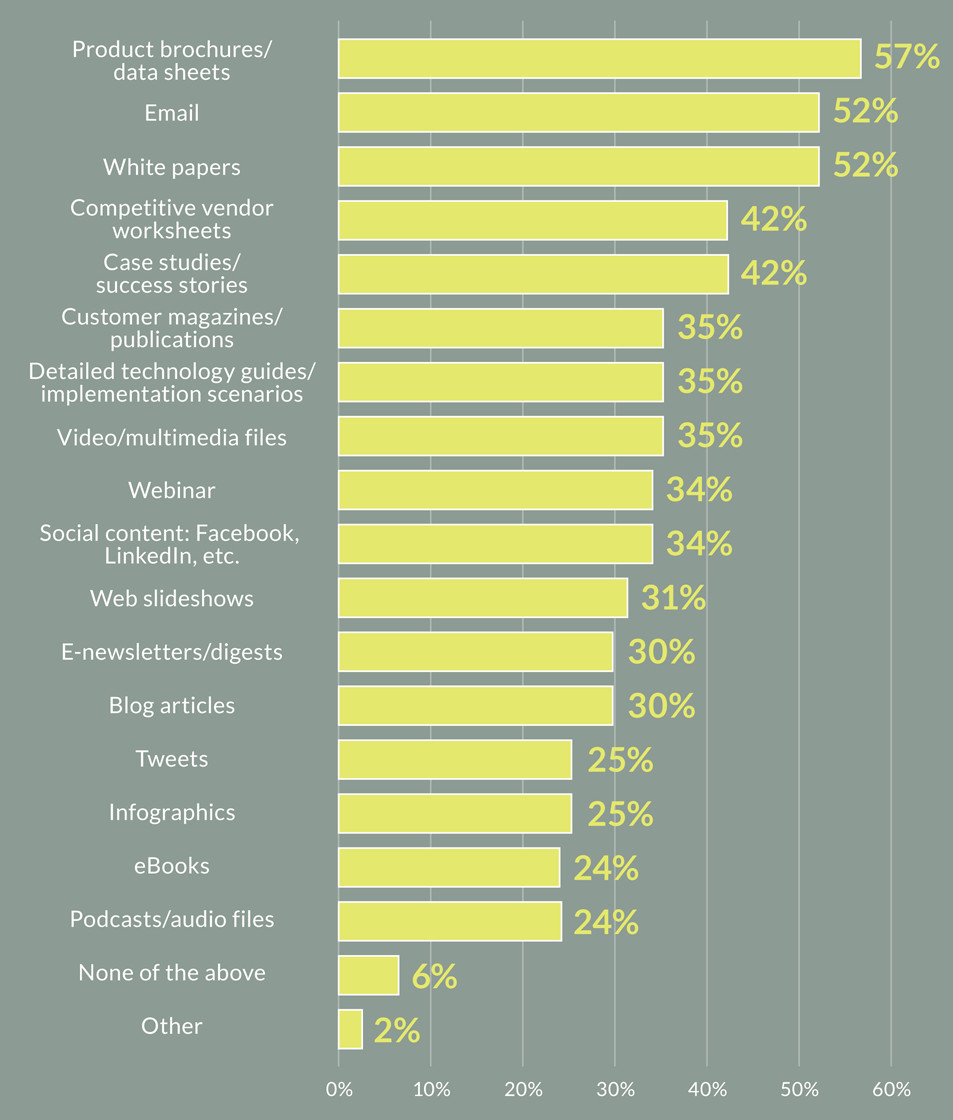
Over half of respondents to the study reported reading an equal amount of emails and white papers. But when it came to influencing their decision, white papers were the clear leader:


whitepapers-emails


White papers were more often used as an influence tool than emails


Before you set your staff to churning out white papers, keep in mind that it’s not that simple (it never is!) The study also went into detail on what types of content was consumed across 6 months to lead to a purchase. The results are pretty surprising:


types-of-content

Different types of content have varying degrees of success spurring B2B buyers on their decision


So What Can We Learn from This Information?


There are a few gold nuggets we can glean from the overall buying process of B2B decision makers. But what can we do with our existing content that will put the odds in our favor? Here are a few points to help:


Create a True Apples-to-Apples Comparison Chart


Having product/data sheets is all well and good, but notice that competitor vendor worksheets are also in the mix. Why run the risk of losing a decision-maker’s efforts when you can create your own comparison chart between your B2B service and those of your competitors? The more you can decrease the odds of them having to go offsite to see how your offer compares to others, the more likely you are to keep them engaged on what you do differently – and better.


Make Your Product Data Sheet Enticing


What’s more, a product/data sheet doesn’t have to be some boring overview. Make your best content work for you by bolding key phrases and benefits to stand out. Formulate your headers as questions to create a FAQ-style Q&A.


Make liberal use of bullet points to summarize key features, but include a link where more detailed information can be found. If someone read each of your bullet points and nothing else, would they understand the product enough to be able to make a confident buying decision about it?


Look at your product sheet not as data drivel, but as a way to address the B2B buyer’s key pain points. You have to know what they’re going through in order to present a solution that fits their needs. Talk about features, obviously, but don’t forget to include the benefits of those features in a way that makes sense from the buyer’s perspective.


Writing White Papers that Position You as the Authority


When was the last time you read a white paper that really stood out to you – like “These guys know what they’re talking about!” Never, right? First, don’t call it a white paper. It sounds boring and clichéd. Like a giant sales pitch – which is how many white papers are written. Remember, these are people who are actively looking for a solution. So present your paper in such a way as to address all of their concerns in a way that’s easy to read and understand.


You may want to re-brand it as a “Special” or “Insider” report. Take the time to answer the most common questions and back up your statements with clear, comprehensive proof. This is where the real meat and potatoes of your benefits comes in. Lay out precisely how the decision maker, their team, their company and their customers will benefit from your solution.


Think of your white paper not as a sales vehicle, but as a friendly guide – gently moving the decision maker down through each stage of your funnel in a way that doesn’t feel like a pitch, but more of a mutual understanding. You want the reader to come away with a deeper, fulfilled and complete picture of your solution and how it ties in with their existing needs.


Don’t Forget Your After-the-Sale Content


Oftentimes when closing a client, you’ve poured all your efforts into making their decision as easy and hassle-free as possible. Once they’re all set up and acquainted with your solution – don’t let them simply dry up and wither on the customer vine!


This is the prime time to follow up with upgrades or details on how they can get the most out of your product or service, as well as how to use it to build their business, retain their customers or experience growth faster or more fluidly than before. Remember that no one wants to feel like they’ve been duped or made a fool of. And if communication dries up after the sale, that’s precisely how they’ll feel.


By taking the time to not only write the kind of content that compels them to decide, but walk them through the process and guide them through each step – you’re showing these key decision makers that you’re not “all about the sale”, but rather all about the journey they’re taking to create a better experience for their own customers. And that’s the kind of journey you should take – together.


Do You Sell to B2B Companies?


What have your experiences been with using emails, white papers and data sheets as content to help spur their choice? Have you had different results than those reported on the surveys? Finding that a different method works better? Tell us about it in the comments below and share your story!


About the Author: Sherice Jacob helps business owners improve website design and increase conversion rates through compelling copywriting, user-friendly design and smart analytics analysis. Learn more at iElectrify.com and download your free web copy tune-up and conversion checklist today!


The Good Old Days

Chris Brogan Back in the good old days, everything was easy. Everyone knew everyone. Money just showed up. Man, it was amazing. Everything was the best back in the good old days. Right?

The Good Old Days


There are two lies you tell yourself when you're feeling uncertain.

Continue Reading

The post The Good Old Days appeared first on chrisbrogan.com.


Google Revenues Beat Expectations With $21.3B In Q4 And $75B In 2015

Revenue growth was driven by mobile search acceleration, YouTube and programmatic advertising. Next, Fiber and Verily drove revenue for "other bets."


Please visit Marketing Land for the full article.


Customer Co-Production: How one furniture company tested self-assembly messaging to enhance value and reduce frustration


Self-service and customer co-production of products is everywhere — customers assemble furniture themselves, follow directions on food packages to prepare meals, scan their own groceries at supermarkets and use online banking. Despite its price-lowering and customization value, co-production has a dark side, requiring effort and time from the customer and potentially causing frustration. Today, we’ll look at a study from the furniture industry comparing the effects of two marketing communication strategies to mitigate customer frustration with the co-production process.


The Study


In November 2015, Till Haumann, Pascal Grϋntϋrkϋn, Laura Marie Schons and Jan Wieseke from the Ruhr-University of Bochum, Germany published the results of a field experiment with a multinational furniture company. The company sells furniture that requires co-production from the customer or, in other words, standardized, ready-to-assemble furniture that customers purchase in flat packages and assemble at home.


Depending on customers’ assembly skills, the process can be frustrating to a degree. So the scientists set out to test two ways of alleviating customers’ frustrations with the process (“co-production intensity”) by (1) enhancing the perceived value of the process and (2) reducing the perceived effort and time required in the process.


Method


The study authors asked 803 self-assembly furniture customers to fill in two Web-based surveys. Customers were assigned to experimental and control groups. Participants in the control group were not exposed to any posters, while participants in the experimental group were exposed to one of the two types of company advertising poster messaging:


  • Value-enhancing communication strategy

    • Economic value messaging: The effort the customer invests in assembly allows the company to offer lower prices

    • Relational value messaging: Assembly can be a fun, social activity involving friends or family


  • Intensity-reducing communication strategy

    • Support service messaging: Company provides a support hotline customers can call if they encounter issues with assembly

    • Full-service messaging: Company provides help through reputable, reasonably priced service partner that assembles the product for customers


The researchers asked customers about the message of the poster, to make sure they understood it.


The first survey asked participants about their general attitude toward assembling furniture and demographic information. Participants who purchased and assembled a piece of furniture after the first survey then filled out a second survey, asking about their satisfaction with the process.


Results


Haumann and colleagues found, as expected, that the more customers felt like assembling the product was effortful, exhausting, demanding, time-consuming and costly in terms of time and effort, the less they were satisfied with the co-production process.


However, customers who viewed economic and relational value-enhancing posters conveying the messages that self-service assembly allows the company to provide lower prices, and that assembly can be fun if shared with family or friends, felt more satisfied with the assembly process, compared to customers in the control group who didn’t view any posters.


Similarly, customers who viewed the intensity-reducing support service poster were more satisfied with the assembly process compared to customers in the control group who didn’t view any posters.


The intensity-reducing full-service offer poster did not have a significant effect on customer satisfaction, possibly because using this offer would involve additional cost for the customer.


Summary


Asking customers to engage in co-production can be risky. Customers can perceive co-production as costly in terms of time and effort, and this reduces their satisfaction. However, marketers can use value-enhancing and intensity-reducing communication strategies to increase customer satisfaction with co-production.


Marketers can communicate the economic (price-lowering) and relational (socializing) benefits of co-production to increase customer satisfaction. Communicating that customers can call a support helpline if they experience difficulties also increases customer satisfaction with co-production.


You might also like


Engaging Customers in Coproduction Processes: How Value-Enhancing and Intensity-Reducing Communication Strategies Mitigate the Negative Effects of Coproduction Intensity (from the American Marketing Association)


The Baskerville Experiment: Font and its influence on our perception of truth


Co-creation: The next realization of value-based marketing


Ways of Engaging Consumers in Co-production (By Michael Etgar, Technology Innovation Management Review) 


Off-Site SEO 101 – Guide for Small Businesses

Off-Site SEO 101 – Guide for Small Businesses written by Alex Boyer read more at Duct Tape Marketing


When people think about SEO, most immediately think of keywords on site, content and title tags. While these certainly help your site’s SEO, it is important to keep in mind that not all SEO is done on site. There are a number of things you must do outside of your website to get the best position in search engine results.


Directory Management


Believe it or not, Google doesn’t know everything. It is, however, really efficient at collecting information from around the Internet. There are countless local online directories, from which Google collects its information. If the information about your business is out of date on these sites, it can affect placing on your search results pages.


Manually keeping track of all of these directories can be nearly impossible, but luckily there are directory management tools available that can help you update all of the directories at once and monitor them for inconsistencies. One of our favorites at Duct Tape Marketing is Yext. Yext will also help you manage multiple locations, so your listings will always be seen by people looking for the location closest to them.


Reviews 


Google actively rewards businesses with great online reputation. The better your online reviews on sites like Yelp, Google+ and Facebook, the better your local rankings will be. The highest rated sites are seen as more “trustworthy” by Google and therefore given better organic search positions.


There are a couple of ways great reviews can help with your SEO. First of all, Google pulls reviews directly from Google+, so if you have more than 6 reviews on your G+ business page, you’re results will feature stars indicating your average review score. This can be in the standard results and even the Google 3 pack. These stars really differentiate a business. Just take a look at how our listing stands out here:


Screen Shot 2016-01-31 at 4.59.19 PM


Finally, the more reviews you have on other third-party review sites, such as Yelp or other industry-specific sites, these sites show up higher in search results as well. What could be better than a list of great review profiles when someone searches for your business?


To take advantage of this, you should keep a review profile on every available site that applies to your industry. Every local business should have a Google+ page, a Facebook business page, and a Yelp profile. Then search for something specific to add. Service providers should create at least free profiles on sites like Angie’s List for instance while doctors should be active on HealthGrades.


Backlinks


No matter how many times Google tries to devalue backlinks, you should always be looking to secure as many links on other sites as possible. The more links you have, the more reputable your site is seen as by Google.


A great way to earn more backlinks is by securing guest posts on other reputable blogs. Many blogs in many industries accept blog posts. You can use a tool like Buzzsumo to identify blogs that post from guests. You can also use Pitchbox, a tool that helps you identify and manage reaching out to many blogs at once.


One great way to get backlinks is by identifying on which sites your competitors have backlinks. A tool like Ahrefs can help you find these sites. Simply enter in your competitors’ web addresses, and it will find where their site is linked. You can then enter these as opportunities in Pitchbox, and reach out to them asking for a link as well. It’s worth asking, right?


Social Media Profiles


One often overlooked benefit of holding active social media profiles across all available platforms is simple, you have more pages under your control that can potentially show up in searches.

Keep your profiles active and under your control. You should even hold complete profiles secondary social media sites, just in case they grow and you decide to hold a bigger presence. Ideally, you want the profiles to all to have the same name or very similar names so that they are easily found.


A great way to build up backlinks on these sites is to make sure each profile links back to your site. Of course, you should always promote every blog post across all platforms. These backlinks aren’t counted individually (usually, they are rated by domain) but they will make your content available to every potential audience.


Alex-Boyer-Photo-150x150-e1420769709443.jpgAlex Boyer is a Community Manager and Content Ninja for Duct Tape Marketing. You can connect with him on Twitter @AlexBoyerKC


Here’s a Story: Why Storytelling is Vital to Content Marketing

Outdoor retailer REI recently released a new online video, Trail Angel, as part of their ongoing Every Trail Connects series. Marketers know that as video consumption continues to grow among consumers, especially on mobile devices, telling stories through video is one of the best ways to connect with those consumers.


Using video for storytelling is very different from showcasing your products in a video. It’s also different from customer testimonial videos. Real storytelling is about emotion. And REI gets it.


The below example is where content marketing crashes headlong into storytelling.


REI has created this video, or piece of content, and hosted it on their website. They also posted it on YouTube for others to discover it and share it or embed it easily. And they didn’t just assume people would stumble upon it like a shiny object just off the trail. They sent an email about it. That’s right, an email to their customer list announcing that they made a video. And of course, they shared a trailer for it on their social channels. They want to make sure people see the video.


This initiative shows that REI cares about the same things that their customers do. These trails are important to people’s lives. And after watching the video, you will discover how important.


The Appalachian Trail winds its way up the East Coast from Georgia to Maine. Along the way it intersects with many peoples' lives. The story of this trail is told through one of those people.


Are they using the video to sell outdoor equipment? Of course they are. But this is not a logo-packed video. It is not an overt product placement video. Sure, there are people enjoying the outdoors wearing things that they might have purchased at REI, but that’s not the point. And those connections are never made obvious, even though you can scroll down from the video and buy outdoor gear.


They are building an emotional connection with their viewers and bonding over their shared values. The environment is important. Getting outside is important. And people are important. This kind of connection will beat a 20% off sale every time. This is how you build loyalty. This is how you build advocacy. And these are the true goals of content marketing.


Watch the video and let us know what you think on Twitter. We’re @OracleMktgCloud.


Before you can produce work like this, you really need to get the basics of content marketing down. The Modern Marketing Essentials Guide to Content Marketing can help.