Wednesday, May 4, 2016

4 Causes for Search Traffic Plateaus (and How to Fix Them)

flat traffic


Every marketer and business owner would love to see a search engine traffic graph that never stops rising.


And if you're an expert SEO, you can manage that in many cases.


But likely, your search traffic will plateau at some point or another.


Month after month, it'll stay about the same, rising or dropping an insignificant amount.


Sometimes it is your fault, but sometimes, it may be out of your control-at least initially.


At that point, you have two options:


  1. Find additional sources of organic traffic besides the standard search result listings.

  2. Determine the root cause of your traffic plateau, and take corrective action.


I'd recommend using both options, but since I've written about the first one before, this post will focus on the second.


I'll go over the four main reasons why search traffic plateaus and how you can get your content and business back on the right track. 


Possible cause #1 – Fluctuations in keyword volume


The first thing you want to do is make sure you're not having a knee-jerk reaction.


It's fairly common for rankings to improve but for overall traffic to decline because of seasonal fluctuations in keyword volume.


Here's how you check for this.


Start by heading to either your analytics or Google Search Console (former Webmaster Tools). Look for the top 5-10 keywords that send you organic search traffic, and write them down.


In Search Console, you do this by going to the search traffic, search analytics section, and sorting by clicks.


image06


With that list, head to the AdWords Keyword Planner, and enter those keywords (you can do all at once or one at a time).


Once you click “Submit,” you'll get the standard search volume for each keyword. Make sure you have the right country and language selected if it's different from the default.


Next, hover over the little graph icon beside each keyword to reveal the search volume of the term over the past 12 months:


image00


This tells you whether there are significant variations from month to month for your main keywords.


If most of the keywords indicate that search volume should be expected to be low during the previous few months, your search traffic probably hasn't actually plateaued, and it'll pick up in the more popular months.


What if those keywords didn't reveal any significant fluctuations? There's still one more possibility to consider.


Next, consider trends: If you're getting 30% of the search traffic in your niche, what happens when your niche becomes less popular?


Even if you increase your share of the search traffic, your overall traffic may stay the same.


To check this, head over to Google Trends.


Type in a keyword that describes your niche and content. I suggest trying more than one if possible.


That will generate a graph showing whether more people or fewer people in general are searching for terms in your niche compared to previous time periods.


image03


If the terms' popularity is going down fast, you're actually doing a great job if you have a plateau in traffic.


If the trends are fairly stable (not going up or down) or trending up, there is a problem that needs to be fixed if you want your traffic to start rising again.


Let's move on to other possibilities…


Possible cause #2 – Plateaued rankings (near the top) or declining rankings


Now it's time to examine your existing content-more specifically, your older content.


New content from the previous month, sometimes two, isn't expected to drive a ton of traffic (it's always a nice surprise when it does).


Instead, there's often a 2-6 month delay, depending on a bunch of different factors.


I'm assuming you're tracking your keyword rankings; otherwise, this is going to be difficult. If you aren't, find a good keyword tracker, and start as soon as possible.


image02


For all the main keywords of your older content, note whether or not rankings have increased, stayed the same, or declined over the course of the plateau plus a few extra months.


For example, if your plateau has been going on for 2 months, look at the rankings over a 4-month period.


A decline in a single keyword doesn't mean anything, but if you see a decline in more than 25% of your keywords, that tells you that your old content is losing its rankings, and it's a trend.


There are three common reasons that cause this type of loss.


Reason #1 – Link decay: In an ideal world, when you earn a link to some of your content, it stays there forever, and you can just build upon it.


But the Internet goes through a lot of change on a regular basis. Domains go in and out of registration, and pages are continuously created and destroyed.


Even huge websites go through big re-designs that involve merging and deleting content.


All of this leads to one thing: link decay. Links become dead or missing.


image01


You can see this by using a tool such as Ahrefs. Enter just about any URL with links pointing to it, and you'll see that in addition to gaining links, that URL also loses links.


image07


That's what my advanced guide to content marketing looks like.


And this is how you'll check for this cause.


Enter your content URLs that have lost rank, one by one, and see which links they lost in the weeks leading up to any drops they've had.


If you notice that most of them lost important links, it's likely the cause (or at least part of it) for the traffic plateau.


Reason #2 – Algorithm change: Google is constantly updating its algorithm, and these updates can cause small (or big) shifts in the search results.


Big sites aren't usually affected by these too much, mainly because of link diversity.


One of the things that Google is constantly tweaking is ways to discern between high quality and low quality links and ways to weigh them correctly.


To speak in very general terms, forum links are low quality, while blog post links are high quality. Although there are many situations where that's not true, accept it for this example.


So, if Google is able to detect forum links better, or at least the spam forum links, it can devalue them. As a result, content that relied on forum links will tank.


Link diversity refers to the number of different types of links you have. Ideally, you want a healthy mixture. In that case, even if Google devalues a specific type of link, it will only affect a small portion of your links.


image05


Big sites build up a healthy diversity naturally.


However, if you're dealing with a smaller site, you may have purposely gone after certain types of links, which leaves you vulnerable in case Google makes a tweak that targets those links.


If you've done that (targeted specific links) and saw consistent drops across most of your keywords, this is likely the problem.


You'll need to expand your SEO skill set to build a more diverse and reliable SEO strategy.


Reason #3 – More competition: Sometimes, losing rankings doesn't have anything to do with you; it has to do with someone else doing better.


If your average ranking drop was pretty small (a spot or two), there's one final likely reason: someone created better content.


Pull up the current search rankings for each of the terms that dropped a few spots. Next, look for the date when each one was published.


If it's not in the search results, check for the date on each page itself. If that's not an option, enter it into the wayback machine to find the earliest recorded version.


Like I said before, it usually takes at least a month or two for a page to start ranking highly (and stay there) on any somewhat competitive term.


That's why you're looking for a page that was created just a month or two before your first ranking drop.


If you're using a really good rank-tracking tool, you may be able to see the SERPs from before and determine which pages surpassed you.


If you establish that this is the issue, you need to step up your SEO. Put more effort into link building (perhaps learn more while you're at it), or edit and improve your content so that it's clearly better than the results above yours. Ideally, do both.


Possible cause #3 – New content is not driving traffic


The next scenario is that your old content is ranking just fine and is still driving traffic.


However, you might be able to see that your fairly recent content (1-4 months old) is not ranking well or driving much traffic at all.


That may or may not be a serious problem, and the question then becomes “why?”


Reason #1 – You're going after more competitive terms: I highly recommend starting any SEO campaign with trying to rank for easy terms and getting quick wins.


If you do it well, you will see impressive growth in your search traffic.


However, this naturally leaves you with harder keywords to go after. These may take more link building work than before, which will, of course, take longer.


If this is the case, having plateaued traffic for a few months isn't a big deal because if you keep up the work, you should break through and see some big spikes as you start to rank for those harder keywords.


Reason #2 – Your SEO strategy has become less effective: If you typically do the same promotion for all your content, that means you're consistently getting the same type and quality of links.


In the past, those links may have ranked your content with no problems.


Once you were ranked highly, you naturally gained other links from people seeing your content on the first page and referencing it. That's why your old content may still be ranking fine.


However, if those links are not sufficient anymore, in quality or quantity, you're not going to find success.


Take this opportunity to upgrade your SEO strategy and improve your link building skill set.


Reason #3 – Have you been slacking? Quality is always an important part of SEO, but so is quantity.


If you're not publishing as much content as you have in the past, of course your new content won't produce the same growth that your old content did.


There's no special solution here. Take an honest look at how much you've been publishing in the past few months. If it's not enough, revise your content schedule, and start publishing more to get on the right track.


image04


Possible cause #4 – You're nearing a limit for your specific niche


It's the right idea to target a very specific niche with your content marketing.


If you target one with low competition, you might be able to rank #1 or #2 for all your main keywords.


After that, most marketers start targeting long tail keywords.


This is fine, but you need to understand how it affects your search traffic.


If you're ranking for a term that gets 4,000 searches a month with one piece of content, it would take 100 pieces of content ranking for searches that get 40 searches a month to equal the search traffic you get.


So, if you rank for bigger terms quickly, your traffic is going to explode. However, since you can't keep targeting terms with the same level of search volume, your growth rate will decline.


Your traffic may not have even plateaued; it may just be increasing at a much slower rate.


If this is the case, you're doing an excellent job at SEO.


However, your growth rate will continue to be slow if you target keywords only in this specific niche because there are only small ones left.


What you need to do now is branch out to a closely related niche and repeat your entire keyword research and SEO strategy.


Continually keep broadening your scope as you dominate each new niche.


Conclusion


A plateau in search traffic happens to all SEOs and marketers and one point or another.


What's important is how you respond to it.


By now, you should understand the four main causes for a plateau, ways to fix them, and the next steps to take.


If you have a unique situation that you have a question about, let me know about it in a comment below, and I'll try to clear things up.


Do Visuals Really Have an Impact on Online Advertising Success?

online-advertising-success


Humans are visual creatures by nature. In fact, research shows that 90% of the information that comes to our brains is visual. And as it turns out, our visual intelligence is actually increasing while verbal intelligence is on the decline, according to an infographic from WebDAM.


What does this mean? It means that the way people consume information and the way they communicate is changing. And marketers who want to effectively reach their audiences will need to more strategic with visuals in all their marketing tactics-including online advertising. Simply paying to be at the top of search results or news feeds is no longer enough to get the results you're looking for.


But the importance of visual content in your online advertisements goes beyond the fact that we're becoming an increasingly visual as a society. Below we dive into some other reasons visual content should be a focus and outline some best practices, too.


Why Visuals Matter in Online Advertising


Images Impact How People Feel


It's true what they say. A picture truly is worth a thousand words. Images have the power to move us, and to evoke feelings and memories. And in advertisements, images can definitely impact the way we feel about a product or brand. In fact, when it comes to ecommerce sites, 67% of consumers say the quality of a product image is “very important” in selecting and purchasing an item.


One of my favorite brands using visual content to give people all of the feels is Love Your Melon. Love Your Melon was founded to improve the lives of children battling cancer by providing them with a special hat. With each hat purchased by the public, 50% of the net proceeds are donated to the organization's nonprofit partners in the fight against childhood cancer. Throughout the year the brand releases new products and boosted/sponsored Facebook posts are a major promotion tool. And at the center of it all is an awesome image that encompasses the brand's mission and the good they're doing for sick kids.


Love Your Melon


Of course, I also have to mention Chevrolet's tribute to the late, great Prince Rogers Nelson following his death on April 21, 2016. Most people first saw it on Twitter, but the company also ran the ad in several newspapers.


Chevrolet


Visual Content is More Engaging


Visual content is engaging and eye-catching by nature. Videos and images can get us to stop, look and watch. How many times have you found yourself watching one of BuzzFeed's Tasty videos in your Facebook news feed this week? In addition, visual content often compels us to share with others. According to a Buffer infographic, visual content is 40 times more likely to be shared on social networks.


General Mills recently released a cute video ad on Facebook featuring the “honorary real Trix rabbit” to let the world know that the company's cereals all contain real stuff. The ad delivers information in a visually delightful way and uses the memorable Trix campaign slogan to remind people General Mills was part of their childhood.


Visual Content Rules the People


In today's digital world, mobile devices have put a camera in people's pockets and the ability to share the photos they take in real-time. According to the Mary Meeker's 2015 Internet Trends Report, people uploaded 1.8 billion photos every single day in 2014. That same report indicated that 44% of millennials use the camera or video function of their smartphones at least once a day. In addition, visual social media platforms such as Snapchat, Instagram and Pinterest are on the rise-especially among young people. And of course, YouTube has been a growing go-to for people for the last few years.


Best Practices


  • Be thoughtful. Just like any digital marketing tactic, thinking about who your audience is, what they need and the message you're trying to spread is essential when choosing what visuals to use.

  • Be consistent. Your visual content should be representative of your brand and be consistent across all of your digital channels. (Read: Learn How to Create a Better Customer Experience with Omni-Channel Marketing)

  • Show your audience something special. Give them a sneak peek at a product launch or a behind-the-scenes video story. This type of visual content can pique interest and help spread awareness about your brand, rather than trying to sell a product or service outright.

  • Use real images. Real images resonate with people. As an example, the following two ad images were used to advertise a furnace inspection promotion on Facebook. The ad featuring a real image and humorous hashtag received a 22% higher click-through rate, than the illustrated melting snowman ad.


Furnace Fail People


Furnace Fail Illustrated


  • Illustrate your message. Ask yourself: How can I convey what my message is through an image? Once you've picked an image that can deliver your message, make sure any text supports the overall message.

  • Show them the product. Sometimes just simply using an image of your product is all your need to do. For example, if you are advertising a new software, provide a snapshot of the backend that shows its capabilities or features rather than a jovial person sitting at a computer. How-to videos can also be incredibly impactful.

  • Don't be too busy. Make sure your images don't have too much going on. Humans are easily distracted and you want to keep their attention.

  • Think mobile. It's no secret that mobile devices are overtaking desktop computers. Make sure that your visual ad content will load quickly and can be easily seen on mobile.

  • Size images to proper dimensions. Make sure your images are properly sized for the advertising medium, otherwise they could be cropped and cause your ad to look unprofessional. And people will move on without a second thought. (Also, proper image size is important for your social media profiles and updates, too. Check out HubSpot's ultimate cheat sheet for social media sizing guidelines.)

  • Take advantage of free tools. You don't have to be a graphic designer to pull off high-quality ad images. Canva, Pixler and PicMonkey are awesome and all offer free versions.

  • Use color. Colors are more likely to grab and hold your audience's attention. Research from Xerox shows that colored visuals increase readers' recall and attention spans by 82%.

  • Don't be afraid to test. Use a couple different images in your ads so you can see which type or style better resonates with your audience.


What is one of the most visually compelling online ads that you've seen recently? Why did it resonate with you? Tell us in the comments section below.


Header image via Shutterstock


Email Newsletter
Gain a competitive advantage by subscribing to the
TopRank® Online Marketing Newsletter.


© Online Marketing Blog - TopRank®, 2016. |
Do Visuals Really Have an Impact on Online Advertising Success? | http://www.toprankblog.com

The post Do Visuals Really Have an Impact on Online Advertising Success? appeared first on Online Marketing Blog - TopRank®.


5 Ways Your B2B Marketing Automation is Failing

Ascend2 found that the most significant barrier to marketing automation success is the lack of an effective strategy. And according to B2Bmarketing.net's Marketing Automation Benchmarking Report, 17% of marketers say marketing automation has been very beneficial for their company. Five-seven percent said it was quite beneficial, while 26% saw limited to no benefit.


If your business sits in the last bucket, the 26% that is not yet reaping the benefits of marketing automation, you're likely ready for some tips on what you need to do differently. How can you join the 74% of B2B marketers who say they are experiencing a 10% or greater increase in sales opportunities through lead nurturing?


For marketing automation to yield its revenue generating benefits, you need each of the three pieces to the puzzle: people, process, and the marketing automation system. If one is missing, the likelihood of success is greatly diminished.


It often comes down to reversing the age-old cart-before-the-horse problem. In the rush to adopt marketing automation, marketers sometimes fail to do their due diligence.


If your horse is not leading your cart full of marketing initiatives forward, you may be stuck at any of these five obstacles. I will help you put the process and necessary people in place, freeing up your marketing automation system to do the job it was designed to do.


1. Lacking Strategy to Generate and Nurture Leads

Have you planned to acquire lists of leads or attract them through your content marketing initiatives? If you want to use content marketing successfully, you'll need to create a content strategy. That starts with using persona research to understand your buyers' journey.


By talking with customers as well as prospects who ended up not doing business with you, you can learn how buyers travel from initial problem identification to awareness of a solution, to weighing the alternatives and making their final decision. Dig deep to find out the questions that potential customers ask throughout the buying cycle.


Once you know the questions your buyers ask, it's easy to create your content plan. Simply map the customers' questions to the content that will answer them. Decide which content you'll make available for everyone to build awareness. Determine which high-value content you'll reserve for people who are willing to exchange their contact information for it.


Winning the lead is just the beginning. Since half those leads won't be ready to buy day one, but will be in the future, you need to plan a way to nurture them. Marketing automation provides the system to make this happen effortlessly. However, you need a content plan for the email nurtures. You should design each email to answer one or more of the buyer's questions, educating them, so they have the knowledge they need to make a purchase decision. Remember, each insight you share builds a little more trust.


Of course, you don't have to limit your nurturing to emails. While email marketing is a fast and cost-effective method, you may want to supplement it with telemarketing and direct mail. Telemarketing offers the greatest level of personalization and is often essential to gathering the information you need to qualify a lead. Direct mail may be appropriate when you are trying to reach a C-level decision maker and want to provide a tangible representation of your organization.


2. Failing to Set Goals for Data Acquisition

Now that you have a solution in place to attain your leads, you need to make sure you know what data to acquire for each of them.


Bear in mind that you may not be able to get all the data during the initial lead capture. So, it's a good idea to test the number of fields that you put into a form on your landing page. It's possible you'll see higher conversion rates when you ask the lead to fill in only one or two fields, however, you may discover the leads are not high-quality. If you ask the lead to fill a few more fields, you likely will have lower conversion rates, but the leads could be more qualified.


No lead form is apt to capture all the information that you require to qualify your leads. So, you want to decide how you are going to follow up and gather the remainder of the information that you need. You may, for example, need to have a one-on-one phone conversation to determine whether the leads have the budget required, the authority to buy, the need for your product or solution and some urgency to make it happen.


3. Not Keeping Score

Marketing automation systems enable you to score leads to represent the perceived value of each lead, in other words the likelihood that it will turn into a sale. So a fundamental aspect of your marketing automation strategy should be to determine how to score each lead based on demographic criteria (size of firm, title, etc.), as well as their behavior. Someone who downloads a white paper, watches a webinar, and signs up for a free demo would likely score higher than another individual who only reads a blog post.


4. Sailing Without a Crew

We talked about needing people, processes, and systems to achieve your goals. Before you launch your marketing automation system, ensure you have people in place who can create the content to fuel it. Also, get a team lined up to handle telephone conversations you'll need for in-depth lead qualification.


You'll likely need skilled business development specialists who are comfortable working on the phone. While you may not need to have these individuals in-house, it's good to vet out a business-to-business telemarketing company before you get started with marketing automation. Look for a vendor that can provide staff on an as needed basis. Also, their reps should be able to talk peer-to-peer with top managers and C-level executives.


5. Neglecting to Measure Success

You could very well be missing out on one of the beauties of marketing automation: the ability to review the success of your marketing initiatives. Before you get started, determine what you want to measure and the reports you need to review. You can create a dashboard that enables you to access daily, monthly, and quarterly metrics with the click of a button. This dashboard empowers you to get the insights you need to take action and optimize your marketing efforts.


To make the most out of your marketing automation system, put a process and the people first in place that you need to support it. They are prerequisites for success.


Join other Modern Marketers that are delivering better leads, aligning marketing with sales, and generating a lot more revenue. Download the Marketing Automation Simplified guide to see your marketing automation system succeed.


Marketing Automation Simplified


An Infographic About Infographics (We Need to Go Deeper)

People love infographics. They're easy to digest and even easier to share.


But if you're going to take the time to design and push one out into the world, you want to do it right (right?).


Well, our friends over at OneSpot put together a pretty meta infographic about how to, well, do infographics well.


MTI4OTkzMjIyNjc1NDQ5ODY2


Peep the meta infographic below.


infog


Embed this infographic on your site


Level Up Your Web Analytics with Customer Data

Analytics has become synonymous with data-driven marketing. But there is one important distinction within the realm of analytics that can accelerate your business growth by helping you better understand your customers. I'm talking about the difference between web analytics and customer data analytics.


Web analytics includes unique sessions, average session lengths, bounce rates, and other aggregate information. This type of data is great for optimizing a website and understanding campaign performance.


However, it's pretty difficult to use this aggregate data to understand drivers of user conversion or segment users into cohorts to which you can send more targeted emails. Since your success ultimately hinges on your users, the more data about them you can directly collect and analyze, the more you'll learn how to improve your business.


Introducing Customer Data Analytics


Customer data is any piece of information-who the customer is, what the customer is doing, and where on your page/app the customer is-that indicates how your customers are using your product or service and interacting with your brand. Other terms of this include “customer lifecycle data,” “behavioral data,” or “usage data.”


Naming aside, the key here is that this kind of data is generated directly from user actions. You'll be able to get a complete view of your user's journey including how they interact with your product.


With customer data analytics, you can more easily understand how they heard about your product, what features they love, what features they want improved, etc. Collecting and measuring customer data can help improve your product design, send more personalized emails, and better empower your customer-facing teams. All important things that can drive growth!


At Segment, a customer data platform, we use over 20 different customer data tools via our own product to ensure that the data is consistent when it ends up in those end tools. In this post, I'll share the broad categories of these tools and how you can use them to grow your business.


1. Improve product design


It's virtually impossible to design something in a vacuum that users immediately grok. Part of the iterative design process is to continuously get feedback from and observe real users using your product.


Web analytics data, which is primarily quantitative, can help identify problem areas; for example, that the conversion to Sign Up on this page needs improvement. However, that is about all it can tell us. Customer data, which is tied to individuals, can not only reveal the poor conversion rate, but also show us other actions in each user's journey or help you uncover qualitative feedback that may be useful in improving the conversion rate.


There are three types of tools here that generate this valuable feedback:


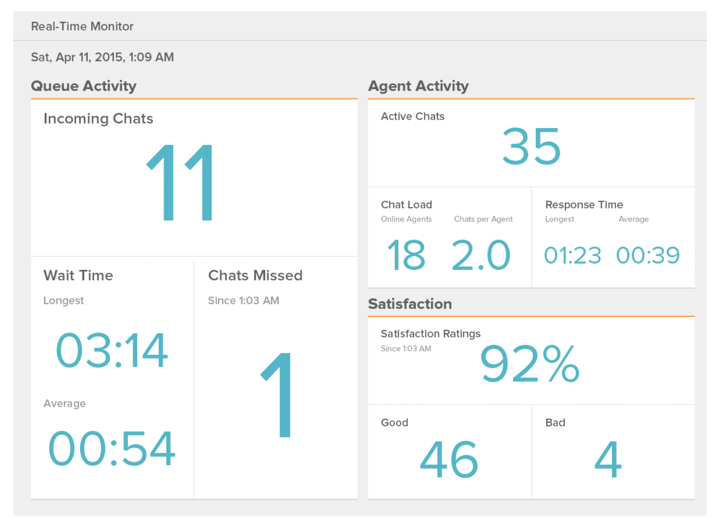
Live chat tools are exactly what they sound-they are a little widget on your site or app that allows people to chat in real time with your team. This is great for customer development, sales development, providing support, and finding problem areas in the design.


Zopim-screenshot
Here is real-time analytics from Zopim, a live-chat tool.


Session recording and heat mapping tools are great for seeing what your users are doing on your site or app. Want to know if your customers get stuck on a form? Or see if they scroll down far enough to see the final call to action? These tools can help and inform your design decisions in future iterations.


fullstory-screenshot
You can browse each individual user session in FullStory.


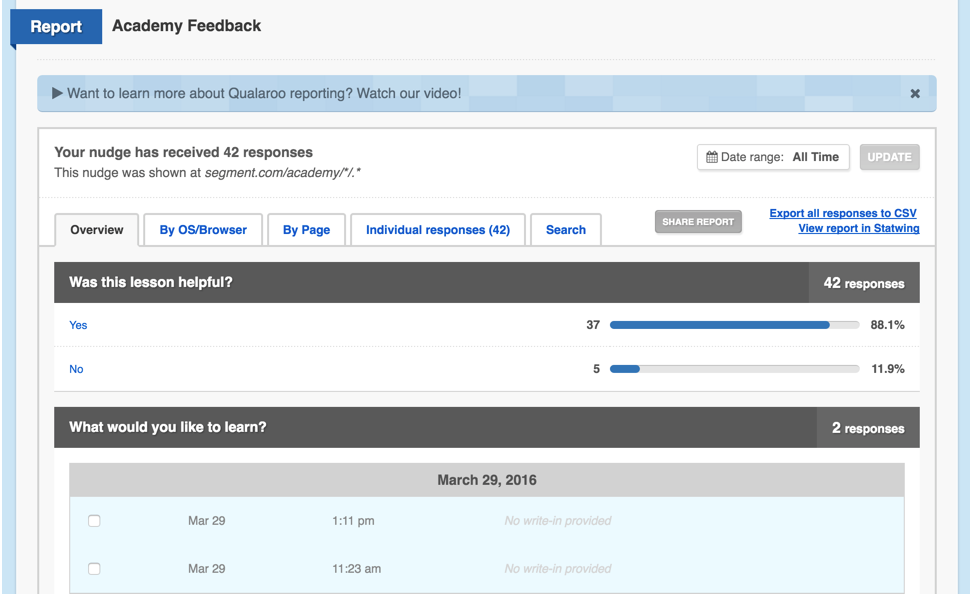
Surveys are another example of a qualitative tool. You can create little questionnaires that appear in a widget on the site. This is great if you don't want to be manning the chat box 24/7 and if you have a specific question you want to ask that requires minimal thinking for your users to answer. In our experience, if the live chat tools provide vague responses, then switching to a survey with pointed questions might help you generate better insights.


qualaroo-screenshot
Here are real results from the Qualaroo survey on Analytics Academy.


By leveraging a combination of these tools, you can quickly understand problem areas in the design of your app and fix them.


2. Send more personalized emails


If there is one thing to know about marketing, it's that there is no one perfect message-only targeted messages. Emails, push notifications, and display ads that speak more directly to the recipient will see higher engagement rates.


But how do you build an email list of your users that has the additional dimensions to allow you to make those segmentations?


Well, many modern email and push tools today allow you to do just that. These tools can collect additional traits (of your choosing), which then can be grouped together in the end tool.


Here are the common use cases of this:


  • Sending a coupon to all of your users who abandoned cart within a day or two (BONUS: retarget them)

  • If there was a bug that caused your mobile app to crash for a portion of your users, send them a specific email with a coupon or credits for an in-app purchase

  • Identifying users who click through all of your emails or scroll to the bottom of your blog posts.. send them a strong email to sign up!


For example, below is sample tracking code that you would send to Customer.IO, a popular email tool (here's a guide to other marketing automation tools):


```javascript
_cio.identify({
id: '1e810c197e', // must be unique per customer
email: 'bill@initech.com'
name: 'Bill Lumbergh',
plan: 'premium',
tps_reports: 5
});
```

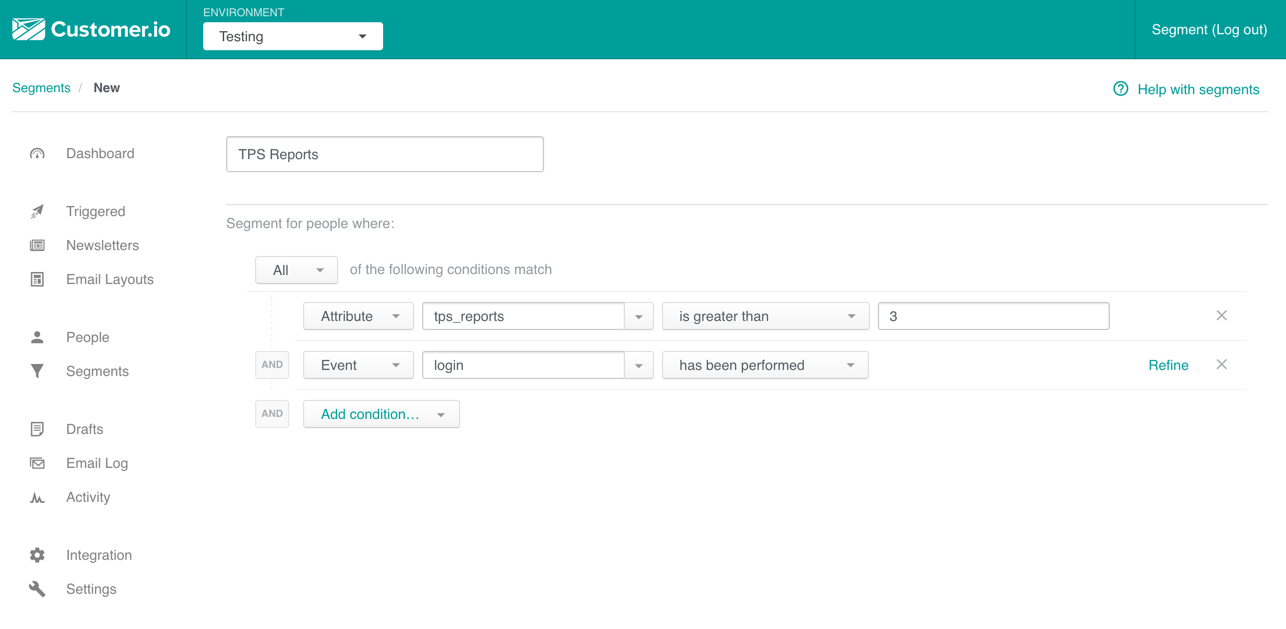
And here is how you would use those traits and events to create a unique segment of users to whom to send a custom email to:


customer-io-screenshot
Creating a segment of users who have created more than 3 TPS reports and have logged in.


Besides higher engagement in open and click through rates, your users will also appreciate and trust your brand if you only send emails that are relevant.


3. Prepare your customer facing team


We've all been on the wrong side of a call with our credit card companies, where we're repeating our mother's maiden name ad nauseum, after being transferred countless times to different departments.


The epitome of a terrible customer experience!


We're fortunate that modern companies now have learned from these gross injustices. Companies today equip their sales and support teams with customer data so that they don't have to put their customers through the same cumbersome exercise. By putting the data in front of the right person at the right time, companies can make that data actionable.


There are many ways to pull this customer data for your sales and support reps. Tools such as Zendesk and Intercom offer this ability to look at account data and usage out-of-the-box. Salesforce also provides the ability to create your own custom dashboards in the Account object view.


account-usage-dashboard-salesforce
A custom account usage dashboard embedded in a Salesforce page.


To learn more about embedding custom dashboards, here are two blog posts on getting custom product usage data into Zendesk and Salesforce.


How do I get started?


Fortunately, there are thousands of tools out there that can help you collect, analyze, and use customer data. But how do you know what tools to choose?


Here is a great guide that prescribes a framework to choose tools for your marketing and growth stack. And if you're on a budget, here is fantastic article about building a $9 marketing stack.


Kissmetrics is a great analytics solution that is geared towards marketing and growth. The customer data collected can allow you to perform granular analysis on any individual user, as well as group them in cohorts to look at activation and retention.


To learn more about using analytics to drive growth, check out Segment's free email course Analytics Academy!


About the Author: Andy Jiang works at Segment, a customer data platform developers and analysts love because of its elegant APIs and extensive partner ecosystem. He writes about using data to create delightful customer experiences that drive business growth. Follow him on Twitter at @andyjiang for product updates and lame jokes.


Is There Such a Thing As Work-Life Balance?

Is There Such a Thing As Work-Life Balance? written by John Jantsch read more at Duct Tape Marketing


Marketing Podcast with Carrie Wilkerson


Carrie Wilkerson via Twitter

Carrie Wilkerson via Twitter


Ah, yes, balance, now there's a goal.


But as a small business owner is it even possible?


No, I don't think so, at least not in the traditional 2 + 2 = 4 kind of way.


Balance for me is less about accounting for where you spend your time and more about how you spend your time and how that makes you feel.


So in that sense, you sure better love the work you are doing because you may spend more time at the best and worst job on the planet.


My guest for this week's episode of the Duct Tape Marketing Podcast is Carrie Wilkerson, speaker, consultant, author of the bestselling book The Barefoot Executive, and founder of CarrieWilkerson.com. We discuss work-life balance, managing stress and taking control of your life.


Questions I ask Carrie:


  • What does it mean to have the perfect work-life balance?

  • How can you remove the guilt cloud of the “Should-have-dones” off your mind?

  • How can you avoid the fear of missing out?


What you'll learn if you give a listen:


  • How modern lifestyle changes have added to this concept of work-life balance

  • Why work stress may affect women more than men

  • How to implement the discipline necessary to be more productive


This episode of the Duct Tape Marketing Podcast is brought to you by FreshBooks, small business accounting software for non-accountants. Freshbooks is offering a free month of unrestricted access just for Duct Tape Marketing podcast listeners. You don't even need a credit card to register. To get your free month, go to freshbooks.com/ducttape and enter DuctTape in the “How Did You Hear About Us?” section.