Please visit Marketing Land for the full article.


Did you know that businesses that use marketing automation to nurture prospects experience a 451% increase in qualified leads? According to the State of B2B Event Marketing study, events are the most effective tactic for B2B marketers to increase their sales pipeline and generate revenue.
So, how can events and marketing automation work together to bring in more leads, increase their sales pipeline, and ultimately generate more revenue? And, why are marketing and event automation essential lead generation tools for marketers, and why are these systems integral parts of any effective marketing strategy?
Here's an overview of how event management has evolved, how marketing and event automation work together, and why the two are integral components to any modern marketing technology stack.
60% of companies with revenue of 50 million or more currently use marketing automation. Being an effective marketer today means having access to rich and insightful data and having the ability to use this data to personalize customer engagement, automate lead nurturing, and drive up-sell and cross-sell activities. Marketing automation enables marketers to qualify and nurture large quantities of leads, capture customer intelligence across channels, and analyze the results of cross-channel marketing. With marketing automation, marketers eliminate operational inefficiencies and become more effective contributors to revenue in their organizations.
63% of marketers use in-person events as lead generation tools. Event Automation takes event management a step farther, by fully integrating marketing and event management systems together. Event Automation allows companies to automate, personalize, and measure event management and marketing activities, so they can increase marketing leads, sales pipeline, and revenue generated from events. Despite the growth in digital marketing, in-person events continue to play a critical role in enterprise marketing and make-up 28% of the total B2B marketing spend.
Marketers are no longer merely responsible for building creative brand campaigns. Success for the modern marketer hinges on credible revenue generation, and this requires a much more systematic approach to market engagement and a deeper understanding of technology. When the integration of marketing and event automation is not a part of the marketer's modern marketing tech stack, it is because in-person events have been treated as “offline marketing" and not integrated with online efforts and event objectives have not been fully developed in corporate marketing goals.
But in order for today's marketers and event professionals to deliver more measurable goals from events, today's marketing tech stack must be designed accordingly. Integrating marketing automation and event automation helps event planners and marketers deliver personalized experiences for attendees, sync attendee data into marketing automation platform to send them follow-up material, and deliver credible ROI from events.
Once you have a solid marketing automation platform, you need to have an enterprise-level event automation system that is capable of easily integrating with your marketing platform. Events no longer need to be left on the sidelines of the marketing automation and marketing analytics world.
When we take our marketing activities offline through events, we shouldn't lose sight of our customers. Instead, the goal for marketers should be to create a fully immersive and engaging customer experience with their brand, messaging, and activities at an in-person event, and to capture all of this rich data within the systems we use to analyze and leverage it.
To learn how to increase your sales pipeline and generate more revenue from events, download The Deep Dive Guide to Integrating Marketing Automation and Events.


Want more conversions?
Well, it's possible.
However, the first step is realizing that conversions are people. And those individuals desire a remarkable customer experience.
The key is to remove barriers in the sales cycle. This includes cumbersome checkout processes and poor follow-up sales procedures.
Your SaaS team must perform better. It's one of the best ways to crush the competition.
“Successful sales people, and successful sales teams, exhibit a superior ability to eliminate the common barriers that would otherwise prevent their prospects from making buying decisions,” writes Bob Apollo, managing partner at Inflexion-Point Strategy Partner.
“They take pains to identify how and why their prospects choose to buy, and what they need to do to straighten the path and remove the obstacles that might stand in their way.”
Earn more sales. Solve these five obstacles blocking your SaaS conversions:
Do you remember that classic Tootsie Roll commercial? The one that challenged kids to answer the question: How many licks does it take to get to the center of a Tootsie Roll Pop?
Kids would literally waste an entire afternoon counting their licks.
Your SaaS team should ask a similar question. How many clicks does it take for a customer to convert?
People don't enjoy time-consuming tasks. And if they're ready to buy, prospects don't want to spend the next 15 minutes clicking through all your useless sales steps.
“Asking your users for a lot of information even before they've seen your app could backfire.
Marketers tend to get greedy with information, but the more info you require, the more friction you introduce. If you're asking for more information up front, make sure to justify each action to eliminate friction,” states Sadhana Balaji, a product marketer at Chargebee.
So, limit the number of steps it takes for a prospect or free trial user to sign up for your service.
According to MarketingSherpa, “by optimizing step one of its sign-up funnel, 1-800-DENTIST lifted conversions by 23% in less than a week.”
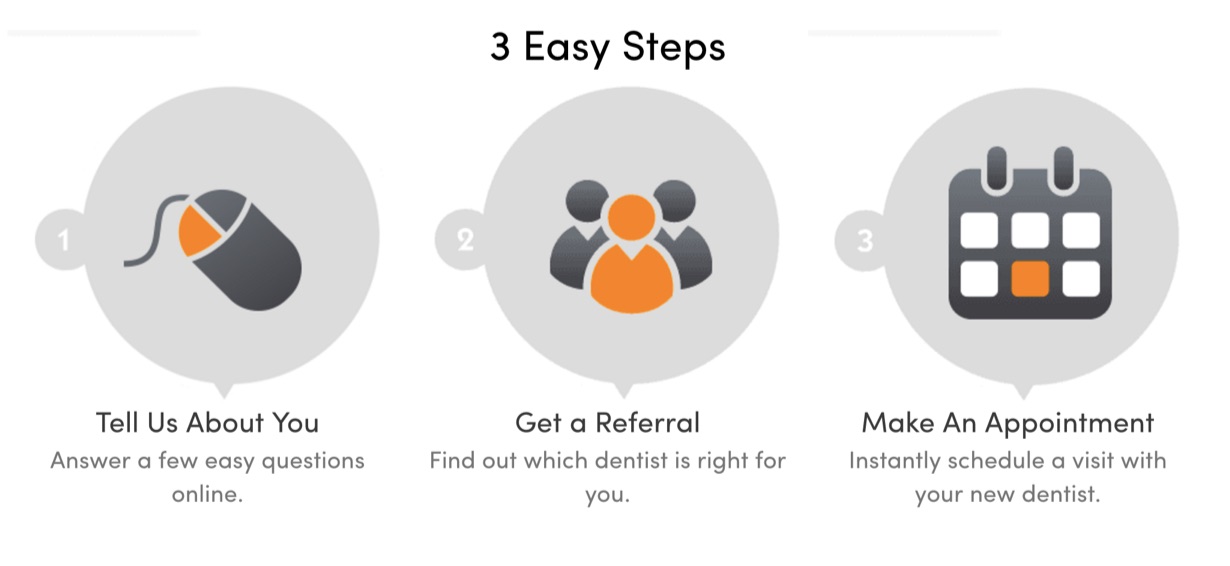
Moreover, as you decrease the steps in the process, consider eliminating the multiple add-on features during initial setup.
Studies show that “contrary to economic belief that more choice is better, confronted with too much complexity, we make bad decisions, or stick with what we have already got.”
Thus, overwhelmed prospects may just abandon their sale completely.
Save the customer time and boost your revenue. Remove the 12-step signup process.
People are different. We don't think the same. We don't eat the same foods. And the needs of a 20-year-old woman are different from an 80-year-old man.
This concept holds true within your target audience. Prospects are buying your products for different reasons. Some may desire the all-in-one platform, while others love the 24/7 email support.
Use your customers' differences to your advantage. Start segmenting.
Segmentation helps your team sell specific product benefits to different users.
“If you are looking for segmentation ideas, a great place to start is by asking the sales team about the various roles and buyers they speak to on a regular basis…Use the information you gather from sales to create segmentation strategies that will resonate with your audience,” states Anna Talerico, executive vice president of ion interactive.
The goal of segmentation is to customize the shopping experience. You want prospects to feel like you're talking directly to them.
Graphic design tool Snappa sends targeted emails to their subscribers based on their position in the sales funnel. Here's an example of their process flow diagram:
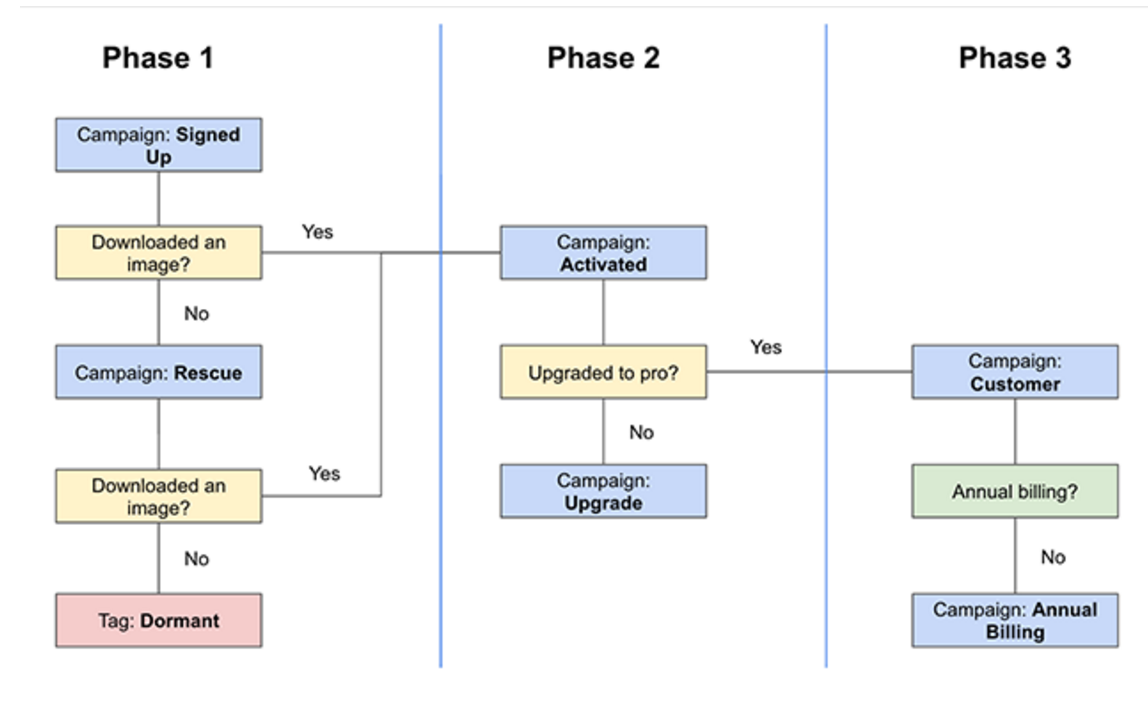
“Marketing leaders must have a single view of the customer that allows them to engage in two-way, personalized conversations across technologies, locations, and physical objects at mass scale,” says Joydeep Bhattacharya, author of Seo Sandwitch Blog.
Don't get stuck selling everything to everybody. Differentiate your message.
Research reveals that “65% of B2B marketers have not established lead nurturing campaigns.” Without a clear path, your SaaS team may be causing more harm than good.
Poor lead nurturing results in unethical sales practices, missed deals, and negative brand image. No one wants 10 voicemails in a day from a salesperson.
Rather, strive to educate and build a relationship with your prospective user. That means informing them about your product, not selling.
“It's about giving the right content to the prospect at the right time, and you can only do this by watching for signs that they're progressing through the buying cycle. This is done through lead scoring…,” says Sarah Burke, content writer and marketer at Spokal.
Learn where the buyer fits into the sales process. Then, adjust your lead nurturing efforts accordingly.
The image below details the types of content that fit the buying cycle. Top of the funnel prospects may desire video, while the bottom of the funnel consumers may need quotes.
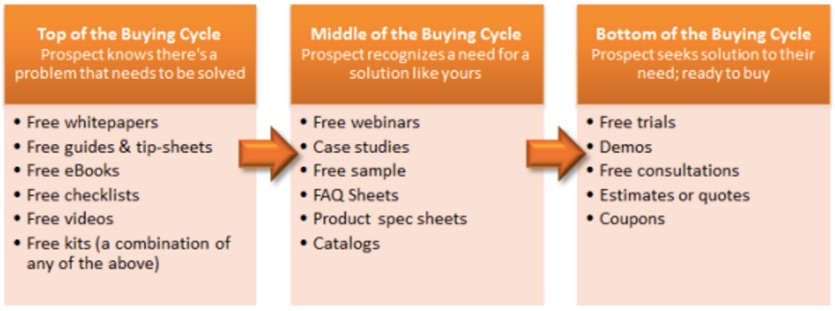
Moreover, lead nurturing is built on trust. If buyers don't trust your brand, it's time to add some social proof to your sales message.
“Trust badges are also known to increase conversions. Getting a BBB seal can put people at ease knowing that you've been vetted by one of these organizations. You'll also want an SSL certificate to show that your payment gateway is secure and trustworthy,” writes Sid Bharath, an entrepreneur and growth hacker.
Sell with the intention to build relationships.
Studies indicate that “91% of organizations said they aspire to be among the customer experience leaders in their industry, yet only 37% had started a formal CXM (customer experience management) initiative.”
To jumpstart your CXM program, figure out what value you offer your users. It should be clear and concise.
Aim to make an emotional connection between your product and the consumer's needs.
Invision's value proposition is simple. The SaaS offers people the opportunity to design and collaborate efficiently. They want their customers to design with confidence.
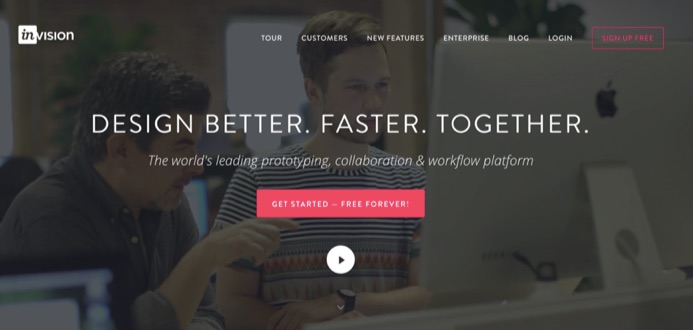
Kevin Dewalt, a startup founder, investor, and advisor, suggests offering incentives to portray value. He states:
“Offer additional purchasing incentives to customers who complete Acceleration events to get them to convert early. Examples of purchasing incentives are coupons, annual contracts, or special offers. Or simply tell them to enter a credit card now so they don't lose service.”
Take control the customer experience. Show the value of your service.
Adobe reports that “38% of people will stop engaging with a website if the content/layout is unattractive.”
Customers want eye-catching websites. Your design must grab and hold their attention.
In addition, with loads of information at buyers' fingertips, it is rare for someone to call a sales department.
So, if customers don't like what they see, they may just leave. That's why your sales page must explain your product and address your consumer's concerns.
“As buyers spend more of their time self-educating before contacting sales…the pricing page of SaaS websites has reached critical importance in the buyers' journey for enterprise SaaS sales..,” writes Brian Devaney, inbound marketing strategist at New Breed Marketing.
Unbounce's sales page is an exemplary example. It tells prospects what they will receive and the prices. And the layout is clean with ample white space.
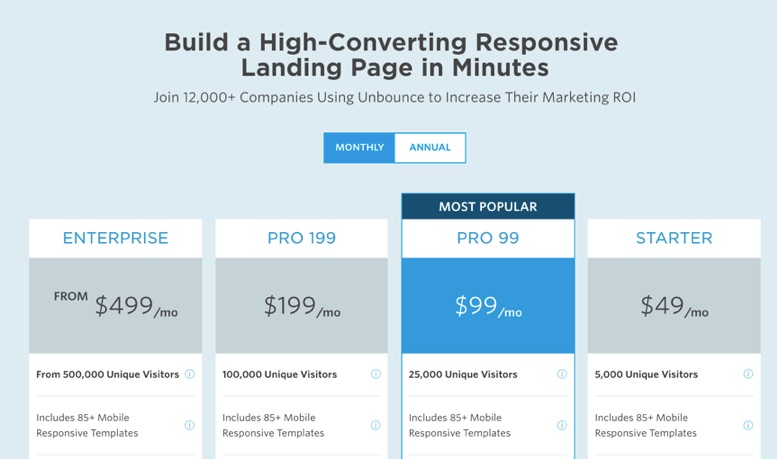
Evaluate your sales page. Is it time to change the copy or the layout?
Eliminate the roadblocks in your sales cycle. Gain more users by improving the overall experience.
Ditch the multiple steps to sign up. Stop mass selling with one message. And revamp your sales page from the customer's perspective.
Get rid of the obstacles. Start converting.
About the Author: Shayla Price lives at the intersection of digital marketing, technology and social responsibility. Connect with her on Twitter @shaylaprice.


The post Online Marketing News: Snapchat Unicorns, Periscope Moderation and Instagram Business appeared first on Online Marketing Blog - TopRank®.


What's a marketer to do? We heard that influencer marketing was the next big thing. We heard about companies getting amazing results with it. But it seems you can't go anywhere online recently without seeing headlines like this:
And this:
Note the social shares on those two articles: 242,000 for the first one and nearly 50,000 for the second one. If influencer marketing is burning down, that's a lot of people standing by with marshmallows to roast.
But don't panic. These two articles, and many more like them, refer to a specific kind of influencer marketing. Generally speaking: the bad kind. Specifically, the practice of writing massive checks to teenagers with a lot of followers on Instagram or Vine in exchange for product promotion. That particular economy, which converted cash to “influence” or “awareness,” was pretty much doomed from the start. You're in trouble any time you convert real money to something fundamentally unmeasurable.
But it's not fair to say that influencer marketing is dead, or in trouble, or collapsing because bad influencer marketing isn't working out. That's like declaring “Movies are dead!” because Gods of Egypt flopped at the box office. Influencer marketing works when it's done well. At TopRank Marketing, we have achieved amazing results for our clients with the practice.
The only thing better than learning from your mistakes is learning from other people's mistakes. So let's take a moment to mourn the passing of bad influencer marketing-and then let's perform an autopsy to see how we can avoid their fate. Here are four ways to make sure your influencer marketing stays alive and well:
#1 – Build Relationships
In a way, the Instagram and Snapchat “influencers” are just billboards. You stand here and hold this beverage/face wash/protein powder, we give you $500. You deliver the commodity of X number of eyeballs for the money. If a rival beverage/face wash/protein powder company comes along and offers you $550, you move on.
Good influencer marketing is more than advertising using someone's social media presence as the billboard. It's about cultivating an ongoing relationship that continually generates value for everyone involved. Influencer relationships should be built with care, personal attention, and respect. Yes, sometimes you may pay an influencer for their involvement, but that transaction takes place in the larger context of the relationship.
#2 – Produce Something of Value
Bad influencer marketing can be, at its worst, just a celebrity endorsement with a different kind of celebrity. The celebrity gets paid, and the audience gets… what? The vicarious thrill of seeing that they drink the same brand of face wash as that guy on Vine?
Good influencer marketing goes beyond endorsement to create something of value for the audience as well as the influencer and the brand. That's why it works. For example, our Content Marketing World eBook series from last year rounded up advice from dozens of highly-skilled marketers. The eBooks promoted the event, and they highlighted our influencers, but they were also useful and entertaining for the audience. It's an unbeatable combination.
#3 – Recruit More than Brandividuals
One big problem with bad influencer marketing is it focuses entirely on “brandividuals.” According to our CEO Lee Odden, a brandividual is someone who is in the business of being popular. They have a huge social media presence, sure. But they may not be able to call that audience to action. A true influencer, by contrast, may be less popular by the numbers, but is credible, authoritative, and able to affect change.
You definitely can use brandividuals to help attract a crowd, and to lure in the true influencers-but a campaign that's all brandividuals may generate more buzz than results.
#4 – Make It Measurable
Step 1: Have influencer post about our combination face wash/protein powder on Snapchat. Step 2: ??? Step 3: Profit. It's not the most sustainable business model, right? But for a lot of bad influencer marketing, that's a pretty accurate assessment. These campaigns trade entirely on “awareness” or, god forbid, “brand lift.” Without any way to track ROI from the influencer activity, it was only a matter of time before the C-suite decided to spend their budget elsewhere.
Don't let anyone tell you that you can't measure the ROI of influencer marketing. It's not only possible; it's crucial. Start by having a specific goal for your campaign-an action that you want your audience to take as a direct result of experiencing the content. Then make sure you can track that action and attribute it to the influencer. Give them trackable URLs to share. Give them their own landing page to send traffic to. Either way you go about it, you should be able to demonstrate exactly what your influencer brought to the campaign.
If you're a teenager with a huge Snapchat following, the death of bad influencer marketing is bad news. If you're a marketer looking to partner with influencers to create cool stuff and expand your reach, there's no need to mourn. Take these four lessons to heart, go forth, and be awesome.
Need help with your influencer marketing, we can help!
Gain a competitive advantage by subscribing to the
TopRank® Online Marketing Newsletter.
© Online Marketing Blog - TopRank®, 2016. |
Influencer Marketing Is (not) Dead: How to Breathe New Life into Your Program | http://www.toprankblog.com
The post Influencer Marketing Is (not) Dead: How to Breathe New Life into Your Program appeared first on Online Marketing Blog - TopRank®.

Relationship Building : How to Expand Business Network written by Guest Post read more at Duct Tape Marketing

photo credit: Pixabay
A relationship building activity in business is a far cry from building personal relationships. Yet, business relationships do have some similarities that clearly require good interpersonal skills and communication. When it is time to expand a business network, it takes a bit of planning and design to affect seamless relationship building activities. To learn how to build a relationship of this nature, there are several precursors to define. These include:
Networking is defined by a host of inclusives. These can be business and industry associates, a loyal clientele, links to community organizations and a well-structured plan of public relations. To learn how to build a relationship, a business must first study the “reflection in the mirror” of the business image. What does that reflection say about the business? Is it customer friendly or somewhat detached and indifferent? The importance of the steps to learn how to build a business relationship can be a catalyst to greater expansion of the business network. For example, the first step to build business relationships is “outreach.” This simply implies the method by which the business intends to draw together a close relationship with clients. Other steps of outreach to clients can include hosting onsite programs or online programs. It can also include special events.
The most important feature of outreach is “familiarity” with each client on an individual basis to learn their needs and their buying impulses. When the business is familiar with its clients, this is a free exchange in which clients also become familiar with the business. This leads to a reliable clientele of buyers.
It may seem ironic that a business must rely equally on local as well as online communities to expand the business network. Putting a face to the business name is crucial to increase business reputation.
Consider the benefits of a networking event. In many industries, a networking event ensures greater real-time visibility than might be afforded through online contact alone. For example, ANTEC is a networking event attended by plastics engineers for over 70 years. It is attended by thousands of technicians, R&D scientists, professors and students and engineers, as well as tech support, sales, and marketing specialists, manufacturing managers and supervisors. This event provides exhibits, presentation of technical white papers and a host of program presenters linked to the plastics industry. Attending this international event expands the business network through exchanges of ideas and information between industry business leaders and other interested individuals. It takes nearly one year of planning that begins with publicity and registration at local levels of business. This shows the local business community the extension of each related business to the wider range of business potential.
Corporations have long been involved in external events and activities that show a deep sense of corporate social responsibility to the community. Many organizations are recipients of the benefits of corporate social responsibility to the community. For example, the Dow Jones facility located in South Brunswick, NJ shows its corporate responsibility to the community through its Family Center in Monmouth Junction, NJ. Another example is the corporate healthcare giant, Johnson & Johnson, each year this corporation sponsors an “Energy Coloring Contest” for children. However, Johnson & Johnson annual provides charitable donations worldwide to communities to promote women's and children's health with programs such as “Mom and Baby”, “TB Free World”, and “AIDS-Free Future.” This shows how deeply ingrained corporate social responsibility to the community has become.
On a more local level, small businesses regularly connect their businesses to networked associations like Chambers of Commerce where events like “Aligning Business Goals with a Healthy Workforce” and the “Invest in America Summit” held in Washington DC bring together leaders in businesses from local chamber members. The importance of local fundraising events by charities like Catholic Charities, Aleph Institute and Salvation Army and civic groups such as the International Lion's Club, Rotary and Elks, all provide community outreach sponsored by local businesses and corporations.
There are seven relationship building activities businesses can do to build relationships and get involved with the community. These include:
Study the tips on building relationships and the activities that promote better business relationships between clients, vendors and business networks. With a little effort, expenditure of time and dedicated funding, businesses find they enjoy a greatly expanded business network for the long-term.


Knowledge about your customers' preferences at specific moments is critical to unlock the marketing potential of contextual intelligence today's digital marketplace provides. By studying and applying buyer personas and qualification to marketing processes marketers can learn more about customers' preferences. Personas can be leveraged across several departments such as sales, marketing, advertising, and customer service. But the task of actually creating the ideal buyer personas for your business can be a daunting one.
However, B2B marketers are faced with the uphill task of making sense out of data from several systems, both online and offline, internal and external. They are grappling with the fact that the always-connected buyer's behavior and preferences are constantly evolving, and marketers need to maximize the value of customer data in near-real time for better targeting and personalization, as well as to build lifetime value.
Identifying the right buyer persona requires the consideration of several attributes (demographic, psychographic, etc.) in order to make conversations relevant. Just like in the B2C environment where customer expectations of personalization and targeted content most relevant to them are now critical factors in accelerating their decision making, similarly B2B buyers also expect the companies or brands they interact with to know them well and identify their needs and goals.
A data management platform (DMP) combines online and offline data from first-party proprietary systems, and second-party and third-party audiences to provide marketers with a central platform that stores and helps provide insight regarding audience and campaign data that is used for optimizing campaigns and media spend across channels.
It is also deployed against cross-channel campaigns to better inform, for example, nurture programs within an organization.
With the help of a DMP, a marketer can manage and analyze audience profile data to better inform ad targeting through modeling, implement retargeting campaigns for better direct response, and optimize site performance using customer behavior data. It also enables marketers to add analyzed audience data into marketing automation systems, for example, to help B2B marketers receive a more informed view of their customers.
Download Audience Data Management: Driving Top-of-Funnel B2B Prospects Through Digital Advertising and learn more about how B2B marketers can get better targeting and deeper insights by utilizing a DMP.


