Please visit Marketing Land for the full article.


Freedom is an expression that you'll hear a lot this week as we celebrate America's independence. Our forefathers had a vision for a country that provided citizens with certain rights and responsibilities for themselves and their neighbors.
Marketers today have a unique opportunity to sign their own declaration of independence to free themselves of tired content marketing tactics. This is a declaration that removes antiquated approaches to content marketing and instead focuses on creating value for their customers in a way that builds a better future.
Recent research has found that over 80% of marketers are creating content ,which means that the competition for customer attention is becoming increasingly difficult. Now is the time for marketers to break free of tired content tactics and begin creating more memorable interactions with customers. As continue to execute and refine your approach to content marketing, make sure that you avoid making the following mistakes.
In the past, many brands spent time creating content for their website that only provided detailed information about their products and services. Today, the companies that are creating content that speaks to the pain points of their customers are the ones that are winning at content marketing.
Today's savvy and connected customers have countless options available to them which means that marketers must spend their efforts providing helpful resources that focus on solving the top pain points that customers are facing.
Imagine for a second that you wanted to buy a specific type of firework to celebrate the 4th of July with your family and friends. In order to find the best location for purchasing your fireworks, you did some research online. However, once you got to the actual fireworks stand, nothing matched what you found online. Instead of finding the fountains and rockets that your family had their heart set on, there were only snakes and poppers.
When brands fail to provide accurate information and a consistent user experience across multiple channels, it creates an unpleasant experience for their potential customers. We now understand that often times it takes multiple touch points to convert a customer which means that no matter where they are interacting with your brand online, they should be provided with accurate information in a consistent way.
Once you get into a habit (any habit) it can be incredibly difficult to break. It can be easy for brands to get in a rut with their content marketing tactics because let's face it, once you understand how to plan for, execute and measure a particular tactic, it becomes more comfortable each time.
Don't let this get in your way of experimenting with different content types that may appeal to your audience. There is no one-size-fits-all solution and it's important that your content team is experimenting and innovating in a way that keeps your customers engaged. Different content types that you may want to experiment with include:
It doesn't matter if you're selling B2C or B2B products or services, at the other end of every purchase is a person that is driven to make a buying decision. While a company's content could very well be optimized for search engines in a way that makes them findable, that doesn't mean that it's optimized for their buyers.
Once a potential customer reaches your website, offsite content or social profile, you have a very limited amount of time to create an impression. If they can't see themselves in the content, then they will quickly abandon your content in favor of a content that better suits their needs.
In order to stand out, you MUST create content that tells a compelling story in a way that moves your audience. We are visual learners so it's also important to include visuals that help create a connection to your text content
You have the freedom to constantly delight your customers and innovate the way that you approach content marketing. Don't be content with the status quo.The bar for content quality is constantly being raised so it's incredibly important that you take every step necessary to create compelling content that connects you with your customers.
What other tired content marketing tactics would you like to see your brand (or other brands) break free from?
Gain a competitive advantage by subscribing to the
TopRank® Online Marketing Newsletter.
© Online Marketing Blog - TopRank®, 2016. |
Celebrate Your Freedom From These 4 Tired Content Marketing Tactics | http://www.toprankblog.com
The post Celebrate Your Freedom From These 4 Tired Content Marketing Tactics appeared first on Online Marketing Blog - TopRank®.


Many small business owners today think that owning a brick-and-mortar business excuses them from having to learn and master digital marketing.
Nothing could be further from the truth.
In fact, mastering SEO and local optimization for your locally run business will bring a higher ROI than just about any other marketing activity you use.
It's one of the quickest ways to quickly and simply (notice I did not say easily) get your business in front of thousands of new eyes and earn customers for life. With a few simple steps, you can set yourself on the path to long term digital marketing success.
But how do you start marketing your brick-and-mortar business in the digital world? What steps do you need to take over the next 30, 60, or 90 days to successfully grow your online reach and increase sales like you have never seen before?
I'm glad you asked.
In this article, I'm going to give you a step-by-step and day-by-day plan for marketing your brick-and-mortar business.
Thirty days from now, if you follow the steps I've outlined below, you'll be well on your way to having a successful and profitable local marketing plan in place.
The irony of digital marketing is that the simplest steps are often the most important.
Sure, PPC advertising, advanced Facebook campaigns, and AdWords can play a huge role in boosting your sales. But what's next?
For brick-and-mortar business owners, particularly owners who don't think they are very “tech savvy,” following these simple steps for the first ten days alone will result in a huge increase in the number of sales they see from their marketing budget.
Something I have found with many brick-and-mortar businesses is that the owners think that having a website is an unnecessary luxury.
Nothing could be further from the truth!
Having a place for all your customers and fans to congregate is one of the simplest and most important steps on your path to success.
The first step to mastering local SEO is the simplest one. Give your audience a place to find you!
Notice that almost none of these shops have websites that come up in Google…
For the first 10 days of this master plan, focus on building your website and ensuring it has a great design. After that, focus on 1-2 social media platforms.
That's it.
Creating presence on a couple of platforms that are easy to navigate and even easier to find is the first key to your marketing success.
Once you develop your website, set up your Facebook page and a Twitter or Instagram account. Then, the real work begins.
And what is that “real work?”
Creating quality content.
One of the fallacies many entrepreneurs believe is that simply having a website with some on-page SEO is enough.
But that's not how Google works, and that's not how people work either.
If you want to attract new customers and build a loyal fan base, you need to place a premium on creating and curating high quality content.
Look at the bottom of the image above. Ramit has 241 PAGES of content on his blog.
I've got 162 pages of blog articles on Quick Sprout.
Content is huge.
But how does this apply to marketing a brick-and-mortar business? Here's how…
Let's say you own a coffee shop in Boulder, Colorado.
You take the first 2-3 days and pay to create your website-design it to look great and navigate easily. Then you set up your Facebook page.
Now, it's time to start populating your website and your social media with killer content.
Continuing with the coffee shop example, the next step would be to start writing articles or filming videos based on your niche.
You could write an article about the best locations for growing coffee or about 3 unconventional brewing methods you can try today, or you could film a video showing people how to do cappuccino art.
The list of things you can do is endless.
By creating this content you will improve your chances of ranking on Google, and you will also start providing free value to customers, which will increase their trust and their desire to give you their business.
Now that you have a great website and are regularly uploading content and sharing it via social media, it is time to increase your email subscriber list. That's where the real money is made!
The key to a successful lead magnet is to offer something that a customer would be willing to pay for-but free.
An excellent example of a lead magnet is from Lucky Brand (above).
Back to the coffee shop…
A great marketing method used by many successful brick-and-mortar owners is the free giveaway.
If someone has found your site or is in your store, offering them a free coffee or pastry (which they would normally pay for) in return for access to their email is a win for both parties.
They get something free. You get a direct line to market your company.
Once you have collected the email, you can start sending updates about specials you are running, events you are putting on, and other cool things happening with your business.
Anytime you have a special event or a 2-for-1 deal, people will actually know about it. They will then take advantage of it.
Many brick-and-mortar business owners make another mistake when delving into the world of SEO. They don't fully understand the difference between “regular” and “local” SEO.
The biggest difference is that local SEO contains a geographical aspect. This geographical information is crucial in “convincing” Google that you're a bona fide local company serving local people.
The entry into local SEO may seem a little bit more complicated than normal SEO. Why? Because it's no longer just about the keywords. There's an element of mystery.
The result? You may have experienced this yourself. Few businesses execute local SEO efficiently.
However, in my opinion and experience, local SEO is easier. Why? Because there is less competition!
Don't worry. I'll remove some of the mystery and help you understand how it works.
Here are some of the essential ways to get started on your path to local SEO mastery.
These two tools are absolutely instrumental for successful on-page SEO.
There is a ton of information you will be able to gather about your website from these tools. Using them effectively will allow you to run tests, analyze the results, and make changes as necessary.
Here's how to set up Google Analytics.
Here's how to set up Search Console:
While this may not seem like a big deal, it is one of the quickest ways to accidentally shoot yourself in the foot with your SEO pursuits.
What's NAP?
It's the Name, Address, and Phone number of your business.
If you do not have the EXACT same Name, Address, and Phone Number on your website that you have on your Google My Business account, you will basically ruin all the hard work you have put into mastering local SEO.
Let me give you a few pointers on doing the NAP portion right.
Make sure the phone number listed is your local number (no 1-800 numbers).
Make sure the NAP info is listed as text on the page and not as an image. You need web crawlers to read the information. They won't be able to do that if it's in an image.
Include the NAP info in your website footer if possible. This means it will be visible on all pages.
If you've had a different name, address, or phone number in the past, find the variations anywhere on the web and correct them. You don't want to confuse users or web crawlers. NAP consistency is important!
For on-page optimization, this is one of the most important steps you can take.
The first step is to make sure your title tag includes these three things:
It is easy for this to come across as spammy and artificial, so put some time and effort into this before you hit “Publish.”
For example, these websites are perfectly setup for local SEO success:
If you're looking for some more inspiration, check out this article for a list of local SEO-optimized title tags.
Next, you want to optimize your meta description.
The meta description is what appears beneath your title tag. It explains a little bit about your company and what you do. The meta description appears in the SERPs to help users understand what they're about to click on.
I recommend that you include your city, state, keyword, and phone number for maximum efficiency.
A meta description doesn't technically improve your SEO. It's designed for users. However, user behavior does influence SEO, so it's still important to optimize this bit of information.
According to one study, Google said that 54% of smartphone users who search for a local business are searching for the hours of operation. And 53% wanted directions.
The simplest thing to do is simply put an “Hours of Operations” or “Business Hours” heading and image next to your maps widget.
This will make life easier for your customers. Plus, it will make Google love you.
While it doesn't directly influence your local SEO ranking, including customer testimonials really helps. Adding BBB ratings, integrating Yelp, or citing other highly trusted sources will build customer trust.
In the example below, The Worthwhile Company cited their “Small Business of the Year” award from the local chamber of commerce. Information like this helps local residents to feel a greater degree of trust in the business.
Social proof also decreases your site's bounce rate, increases the views on your site, and likely increases your opt-ins-all things Google is looking for.
By following all the above advice, you will likely see an increase in your SEO ranking and the number of emails you collect within the first 30 days.
Things will move slowly at first.
That's okay.
These things take time. Slow and steady wins the race.
The final step is to continue producing great content that you can rank on Google. Educate yourself on more advanced local SEO tactics you can start implementing. Most importantly, keep your customers happy.
The more satisfied customers you have, the more people will share your site with others, the more email opt-ins you will receive, and the better your business will be.
All that's left to do is sit back and reap the rewards of a job well done.
And of course, keep on hustling.
To many entrepreneurs, SEO seems like a black box. And local SEO? It's even more of a mystery.
Often, it's viewed as something to be feared, something far too complicated to get involved in, and something that you sure as heck don't have the required experience to excel at.
My hope, however, is that after reading this article, you'll realize that SEO is just like any other skill. With a few simple tweaks, you can massively improve your local business's results for years to come.
So, take this advice, and implement it. You'll see the results for yourself.
What's your experience with using digital marketing to drive a brick-and-mortar business? Share your worst mistakes or best tips!


Today's SaaS customers are savvy.
Old marketing tactics don't excite them. And features disguised as benefits are easily recognized.
As technology evolves, consumer behavior changes as well. Buyers expect quality products backed by efficient service.
This is an opportunity for your business to experiment with new strategies and cater to customers differently.
“As marketers, it's essential to pay attention to consumer behavior and to be creative within the constraints of each marketing channel we use,” states Ash Read, content crafter at Buffer.
Start selling like it's 2016, not 1916. Here are five things you should know about today's customer.
Adweek reports that “81% of shoppers conduct online research before buying.” With access to more information than previous generations, consumers are taking the time to do their homework.
Customers want to know if your product is actually worth their money and time. And to gain that insight, they look for reviews.
Products reviews are vital in online shopping. They offer an honest perspective from a current customer's experience.
Take advantage of this trend. Post reviews from customers on your product pages. Consider creating case studies to showcase how customers benefited from your services.
Unbounce offers their prospective buyers a collection of case studies. Below is a snapshot from the website:
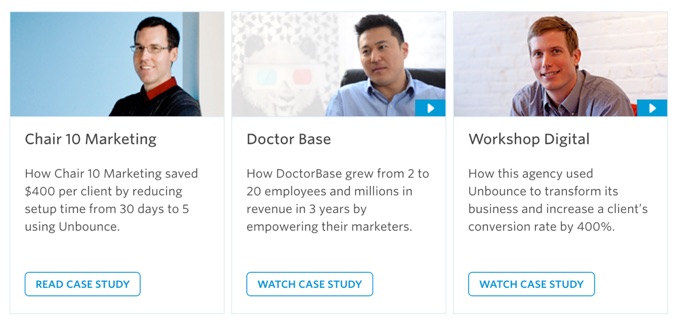
“Businesses that want to generate leads online should focus on making their websites a top destination for information with custom content. People use search engines and social channels to learn about items before purchasing, whether they're shopping for themselves or their businesses,” states Lauren Kaye, marketing editor at Brafton Inc.
And potential buyers aren't just interested in learning about your product. They want to learn about your whole brand.
How are you treating your SaaS employees? Do you use locally sourced suppliers? Are you donating to charities on an annual basis?
Your brand's overall image is important to buyers. So, make your company's information readily available.
Quality, results-driven products will always outweigh more features. People want reassurance that your services will do more good than harm.
Customers possess explicit and implicit performance expectations. That includes anything from specific product features to service benefits.
For example, if your software experiences an outage, will the problem be solved in a few hours? And do your offer 24/7 customer service?
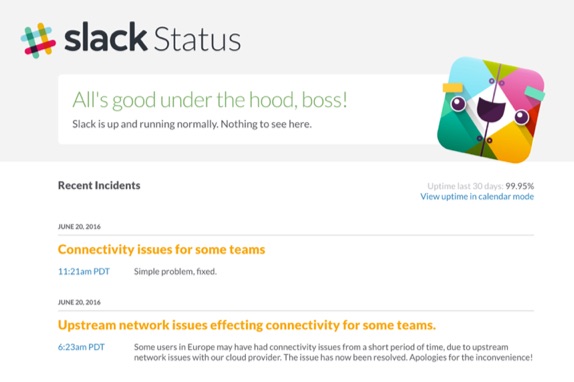
Quality is a win-win situation. Consumers receive what they desire. And your business has the opportunity to charge customers more.
“Customers desire the best product and service quality and are willing to pay a premium for it. High reliability is assumed,” says Ken Dooley, founder of Madison Productions.
For quality to exist, your entire team must be on the same page. Inform employees on how their actions impact the customer.
“Transparency on quality measures helps create buy-in on quality management and enables employees to understand what role quality plays in how they do work, how they can impact quality, and its effects on their customers' satisfaction. Transparency breeds accountability at the most basic level…”, writes Holly Lyke-Ho-Gland, research program manager at APQC.
Quality is dependent on the customer's perception. Figure out what they want. Then, work with your team to create a transparent strategy.
SaaS customers want solutions to their problems today, not tomorrow. With next day shipping and one-click subscriptions, buyers consider speed a minimum standard.
This benchmark holds true for customer service. And buyers are accustomed to using fast communication tools.
“Today's customers are media agnostic, having grown up using the phone, email, Web chat, IM, and social media interchangeably. They are comfortable, and may even prefer, communicating online versus face to face or over the phone,” writes Laura Bassett, director of marketing at Avaya.
Some businesses consider speed a downfall. But your customers may think differently.
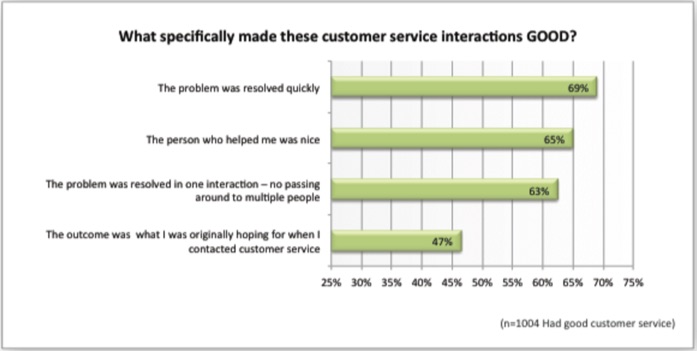
Zendesk found that “69% of participants associated their good customer service experience with the quick resolution of their issue.”
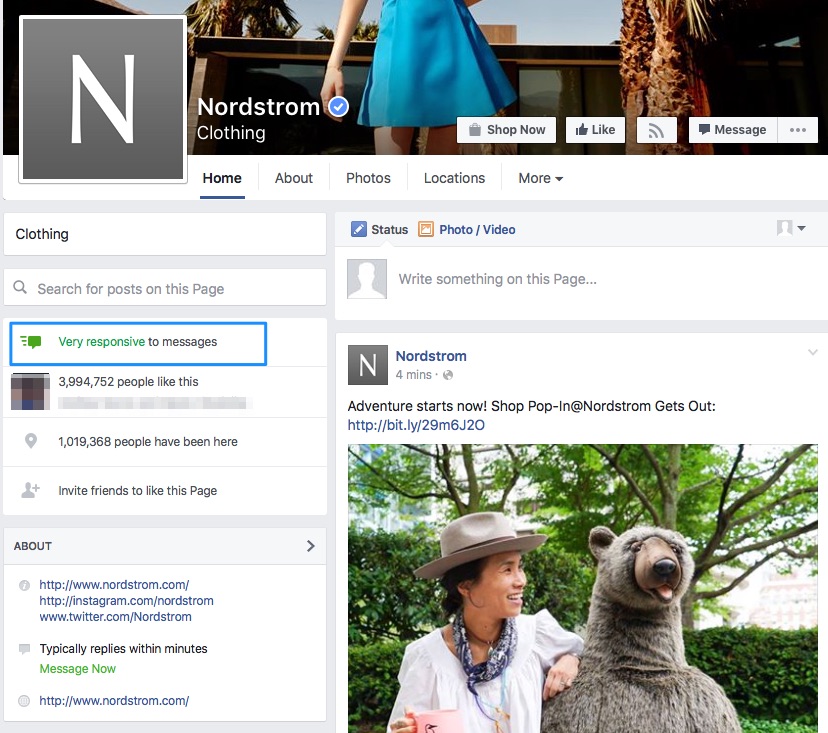
To encourage speedy response times, Facebook also offers brands an opportunity to earn a page responsiveness badge. Companies that respond to 90% of their received messages within five minutes get the designation.
But offering fast service isn't a new strategy. Innovative businesses have always strived to perform better.
“Forward thinking companies realized how much customers hated being on hold while waiting for a service rep that they invested in technology that would automatically call a customer back when it was their turn,” states Shep Hyken, a customer service expert.
So, start responding to your customers' questions in a timely fashion.
Trust is the foundation of all relationships. The same is true between your company and customers. Buyers want to know that your website won't disappear after they swipe their credit cards.
Plus, consistency eliminates brand confusion. And builds upon your previous success.
“By maintaining the same branding across all your resources – both online and offline – your customers will be able to recognize you much faster and will, hopefully, start to show loyalty to your brand,” says Kelly Haggard Olson, creative content strategist at Blue Zoo Creative.
Research shows that “45% of a brand's image can be attributed to what it says and how it says it.” Consumers prefer a consistent brand experience, whether talking to a salesperson or shopping on your website.
Beth Pop Nikolov, content strategist for Venveo, offers a good analogy:
“When you're getting to know a person, you start to develop opinions, ideas and assumptions about them based on your interactions. If they are dressed in a business suit one day, bermuda shorts and a ratty T-shirt the next and then a scuba diving suit another time, it may be hard to nail down exactly who they are and what they are all about.”
Align your marketing and sales team to ensure the same messaging is communicated to consumers. Talk with your customer service reps to streamline quality across all channels, including live chat and email.
Give your customers the trust they deserve. Be consistent.
Boring isn't cool anymore (and it never was). SaaS consumers want one-of-a-kind experiences to share with their colleagues.
Adding novelty to your marketing mix demonstrates creativity. It sparks customers' interests and gets them to pay closer attention to your brand.
Sid Bharath, an entrepreneur and growth hacker, states, “We all want new experiences. We want to see new places, meet new people, and use new products. So don't stop creating something new. Create new products, create new features, create new content, and give your customers new experiences.”
Build originality directly into your company. For instance, how can you enhance your loyalty program?
Coffee maker Nespresso entices their loyal customers with personalized orders, delivery, recycling and customer-service options.

“Put a smile on their face and in their heart. You can do something special for their child, their parent, and their pet. Make them laugh, thank them in a showy way for a major purchase, have a contest or a drawing for something fun that they could share with family and friends,” says Sydney Biddle Barrows, New York-based business consultant.
Go the extra mile. Surprise your customers with your latest product or a free trip to your next conference. Give them an experience worth sharing with others.
Customers are smart. False promotions or useless features don't fool them.
Learn how to meet your customers' needs. Make product information readily available. Offer quality that can't be found elsewhere. And give them a unique experience.
Be in the now. Know your SaaS customer.
About the Author: Shayla Price lives at the intersection of digital marketing, technology and social responsibility. Connect with her on Twitter @shaylaprice.


Before I get to my thoughts on why CMOs need to be bullish on programmatic advertising, let's first take a look at just what programmatic advertising is.
We define it simply as “Automated advertising buying coupled with machine learning.” However, there are no shortages of definitions of the term programmatic advertising.
“Programmatic ad buying typically refers to the use of software to purchase digital advertising, as opposed to the traditional process that involves RFPs, human negotiations and manual insertion orders. It's using machines to buy ads, basically.” -Digiday
“Programmatic advertising helps automate the decision-making process of media buying by targeting specific audiences and demographics.” -Marketing Land
The first definition helps explain it in very simply terms whereas the second helps explain what it does.
In terms of the different types of programmatic advertising, according to the Interactive Advertising Bureau (IAB)-which is an industry organization geared toward ensuring standards across the advertising ecosystem-there are two types of programmatic buying (the process in which you're buying advertising):
1. Programmatic Direct
Also known as Premium Programmatic Advertising, this is an automated technology-driven method used for buying, selling, or fulfilling advertising. It provides for an Automated Guarantee Systematic automation of sales process. No insertion order (IO) or master services agreement (MSA) covered within the partnership.
2. Programmatic Real Time Bidding (RTB)
Two types of RTBs are Open Auction (audience targeting) and Private Marketplace Deals-which require a private marketplace and allow for fixed pricing and data overlays. We are beginning to see more and more of this type of programmatic advertising being used every day.
The shift to programmatic tactics means a few things for marketers and the industry as a whole. In essence, it has validated and delivered against the need for data-driven, and accountable ROI-based media delivery. Additionally, it has enabled an efficient method for publishers to monetize core inventory.
In a nutshell, programmatic advertising aligns media with brand lift metrics for real ROI and only spends money where it will be effective.
And it would appear that many of your fellow CMOs are planning on being bullish as eMarketer predicts that in 2016 programmatic TV spending will climb 127.8% to $710 million and by 2018 will account for 6% of all TV ad spending.

The New Currency of Advertising
Digital delivery and content is the new currency of advertising. Brands must find a way to connect while measuring returns on more than recall or click through rate (CTR). Only programmatic platforms can deliver that value.
Download The Programmatic Guide for Modern Marketers, Publishers, and Media Planners to learn how to deliver advertising that enhances the customer experience and a lot more.


