Monday, October 3, 2016

Email Marketing: What's Really the Issue With Confirmed Opt-In?

It's been an interesting couple of weeks in the discussion surrounding confirmed opt-in (COI) and the direction that the industry is headed. I wrote about the inevitability of confirmed opt-in becoming the standard at some point in the future. The discussion began with a rash of Spamhaus listings, which were supposedly generated from a list bomber. We didn't discuss the merits of how the “list bomber” got the Spamhaus trap addresses, whose anonymity are key to their credibility.


We didn't talk about how the “list bomber” targeted mainstream marketers who used larger ESP's. We didn't talk about just how Spamhaus knew exactly which marketers to list. I bet you didn't tell Spamhaus if you were hit by this. You can draw your own conclusions from what's been written, and also what hasn't been written. It was also interesting timing for this to “randomly” happen just before the holiday period.


So, it's out there, and one could argue that this was a concerted effort on behalf of someone to drive senders to this practice. The funny thing is that COI isn't even a radical concept anymore. Think about when you purchase or sign-up for many programs these days. You get a please confirm your email address, confirm your subscription, or confirm your preferences message right away.


Companies do this for the security of their customers. They don't want to send your information to the wrong person, just because someone made a typo. COI is already a common email practice. You sign up for a Gmail account, and you have to confirm your email address. Nobody sees that email and freaks out, it is standard operating procedure.


Pradeep Mangalapalli, Director of Deliverability Operations, wrote a post last week which highlighted some extensive metrics that we pulled from across the marketing universe (Not just Oracle, we looked at senders regardless of ESP). We found that these campaigns perform at a very high level. Open rates are high, and read rates are also very strong. The spam complaint rate for these types of email is almost zero.


That's because we understand that for the most part, these messages are now part of the expected back and forth conversation with someone we are doing business with, or interested in receiving information. Affiliate marketers have been confirming permission for years, because they were trying to avoid those previously mentioned complaints.


If you are a marketer who doesn't want to do COI right now, that's fine. But I would encourage you to ask yourself (and your team), what are you really afraid of? We've established that consumers understand the process now. That wasn't the case 3 or 4 years ago, but it's basically mainstream these days. I would propose that the real issue isn't the actual COI, but a fear that you are going to lose subscribers.


If that is really the case, it is not because of the COI itself, but some other probably more important issues. What does it say if you think 75% of your subscribers won't click a link in an email whose only purpose is to protect your security?


Maybe they don't know they were “signing up” for your program. Is the user afraid they are going to be bombarded with email they don't want? Is it the fact that you aren't converting 100% of address to your list? Just because you have an email address doesn't mean it wasn't faked, made-up, mistyped, or is a valid address at an account they will just never check.


Would you want an ATM card that didn't have a PIN number, or a credit card where you didn't have to verify a signature? There's a reason why you have to activate a credit card you receive in the mail. You activate it so in case it falls in the wrong hands, there's a step required before that shopping spree. Clicking a link is so much easier.


If you fall in the category of “scared of confirmed opt-in” I would suggest you look a few levels above a simple email. Why would your customers not trust clicking a simple link that protects them and you as a sender from many dangerous elements?


The answer is most likely not the confirmation email, but something else that is probably already costing you money. You can wait until something like CASL comes along and freak out about the “changes” you must make at the last minute, or just fix the leaks today.


Another thing you could do is download Email Deliverability: Guide for Modern Marketers to find out how to achieve email deliverability that really delivers. 


Facebook Organic Reach is Dying: Here's Why It's a Good Thing

Facebook reach

More and more our News Feeds are full of updates from friends… not companies - but there are benefits to this. Image via Shutterstock.

Facebook wears many hats. It does everything, and is everything. It's where we turn to celebrate many important life milestones, share our lives with our friends, organize events, consume media and much, much more. But for marketers, it's an advertising tool.


Social media marketing has changed a great deal over the past few years. One of the biggest changes is Facebook's shift away from organic reach into a paid marketing channel.

If you manage a Facebook Page, I'm sure you're familiar with this subject, and you've probably noticed a sharp drop in the number of people who are seeing and interacting with your content organically.


As a marketer, this change has been tough to stomach. It's now much harder to reach your audience than it was a few years ago. And with recent updates that Facebook is, again, shifting its algorithm to focus on friends and family, it'll be harder still to reach people who are already fans of your page.


Facebook organic reach is hard

TFW you can almost reach your audience… but not quite. Image via Giphy.

Before we dive into why the plight of organic reach is a good thing, let's first take a look at what brought along this decline in the first place.


Want more awesome content to help you crush your marketing goals?

Sign up to get the latest digital marketing tips delivered straight to your inbox.

By entering your email you'll receive weekly Unbounce Blog updates and other resources to help you become a marketing genius.
Understanding how social reach is declining


In 2014, Social@Ogilvy released its much-cited report, “Facebook Zero: Considering Life After the Demise of Organic Reach.”


In the report, Ogilvy documented the harsh decline of organic reach between October 2013 and February 2014. In that short period of time, organic reach dropped to around 6% for all pages, and for large pages with more than 500,000 likes, the number was just 2%.

Ogilvy graph

Based on this data, a Facebook Page with around 20,000 fans could expect fewer than 1,200 people to see its posts, and a page with 2 million fans would, on average, reach only 40,000 fans.


The reasoning behind this change from Facebook's perspective is twofold, as Facebook's VP of Advertising Technology, Brian Boland, explained in a blog post.


The first reason for the decline in organic reach is purely the amount of content being shared to Facebook. Advances in smartphone technology means we can now create and share this content with just a few swipes of the finger or taps on a screen. More and more of our friends and favorite brands are also active on the platform, meaning competition for attention is higher. Boland explains:


There is now far more content being made than there is time to absorb it. On average, there are 1,500 stories that could appear in a person's News Feed each time they log onto Facebook. For people with lots of friends and Page likes, as many as 15,000 potential stories could appear any time they log on.


The second reason for the decline in organic reach on Facebook is how the News Feed works. Facebook's number one priority is to keep its 1.5 billion users happy, and the best way to do that is by showing only the most relevant content in their News Feeds.


Of the 1,500+ stories a person might see whenever they log onto Facebook, News Feed displays approximately 300. To choose which stories to show, News Feed ranks each possible story (from more to less important) by looking at thousands of factors relative to each person.


To a marketer, this may feel like a negative, but it's actually a good thing, because what we're left with now is a far more powerful marketing tool than we had when reach was free.


Let me explain…


Why the decline of organic reach is a good thing


When a social network first achieves mainstream popularity (think Facebook circa 2009, Instagram in 2014-15, Snapchat in 2016) organic reach rules the roost. As a marketer, it's all about figuring out what content your audience craves and giving it to them.


Then, we hit a peak, and suddenly the social network all but transforms into a pay-to-play platform - bringing with it another huge marketing opportunity. At Buffer, it's something we like to call The Law of the Double Peak:


Buffer double peak

Facebook hit the organic peak in 2014, and since then reach has declined to a point where it's almost at zero now. But, on the other hand, we're left with a far more powerful advertising tool than we had before.


It's also important to remember that before social media - with print, radio, TV, banner ads, direct mail or any other form of advertising - there was no such thing as organic reach. You couldn't create a piece of content and get it seen by thousands (even millions) with no budget.


Facebook, now, is probably one of the most cost-effective digital ad products we've ever seen. It's the best way to reach a highly targeted audience and drive awareness about your product or service, and probably an even better marketing channel than it was back in 2012 when organic reach hit its peak.


4 ways to maximize the paid marketing opportunities on Facebook


Once you're over the fact that not everyone on Facebook gets to discover your brand for free anymore…


1. Ensure your ads are relevant


With more than 3 million advertisers all competing for attention in more than a billion users' News Feeds, Facebook uses what's called an ad auction to deliver ads.


The ad auction pairs individual ads with particular people looking for an appropriate match. The social network's ad auction is designed to determine the best ad to show to a person at a given point in time. This means a high-quality, hyper-relevant ad can beat an ad that has a higher advertiser bid, but is lower quality and less relevant.


The two major factors you need to work on to ensure Facebook sees your ad as relevant are your targeting and ad creative.


For example, if you're targeting a broad audience such as men and women, ages 18–25, living in the United Kingdom, chances are your ad may not be relevant to every person. However, if you were to break your audience down into smaller, more specific groups your message may be more relevant (and therefore successful).


2. Test different messages and creative


There are endless opportunities for testing on Facebook Ads: titles, texts, links, images, age, gender, interests, locations and so on.


The image is the first thing people see when your ad shows up in their News Feed. It's what grabs their attention and makes them stop and click, which means it's essential to get the image right. Though, you probably won't hit the nail on the head first time 'round. Thankfully, Facebook allows you to upload multiple images for each advert and optimizes to display best performing ones.


Your creative can have a huge difference when it comes to conversions. AdEspresso recommends coming up with at least four different Facebook Ad variations and then testing each one. For example, you might test two different images with two different copy texts (2 images x 2 texts = 4 variations).


AdEspresso also found that creative with a picture of a person performs far better:


Facebook ad variations

When you create ads, plan out a number of variations - changing copy, images and CTAs in order to discover what works best for each audience you're targeting.


Want more awesome content to help you crush your marketing goals?

Sign up to get the latest digital marketing tips delivered straight to your inbox.

By entering your email you'll receive weekly Unbounce Blog updates and other resources to help you become a marketing genius.

3. Be specific with your content


Combining the first two points above, targeting to a specific segment using creative that is specifically built for that target audience is incredibly powerful.


Many businesses have a range of customers, all with slightly different needs. For each customer your business is targeting, jot down as much information as you can about them and try to form a few customer personas to create specific ads for.


Then, with your target personas in place, think about how you can use Facebook Ads to target each individual group. This could mean creating an ad set for each group and testing different images and copy within your ads to see what works best for each group.


By tailoring ads to specific personas, you can vastly improve your advert's relevancy and also serve the needs of your customer better.


4. Pay attention to real metrics


With social media, it can be easy to fall into the trap of measuring only soft metrics - the things that don't correlate directly with sales or revenue growth, but can still be good indicators of performance. On Facebook, this means things such as Likes, Comments and Shares.


When it comes to paid marketing channels, like Facebook Ads, it's important to have some solid goals in mind and pay attention to the metrics that translate into your ultimate goal. For example, having a post receive a few hundred Likes or a high engagement rate could be seen as success, but that's probably not the ultimate goal of your campaign.


Paid advertising on Facebook is a lot like paid-for marketing has always been. For 90% the end goal is sales or, for larger companies, brand awareness. And with paid-for ads you'll want to be a little stricter with yourself when it comes to measurement. That's not to say ALL advertising on Facebook must be purely focused on selling - that strategy likely wouldn't work - but certainly any specific advertising campaigns should be focused on increasing your bottom line.


How do you use Facebook?


I'd love to hear your thoughts on the evolution of Facebook as a marketing channel. How have your strategies changed over recent years? Are you one of the 3 million businesses who advertise on the platform? I'd love to hear your learnings and perspectives too.


Thanks for reading! And I'm excited to join the conversation in the comments.


Announcing the Updated Kissmetrics Funnel Report

The Kissmetrics Funnel Report is our most popular report, and for good reason.


Seeing where potential customers drop off and segmenting traffic to find the most valuable marketing channels are game changers for businesses.


And today we're announcing new features in our Funnel Report that will make it even more powerful.


Let's start with the new design.


1. More Flexible Design


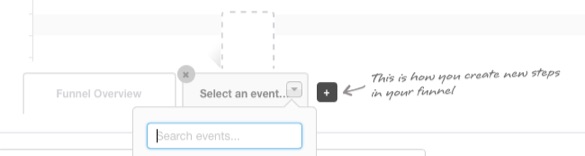
Previously in the Funnel Report you'd create steps horizontally, like this:


adding-steps-old-funnel-report


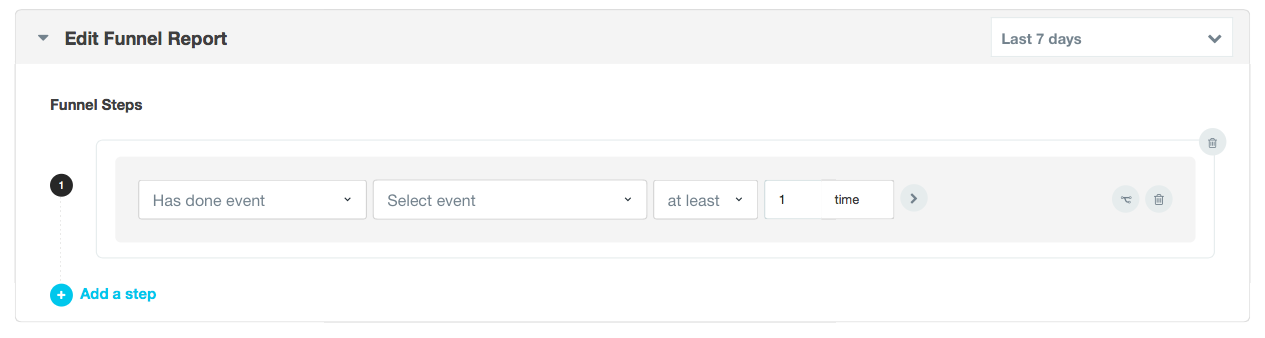
Now, to be consistent with the design of our People Search, we've changed the layout so you'll create steps vertically, like this:


adding-steps-new-funnel-report


This new design flow allows for greater flexibility of some new features we've added (more on that later).


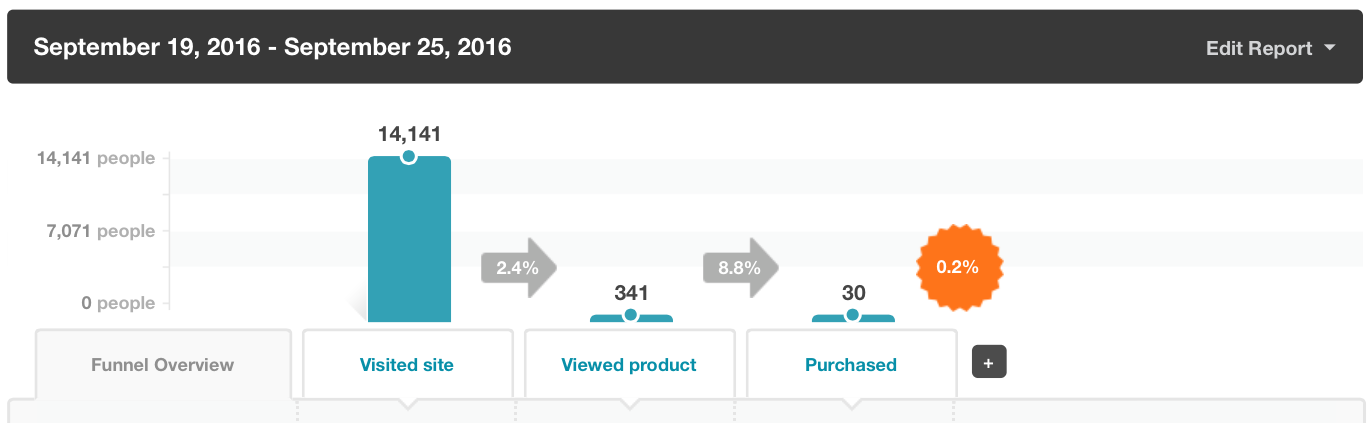
The visualization has also been updated. Instead of seeing something like this:


old-kissmetrics-funnel-report-design


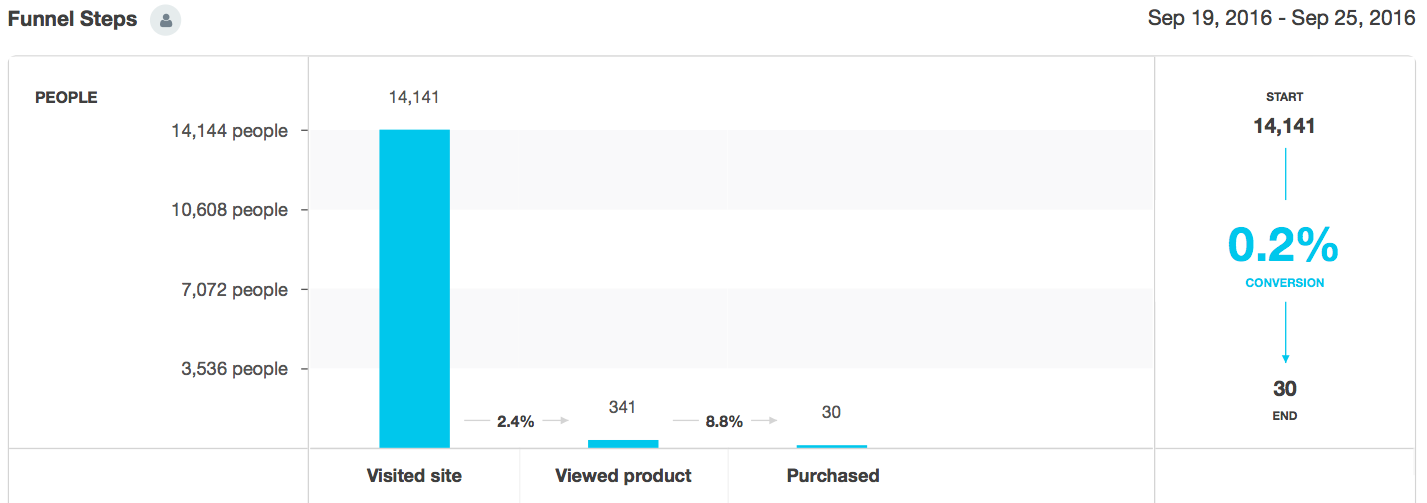
You'll see this:


new-kissmetrics-funnel-report-design


Finally, many of our customers have four or more steps in their funnel. In our previous Funnel Report, there was no way to easily see a funnel with five or more steps.


Now it's as easy as scrolling side-to-side to view additional steps:


sliding-in-kissmetrics-funnel-report


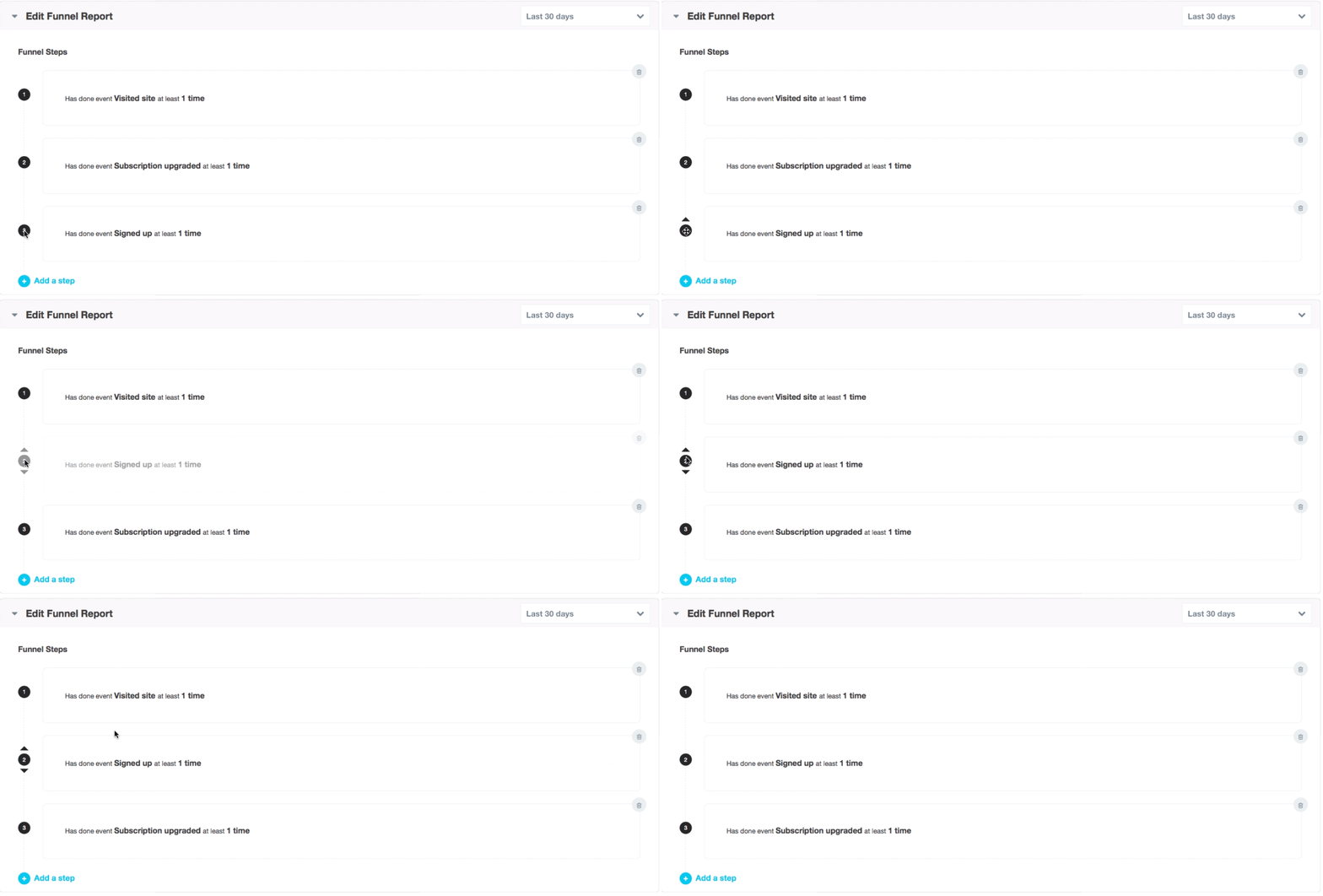
2. Drag and Drop


Did you accidentally create your steps in the wrong order? With the drag and drop feature, you don't have to go back, delete steps, and then re-create them. You just drag and drop the steps into the correct order.


drag-and-drop-kissmetrics-funnel-report


3. And/Or Conditions


Let's say you're a marketer for a SaaS company. You have two ways for visitors to get in touch with your sales team. They can request a demo or sign up. You want to know which one is more effective at driving people to start paying for the product.


Now you'll be able to see people who have done both events or one or the other. So, in our case, we'll create a funnel report that looks for people who have visited the site and then signed up or requested a demo.


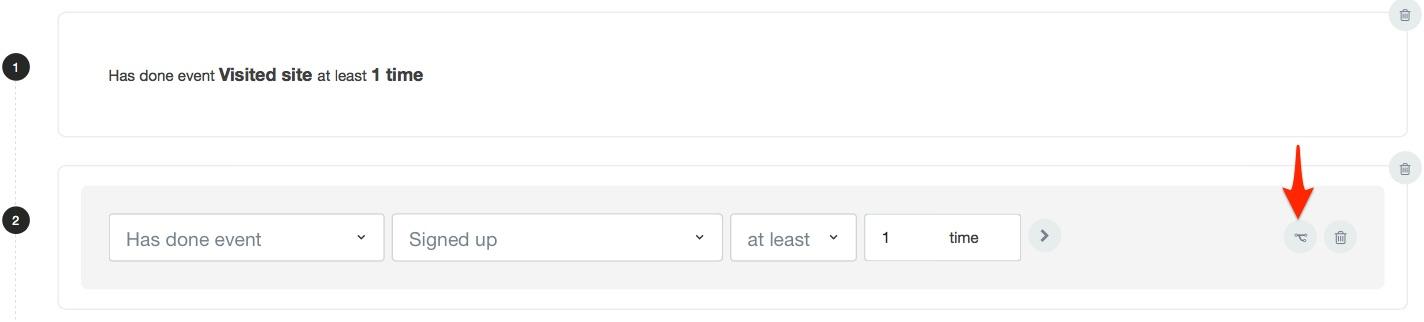
We'll create our first step, Visited site, and fill in the second event, Signed up. Then we'll add a condition by clicking on the button that the red arrow is pointing to:


and-or-funnel-report


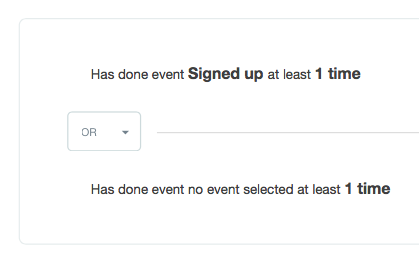
Click on that button and we'll get to choose and/or conditions.


and-or-dropdown-kissmetrics


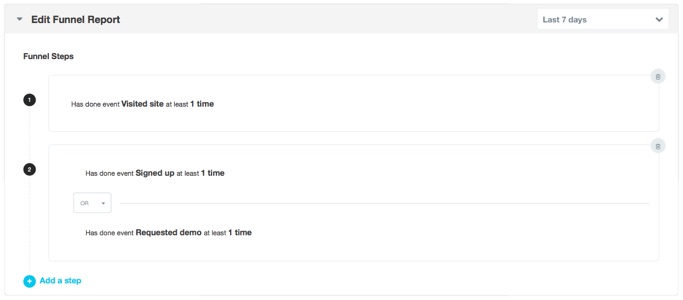
We'll keep it as or and add the event Requested demo. This will ensure that regardless of whether a person signs up or requests a demo, they'll be included in this funnel.


visited-site-signed-up-requested-demo-funnel


We'll run the report and get our data:


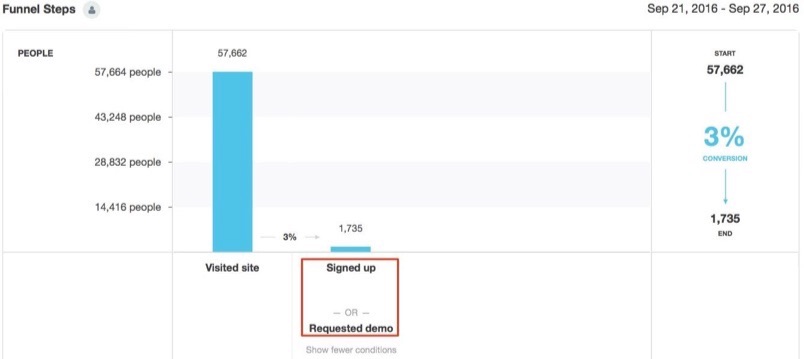
signed-up-or-requested-demo-funnel


You can see that Signed up and Requested demo account for a 3% conversion rate.


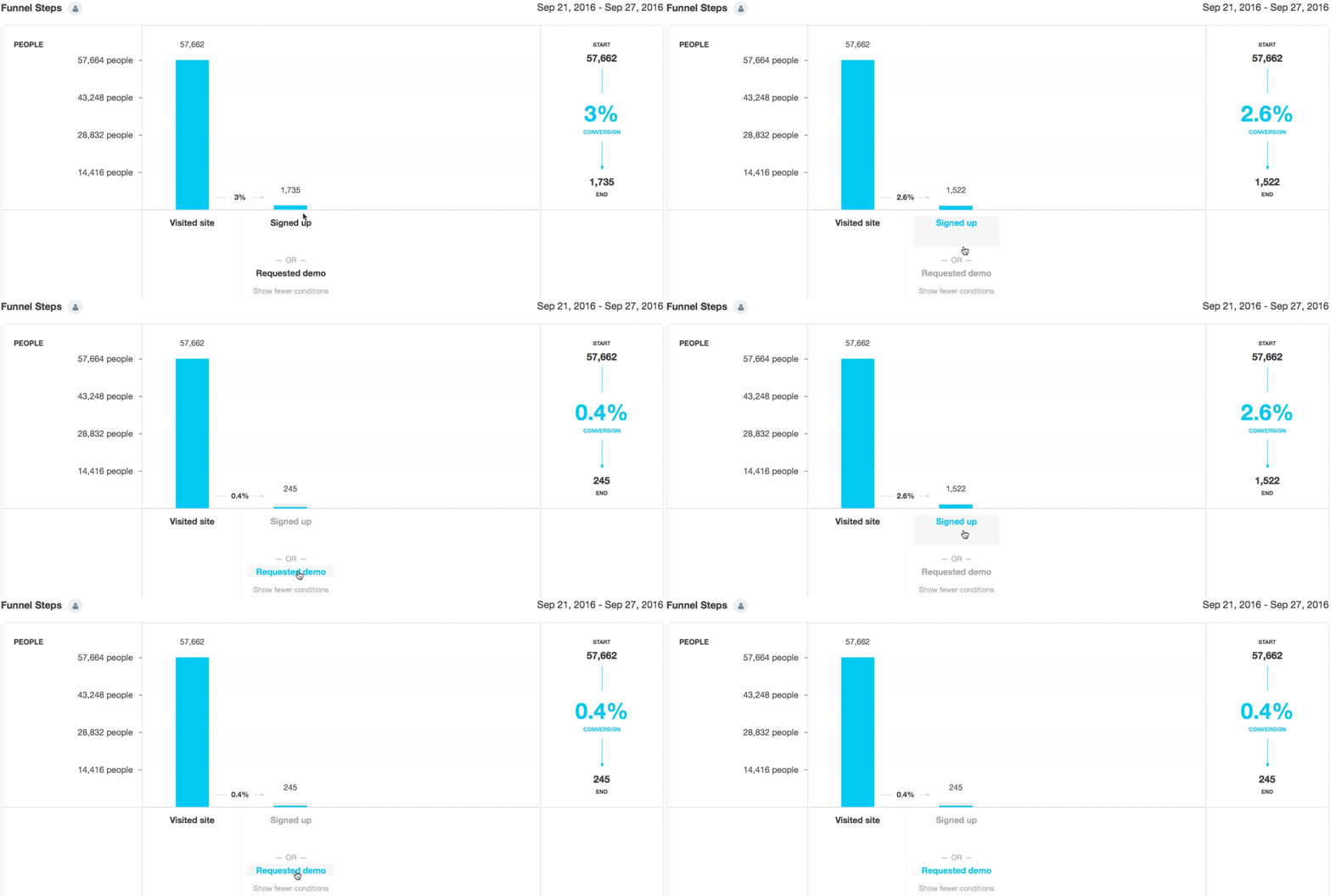
Want to see the individual numbers for each? No problem, just click on one of the two, and the Funnel Report will show you.


comparing-funnels-kissmetrics


We can see that we're getting a lot more signups than demo requests.


We can take this even further by adding additional steps to our funnel report to see how one condition may affect the funnel. Let's continue using this example to illustrate this important point.


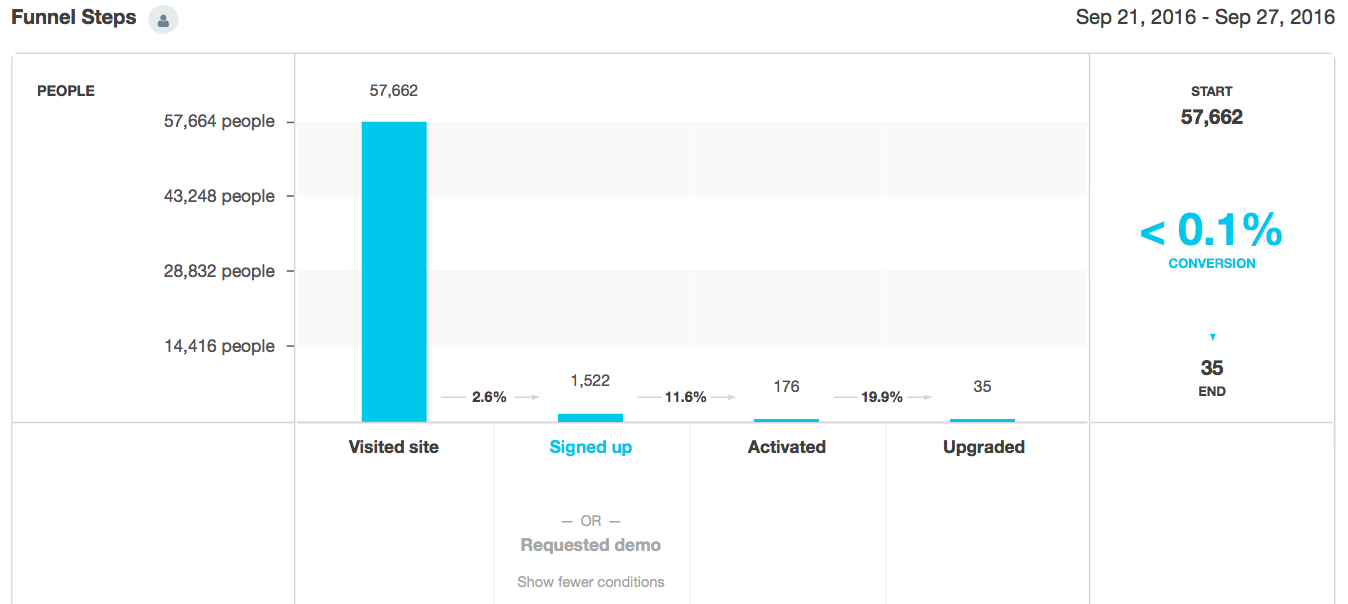
If the next steps after Signed up or Requested demo are activating the product and then upgrading, we can see how each condition affects the funnel. Let's first look at how the funnel performs when people sign up:


comparing-funnels-new-funnel-report


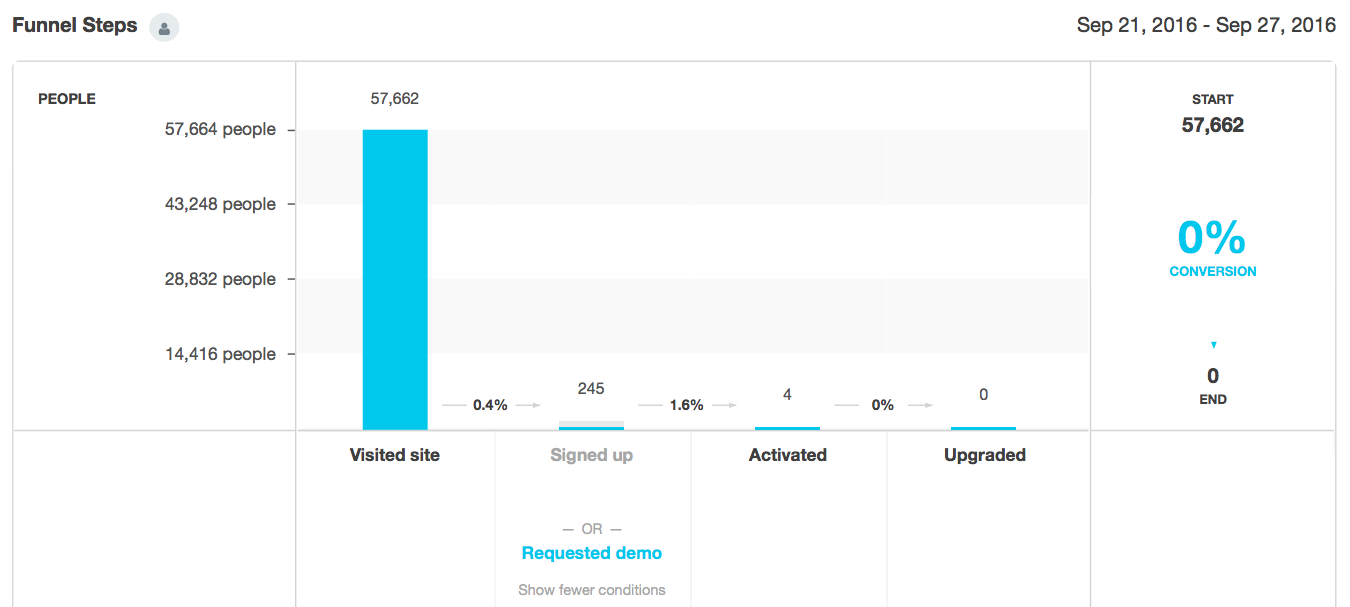
And now we'll compare that to demo requests:


comparing-funnels-new-funnel-report-2


Big difference! We can see that while 245 people requested demos and 4 of those activated the product, 0 of them continued along in the funnel to paying for the product. All the success of the funnel is due to signups, not demo requests. As marketers, we now know we should focus more of our attention on driving signups and not demo requests.


Now let's do something similar with a property. We'll look at all the signups and demo requests that came from San Francisco. Here's how:


Click on the arrow sign next to the condition:


add-property-to-event


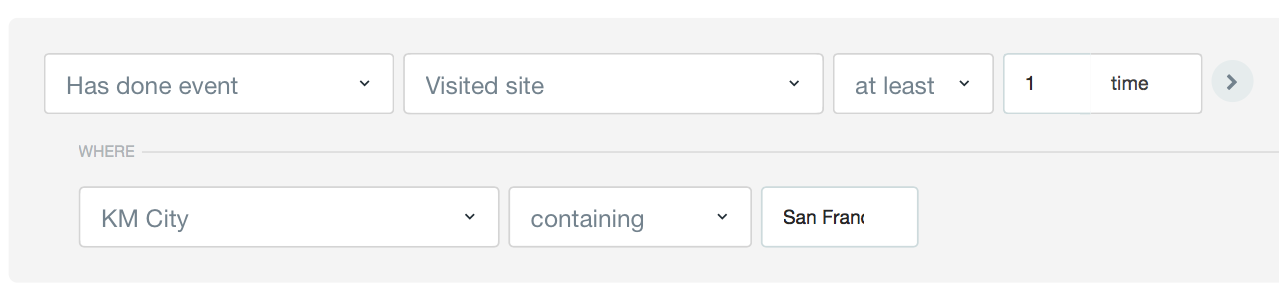
And we'll add the property “KM City” with San Francisco:


km-city-san-francisco


Visited site and KM City are automatically tracked in Kissmetrics. This means that we track it whenever someone visits your site, and we also look at what city they're coming from.


So this way we're telling Kissmetrics to find all the people who visited our site who came from San Francisco.


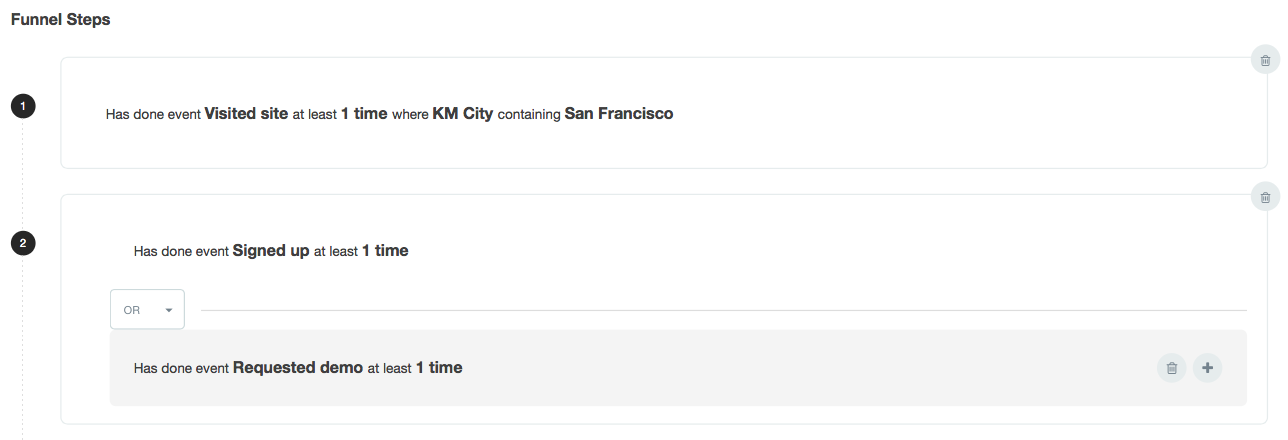
We'll then add the second step in our funnel – finding those people who either signed up or requested a demo:


km-city-funnel-signed-up


And run the report:


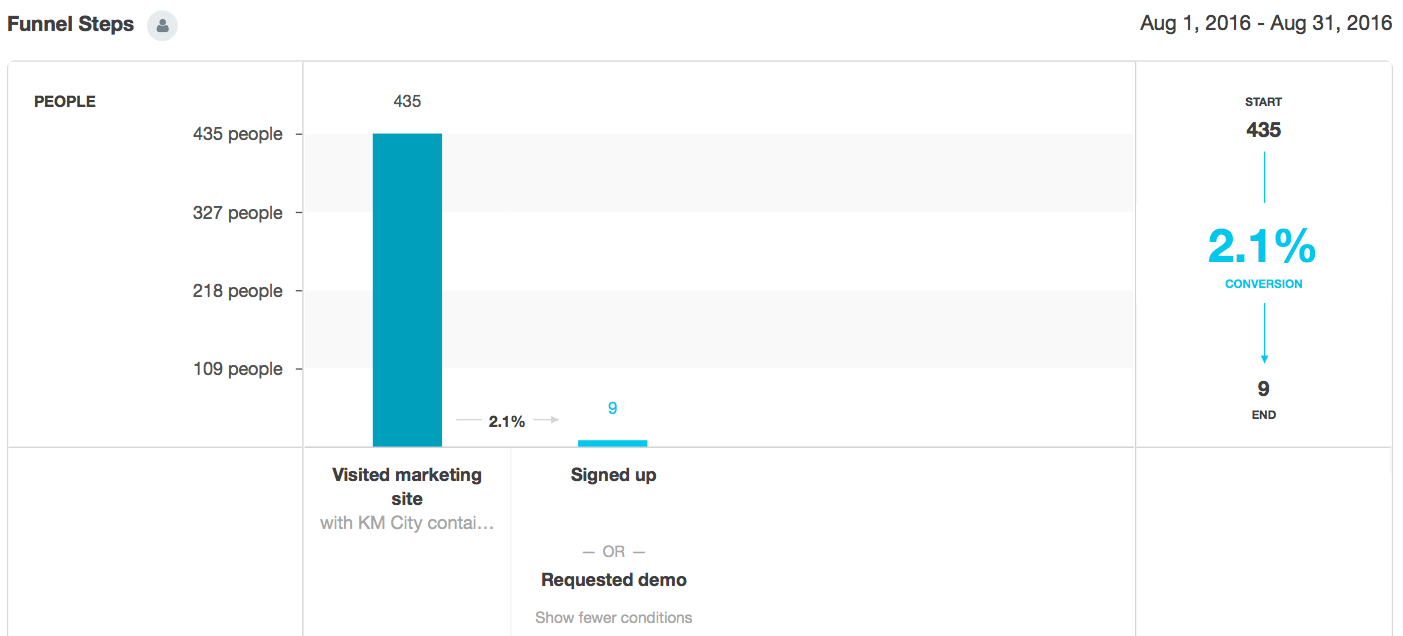
signed-up-demo-san-fran-funnel


We can see that of the 435 people from San Francisco who visited our site during the selected date range, 9 of them converted to signing up or requesting a demo, giving us a 2.1% conversion rate.


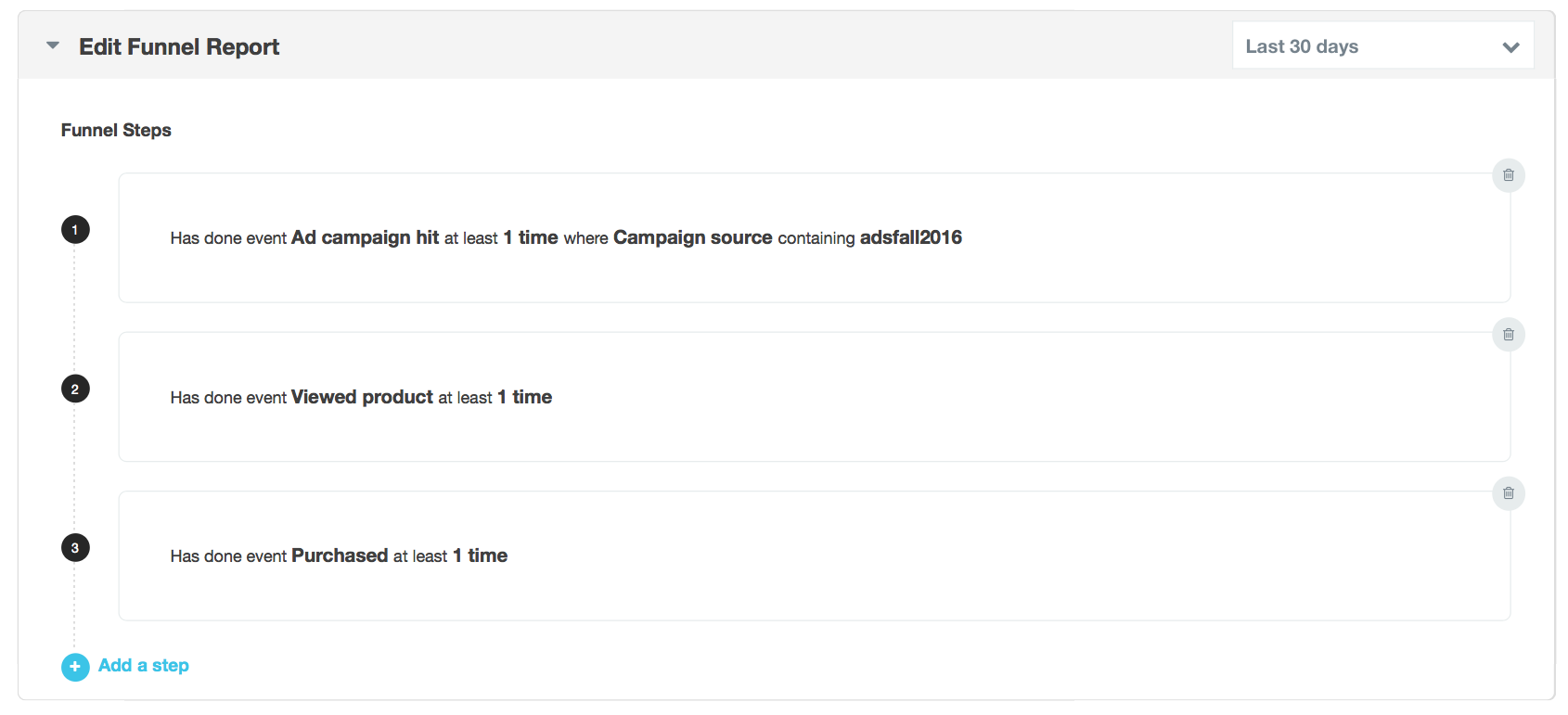
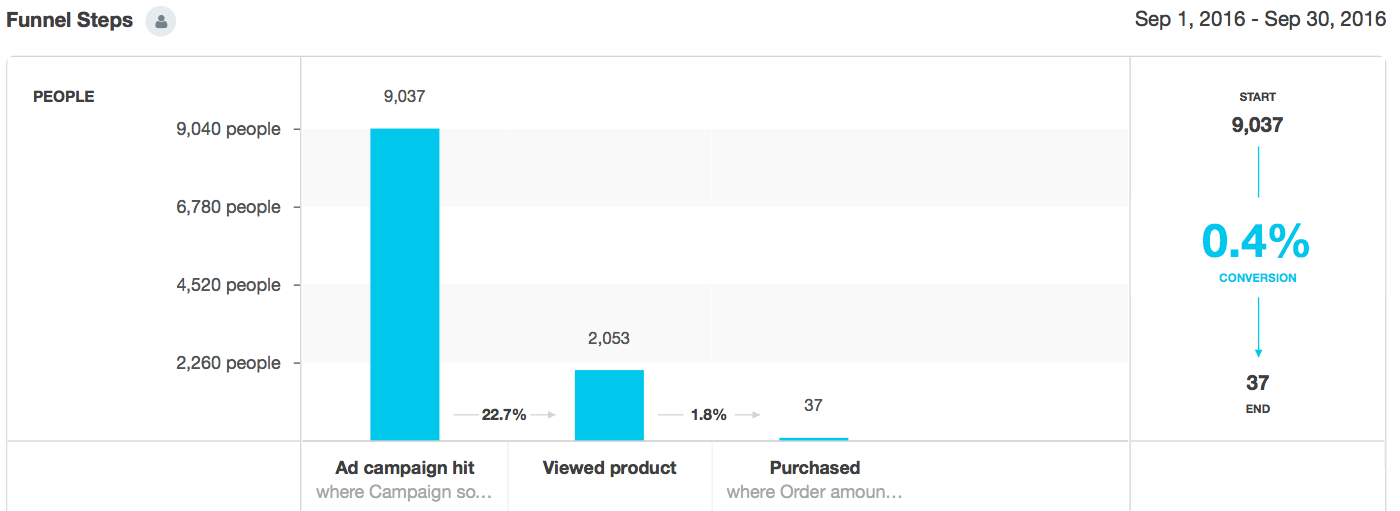
Let's use one more example. Let's say we just ran an ad campaign on 10 different sites. We are linking back to our site, and we tagged the URL with UTMs. We gave the “campaign source” as adsfall2016. Now we'll create a funnel report that looks only at people who came from a UTM with that campaign source.


ad-campaign-hit-funnel-report


You can see that the first step we have in this funnel is finding the people who have visited the site and whose campaign source was adsfall2016. We're also using the event Ad campaign hit, which triggers whenever someone comes from a URL with UTMs tagged. Ad campaign hit is automatically tracked in Kissmetrics along with any UTM parameters you have tagged.


We'll add two more steps – viewing a product and purchasing:


funnel-with-ad-campaign-hit


So now you can see how people progress through a funnel when they are coming from a campaign.


4. Numerical Values for Properties


We've added the ability to add numerical values to properties in the Funnel Report.


Got all that?


Here's what it gets you:


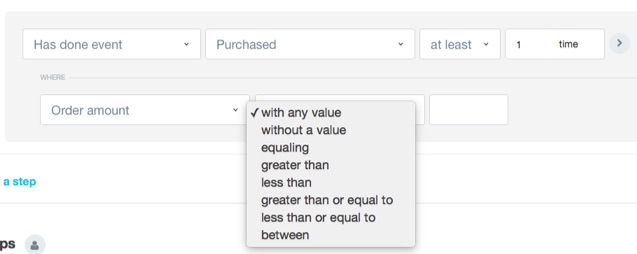
Say you're an e-commerce marketer and you just launched your fall campaign. You want to see the conversion rate for the people who have visited your site and made a purchase of at least $99.


We'll add the property Order amount to the final step and tell Kissmetrics to find anyone who spent at least $99.


order-amount-with-any-value-kissmetrics


We'll select the “greater than or equal to” option and place 99 in the text box:


greater-than-or-equal-to-funnel


We'll run the report and get our data:


ad-campaign-purchased-funnel


This will make finding a specific customer segment even easier.


5. People Who Do Not Have Conditions


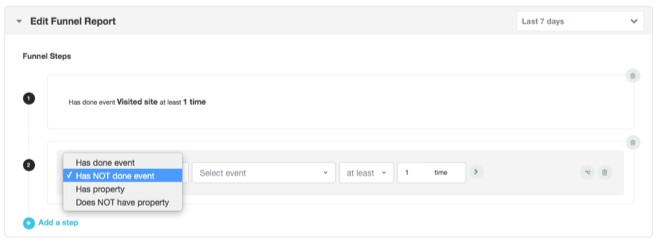
With our new Funnel Report, you can find people who have not done an event or do not have a property.


So if you want to find the people who have signed up but have not viewed a product video, you can do that with the Funnel Report. Or, for another example, you can see the people who purchased who did not use a coupon code.


Here's how to do that:


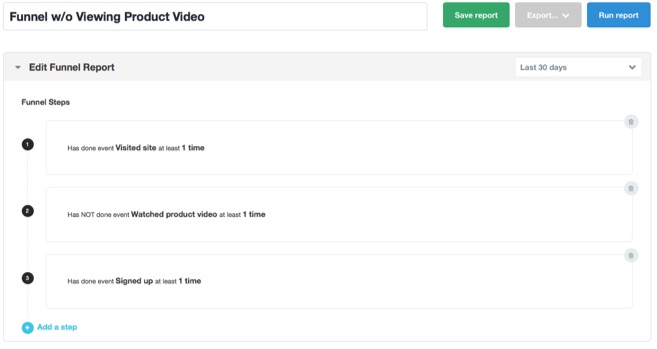
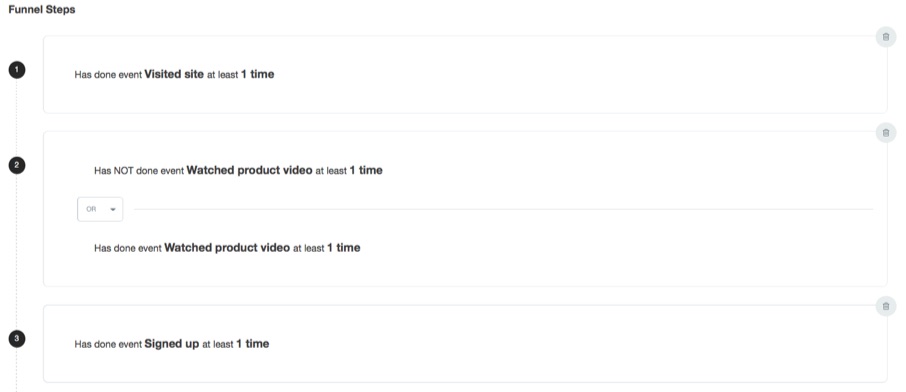
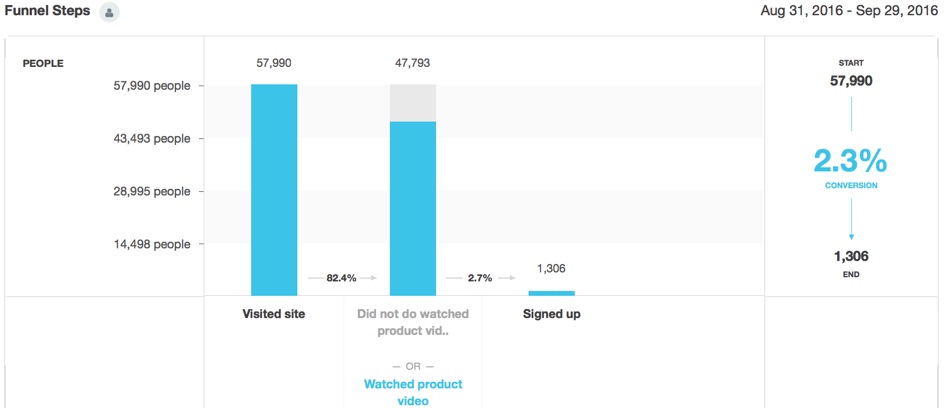
We'll create a funnel report that looks at people who have visited our site, have not viewed our product video, and signed up.


We'll create our first step, Visited site, and then select people who have not done an event. We'll choose Watched product video as the event.


has-not-done-event-funnel


We'll add the final step, Signed up, and make our date range the last 30 days:


funnel-wo-viewing-product-video


Now let's get our data:


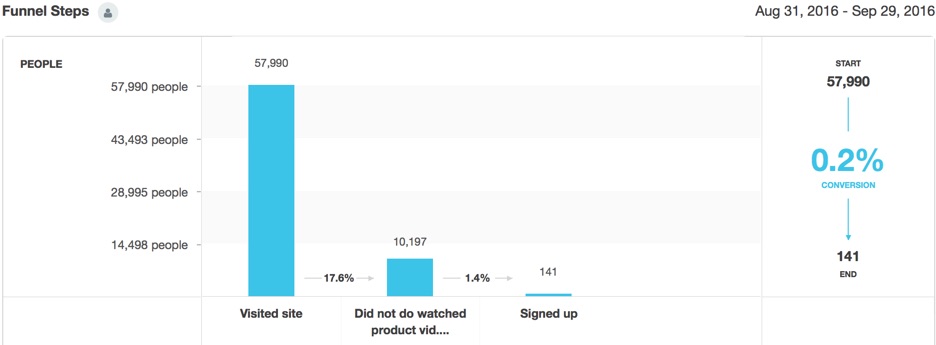
did-not-watch-video-funnel


We see that a minority of people visiting our site do not view the product video before signing up. If we want to compare funnels by adding an or condition to our second step, we can do that too:


has-has-not-product-video


Now let's run the report and click on “Watched product video” to compare the funnels:


watched-product-video-compare-funnels


This shows us that most of the people who signed up had viewed the product video and that people who viewed the product video have a higher conversion rate (2.3% compared to .2%). If we want to improve our site and signups, we'll want to consider showcasing the product video more prominently as it seems to be an effective conversion driver.


Two Smaller Changes


Finally, we made two minor updates:


1. Design changes to advanced settings


Previously you'd change your advanced settings here:


advanced-settings-old-funnel-report


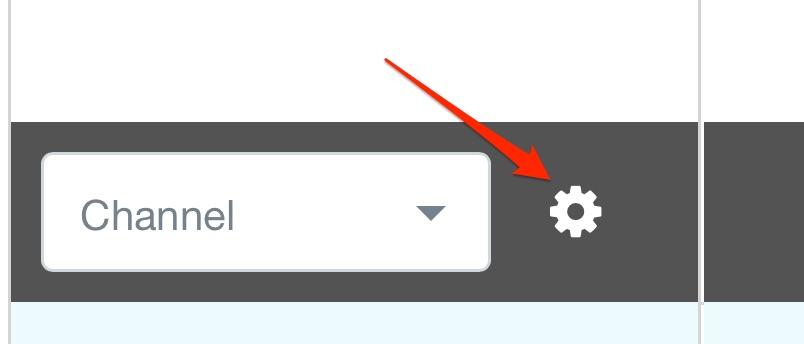
Now you'll find those settings here:


advance-settings-new-funnel-report


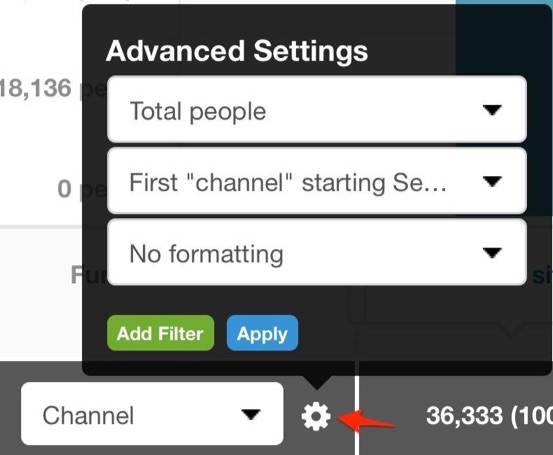
Click on that gear icon, and you'll see the attribution, formatting, and conversion rate options:


advanced-settings-new-funnel-report


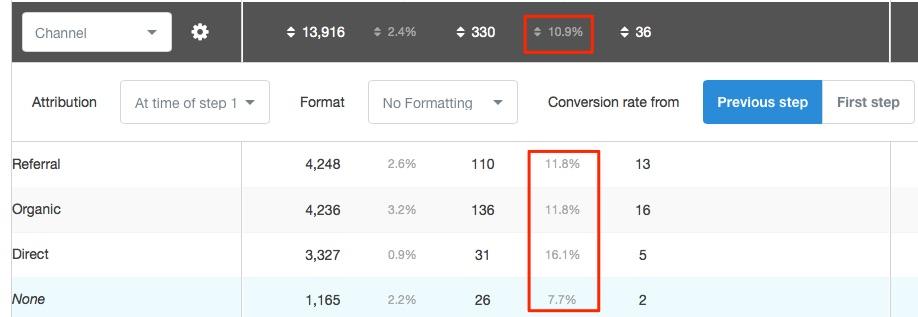
By default, the Funnel Report will display the conversion rate from the previous step. What's changed is that now you have the option to view the conversion rate from the first step. Here's where you'll find the conversion numbers:


previous-step-conversion-rate


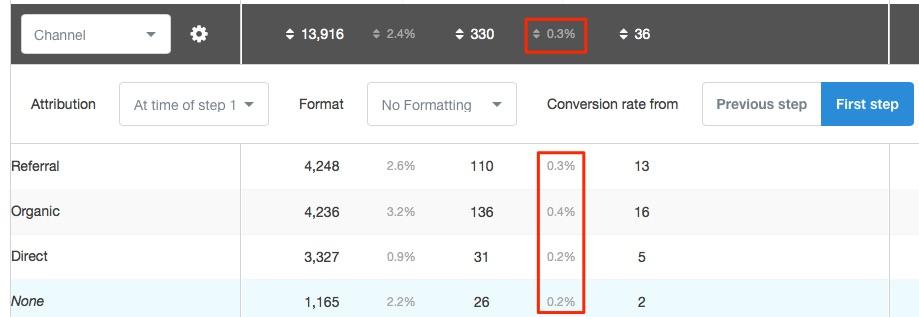
You can easily change the setting to see the conversion rate from the first step by clicking on the First step button:


first-step-conversion-rate


2. Checkbox changed to person icon


In some cases, people enter a funnel in a different order than the steps you have set up. For instance, you may have a funnel like this:


  1. Visited site

  2. Watched product video

  3. Signed up


But what if a customer viewed a product video after signing up? Their steps are:


  1. Visited site

  2. Signed up

  3. Watched product video


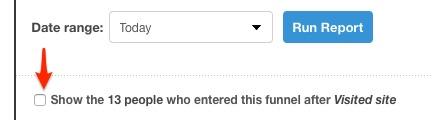
By default, the Funnel Report will exclude these people. But you can include them by checking this box:


entered-funnel-checkbox


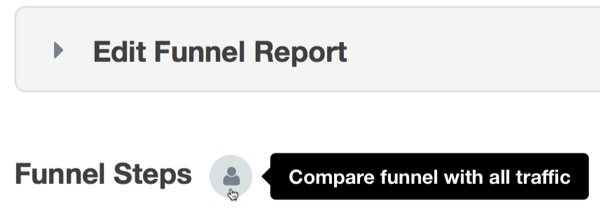
Now you'll find that feature here:


funnel-report-copy-change
We are changing the copy to better reflect the feature


Click that icon and you'll be able to compare the funnel with all traffic. Here's how it looks:


funnel-with-all-traffic


Take the New Funnel Report for a Spin


If you're already using Kissmetrics, you can sign in to your account, and the new Funnel Report will be ready for you.


If you're not already using Kissmetrics, this is a great time to get started.